 Add to Chrome
 Add to Firefox
 Add to Edge
From Citation Selection to Citation Absorption: A Measurement Framework for Generative Engine Optimization Across AI Search Platforms
Apr 28, 2026
Generative search engines increasingly determine whether online information is merely discoverable, cited as a source, or actually absorbed into generated answers. This paper proposes a two-stage measurement framework for Generative Engine Optimization (GEO): citation selection, where a platform triggers search and chooses sources, and citation absorption, where a cited page contributes language, evidence, structure, or factual support to the final answer. We analyze the public geo-citation-lab dataset covering 602 controlled prompts across ChatGPT, Google AI Overview/Gemini, and Perplexity; 21,143 valid search-layer citations; 23,745 citation-level feature records; 18,151 successfully fetched pages; and 72 extracted features. The central descriptive finding is that citation breadth and citation depth diverge. Perplexity and Google cite more sources on average, while ChatGPT cites fewer sources but shows substantially higher average citation influence among fetched pages. High-influence pages tend to be longer, more structured, semantically aligned, and richer in extractable evidence such as definitions, numerical facts, comparisons, and procedural steps. The results suggest that GEO should be measured beyond citation counts, with answer-level absorption treated as a separate outcome.

Text2Tree: Aligning Text Representation to the Label Tree Hierarchy for Imbalanced Medical Classification
Nov 28, 2023Deep learning approaches exhibit promising performances on various text tasks. However, they are still struggling on medical text classification since samples are often extremely imbalanced and scarce. Different from existing mainstream approaches that focus on supplementary semantics with external medical information, this paper aims to rethink the data challenges in medical texts and present a novel framework-agnostic algorithm called Text2Tree that only utilizes internal label hierarchy in training deep learning models. We embed the ICD code tree structure of labels into cascade attention modules for learning hierarchy-aware label representations. Two new learning schemes, Similarity Surrogate Learning (SSL) and Dissimilarity Mixup Learning (DML), are devised to boost text classification by reusing and distinguishing samples of other labels following the label representation hierarchy, respectively. Experiments on authoritative public datasets and real-world medical records show that our approach stably achieves superior performances over classical and advanced imbalanced classification methods.
LKPNR: LLM and KG for Personalized News Recommendation Framework
Aug 23, 2023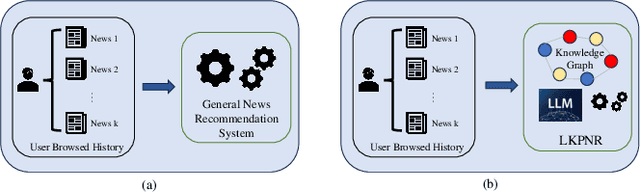
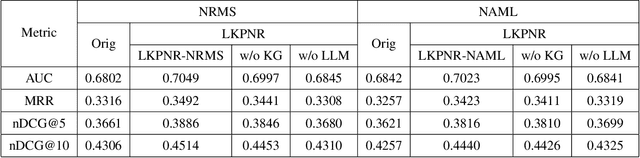
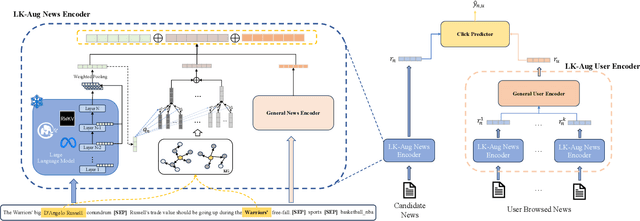
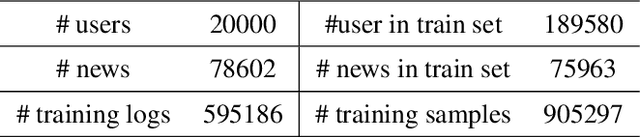
Accurately recommending candidate news articles to users is a basic challenge faced by personalized news recommendation systems. Traditional methods are usually difficult to grasp the complex semantic information in news texts, resulting in unsatisfactory recommendation results. Besides, these traditional methods are more friendly to active users with rich historical behaviors. However, they can not effectively solve the "long tail problem" of inactive users. To address these issues, this research presents a novel general framework that combines Large Language Models (LLM) and Knowledge Graphs (KG) into semantic representations of traditional methods. In order to improve semantic understanding in complex news texts, we use LLMs' powerful text understanding ability to generate news representations containing rich semantic information. In addition, our method combines the information about news entities and mines high-order structural information through multiple hops in KG, thus alleviating the challenge of long tail distribution. Experimental results demonstrate that compared with various traditional models, the framework significantly improves the recommendation effect. The successful integration of LLM and KG in our framework has established a feasible path for achieving more accurate personalized recommendations in the news field. Our code is available at https://github.com/Xuan-ZW/LKPNR.