 Add to Chrome
 Add to Firefox
 Add to Edge
Sat3DGen: Comprehensive Street-Level 3D Scene Generation from Single Satellite Image
May 14, 2026
Generating a street-level 3D scene from a single satellite image is a crucial yet challenging task. Current methods present a stark trade-off: geometry-colorization models achieve high geometric fidelity but are typically building-focused and lack semantic diversity. In contrast, proxy-based models use feed-forward image-to-3D frameworks to generate holistic scenes by jointly learning geometry and texture, a process that yields rich content but coarse and unstable geometry. We attribute these geometric failures to the extreme viewpoint gap and sparse, inconsistent supervision inherent in satellite-to-street data. We introduce Sat3DGen to address these fundamental challenges, which embodies a geometry-first methodology. This methodology enhances the feed-forward paradigm by integrating novel geometric constraints with a perspective-view training strategy, explicitly countering the primary sources of geometric error. This geometry-centric strategy yields a dramatic leap in both 3D accuracy and photorealism. For validation, we first constructed a new benchmark by pairing the VIGOR-OOD test set with high-resolution DSM data. On this benchmark, our method improves geometric RMSE from 6.76m to 5.20m. Crucially, this geometric leap also boosts photorealism, reducing the Fréchet Inception Distance (FID) from $\sim$40 to 19 against the leading method, Sat2Density++, despite using no extra tailored image-quality modules. We demonstrate the versatility of our high-quality 3D assets through diverse downstream applications, including semantic-map-to-3D synthesis, multi-camera video generation, large-scale meshing, and unsupervised single-image Digital Surface Model (DSM) estimation. The code has been released on https://github.com/qianmingduowan/Sat3DGen.

Interacted Planes Reveal 3D Line Mapping
Feb 01, 20263D line mapping from multi-view RGB images provides a compact and structured visual representation of scenes. We study the problem from a physical and topological perspective: a 3D line most naturally emerges as the edge of a finite 3D planar patch. We present LiP-Map, a line-plane joint optimization framework that explicitly models learnable line and planar primitives. This coupling enables accurate and detailed 3D line mapping while maintaining strong efficiency (typically completing a reconstruction in 3 to 5 minutes per scene). LiP-Map pioneers the integration of planar topology into 3D line mapping, not by imposing pairwise coplanarity constraints but by explicitly constructing interactions between plane and line primitives, thus offering a principled route toward structured reconstruction in man-made environments. On more than 100 scenes from ScanNetV2, ScanNet++, Hypersim, 7Scenes, and Tanks\&Temple, LiP-Map improves both accuracy and completeness over state-of-the-art methods. Beyond line mapping quality, LiP-Map significantly advances line-assisted visual localization, establishing strong performance on 7Scenes. Our code is released at https://github.com/calmke/LiPMAP for reproducible research.
ScaleLSD: Scalable Deep Line Segment Detection Streamlined
Jun 11, 2025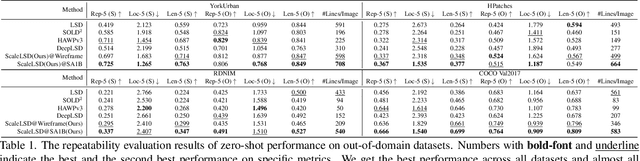
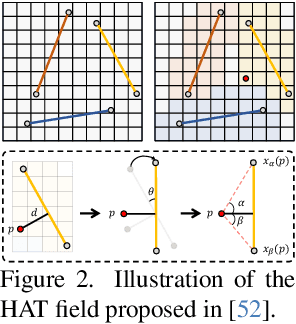
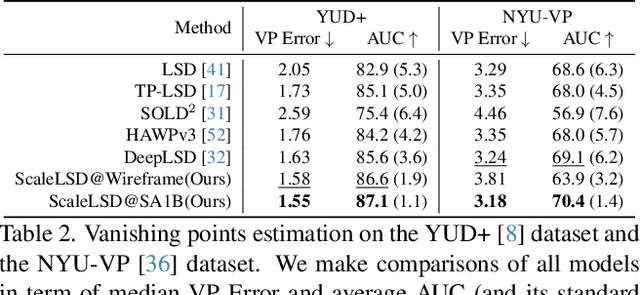
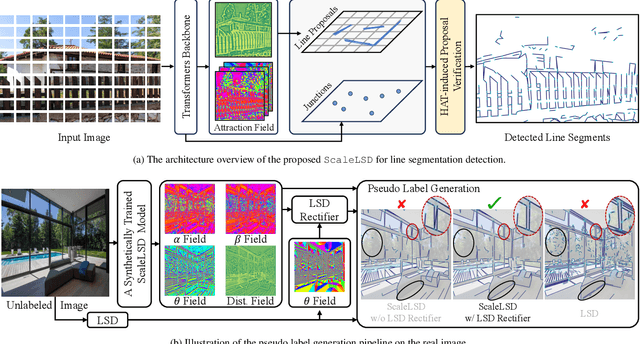
This paper studies the problem of Line Segment Detection (LSD) for the characterization of line geometry in images, with the aim of learning a domain-agnostic robust LSD model that works well for any natural images. With the focus of scalable self-supervised learning of LSD, we revisit and streamline the fundamental designs of (deep and non-deep) LSD approaches to have a high-performing and efficient LSD learner, dubbed as ScaleLSD, for the curation of line geometry at scale from over 10M unlabeled real-world images. Our ScaleLSD works very well to detect much more number of line segments from any natural images even than the pioneered non-deep LSD approach, having a more complete and accurate geometric characterization of images using line segments. Experimentally, our proposed ScaleLSD is comprehensively testified under zero-shot protocols in detection performance, single-view 3D geometry estimation, two-view line segment matching, and multiview 3D line mapping, all with excellent performance obtained. Based on the thorough evaluation, our ScaleLSD is observed to be the first deep approach that outperforms the pioneered non-deep LSD in all aspects we have tested, significantly expanding and reinforcing the versatility of the line geometry of images. Code and Models are available at https://github.com/ant-research/scalelsd