 Add to Chrome
 Add to Firefox
 Add to Edge
Unsupervised Graph Representation Learning with Complementary View Alignment
Jul 27, 2026
Unsupervised graph representation learning aims to derive meaningful node embeddings by capturing both structural and attribute information without relying on labeled data. Existing methods, such as GAEs, have demonstrated effectiveness but typically rely on message-passing mechanisms that assume homophily, leading to performance degradation on heterophilous graphs, where connected nodes exhibit dissimilar features. This homophily bias results in the loss of critical high-frequency components that are essential for identifying heterophilous patterns. To address these challenges, we propose \textsc{AlignGAE}, a novel extension of \textit{MaskGAE} that preserves the full frequency spectrum through complementary view alignment. Our framework introduces a dual-encoder architecture that separately processes structural and attribute information, incorporates node positional encoding to approximate Neighborhood Identity Distribution (NID), and employs dual reconstruction tasks for both edges and node attributes. We further propose theoretically grounded NID alignment strategies that ensure semantic consistency across views while preserving their distinct characteristics. Through comprehensive spectral analysis, we demonstrate that \textsc{AlignGAE} achieves optimal representation properties when the alignment loss converges. Extensive experiments across 12 benchmark datasets validate our approach, showing that \textsc{AlignGAE} outperforms state-of-the-art methods by up to 18.7\% on heterophilous graphs in node classification, while maintaining competitive performance on homophilous graphs. Our results establish a new paradigm for frequency-aware graph representation learning.

LLMTM: Benchmarking and Optimizing LLMs for Temporal Motif Analysis in Dynamic Graphs
Dec 24, 2025The widespread application of Large Language Models (LLMs) has motivated a growing interest in their capacity for processing dynamic graphs. Temporal motifs, as an elementary unit and important local property of dynamic graphs which can directly reflect anomalies and unique phenomena, are essential for understanding their evolutionary dynamics and structural features. However, leveraging LLMs for temporal motif analysis on dynamic graphs remains relatively unexplored. In this paper, we systematically study LLM performance on temporal motif-related tasks. Specifically, we propose a comprehensive benchmark, LLMTM (Large Language Models in Temporal Motifs), which includes six tailored tasks across nine temporal motif types. We then conduct extensive experiments to analyze the impacts of different prompting techniques and LLMs (including nine models: openPangu-7B, the DeepSeek-R1-Distill-Qwen series, Qwen2.5-32B-Instruct, GPT-4o-mini, DeepSeek-R1, and o3) on model performance. Informed by our benchmark findings, we develop a tool-augmented LLM agent that leverages precisely engineered prompts to solve these tasks with high accuracy. Nevertheless, the high accuracy of the agent incurs a substantial cost. To address this trade-off, we propose a simple yet effective structure-aware dispatcher that considers both the dynamic graph's structural properties and the LLM's cognitive load to intelligently dispatch queries between the standard LLM prompting and the more powerful agent. Our experiments demonstrate that the structure-aware dispatcher effectively maintains high accuracy while reducing cost.
Addressing Graph Anomaly Detection via Causal Edge Separation and Spectrum
Aug 20, 2025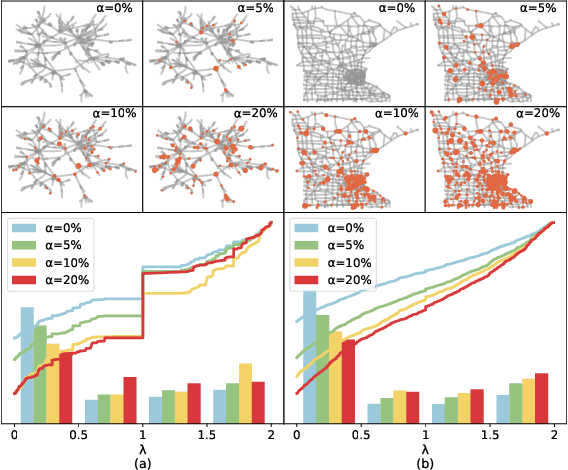
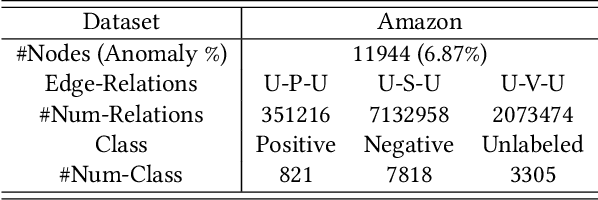
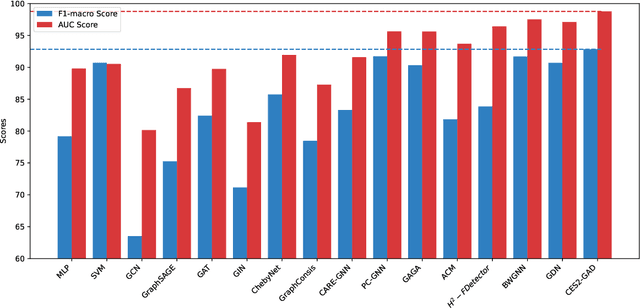
In the real world, anomalous entities often add more legitimate connections while hiding direct links with other anomalous entities, leading to heterophilic structures in anomalous networks that most GNN-based techniques fail to address. Several works have been proposed to tackle this issue in the spatial domain. However, these methods overlook the complex relationships between node structure encoding, node features, and their contextual environment and rely on principled guidance, research on solving spectral domain heterophilic problems remains limited. This study analyzes the spectral distribution of nodes with different heterophilic degrees and discovers that the heterophily of anomalous nodes causes the spectral energy to shift from low to high frequencies. To address the above challenges, we propose a spectral neural network CES2-GAD based on causal edge separation for anomaly detection on heterophilic graphs. Firstly, CES2-GAD will separate the original graph into homophilic and heterophilic edges using causal interventions. Subsequently, various hybrid-spectrum filters are used to capture signals from the segmented graphs. Finally, representations from multiple signals are concatenated and input into a classifier to predict anomalies. Extensive experiments with real-world datasets have proven the effectiveness of the method we proposed.