 Add to Chrome
 Add to Firefox
 Add to Edge
Evaluating and Improving Pedagogical Fit in LLM-Based AI Tutors with the Pedagogical Suitability Index
Aug 05, 2026
Large language models (LLMs) are increasingly used as AI tutors, but a correct answer is not always a pedagogically appropriate one. In classroom learning, effective help depends not only on correctness, but also on whether a response matches the learner's current foundation, the course sequence, and the timing of concept introduction. Existing evaluations focus mainly on answer quality, leaving this instructional fit under-measured. We present the Pedagogical Suitability Index (PSI), a composite metric of six theory-informed sub-scores that evaluates how well LLM-generated tutoring responses align with learner readiness and curricular progression, and we further use PSI as a structured feedback signal for response improvement. We evaluate four LLM tutors (ChatGPT, Gemini, Gemma4, and Qwen3) across 240 scenario-based evaluations using paired standard and defective prompts, then apply a PSI-guided regeneration protocol to 62 weak-performing cases. Baseline differences across the four tested models were modest overall (PSI range: 0.557 to 0.638), and open-weight and closed models did not exhibit a clear separation in pedagogical fit. Under the tested prompt perturbations, overall PSI remained largely stable (Delta = -0.002), though sub-score trade-offs emerged. More importantly, PSI-guided feedback substantially improved weak-performing cases: 51 of 62 cases improved (82.3%). Focused manual evaluation of the 62 PSI-selected weak cases provides initial evidence that the identified weaknesses are instructionally meaningful and that many PSI-guided regenerations correspond to human-judged improvement. These results suggest that learner- and curriculum-aware alignment may matter more for effective tutoring than model category alone, and that such alignment is both measurable and improvable.

DiffHLS: Differential Learning for High-Level Synthesis QoR Prediction with GNNs and LLM Code Embeddings
Apr 10, 2026High-Level Synthesis (HLS) compiles C/C++ into RTL, but exploring pragma-driven optimization choices remains expensive because each design point requires time-consuming synthesis. We propose \textbf{\DiffHLS}, a differential learning framework for HLS Quality-of-Result (QoR) prediction that learns from kernel--design pairs: a kernel baseline and a pragma-inserted design variant. \DiffHLS~encodes kernel and design intermediate-representation graphs with dedicated graph neural network (GNN) branches, and augments the delta pathway with code embeddings from a pretrained code large language model (LLM). Instead of regressing absolute targets directly, we jointly predict the kernel baseline and the design-induced delta, and compose them to obtain the design prediction. On PolyBench, \DiffHLS~attains lower average MAPE than GNN baselines under four GNN backbones, and LLM code embeddings consistently improve over a GNN-only ablation. We further validate scalability on the ForgeHLS dataset.
DeepCircuitX: A Comprehensive Repository-Level Dataset for RTL Code Understanding, Generation, and PPA Analysis
Feb 25, 2025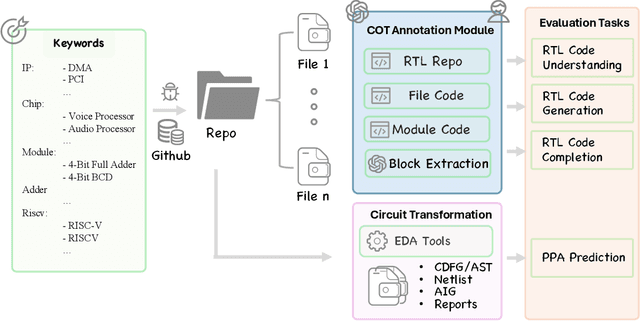
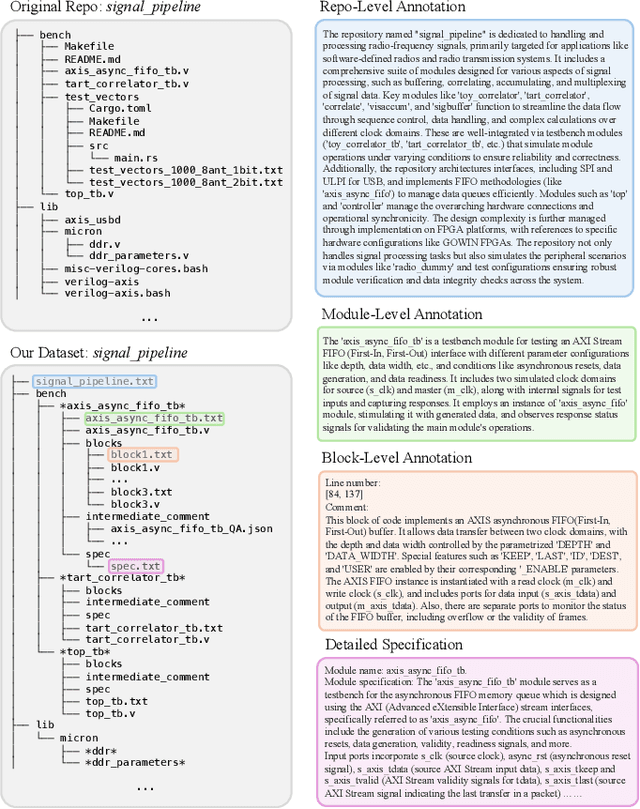
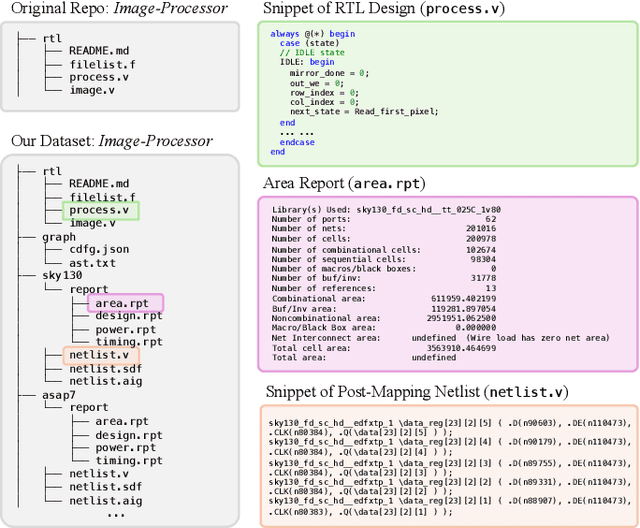

This paper introduces DeepCircuitX, a comprehensive repository-level dataset designed to advance RTL (Register Transfer Level) code understanding, generation, and power-performance-area (PPA) analysis. Unlike existing datasets that are limited to either file-level RTL code or physical layout data, DeepCircuitX provides a holistic, multilevel resource that spans repository, file, module, and block-level RTL code. This structure enables more nuanced training and evaluation of large language models (LLMs) for RTL-specific tasks. DeepCircuitX is enriched with Chain of Thought (CoT) annotations, offering detailed descriptions of functionality and structure at multiple levels. These annotations enhance its utility for a wide range of tasks, including RTL code understanding, generation, and completion. Additionally, the dataset includes synthesized netlists and PPA metrics, facilitating early-stage design exploration and enabling accurate PPA prediction directly from RTL code. We demonstrate the dataset's effectiveness on various LLMs finetuned with our dataset and confirm the quality with human evaluations. Our results highlight DeepCircuitX as a critical resource for advancing RTL-focused machine learning applications in hardware design automation.Our data is available at https://zeju.gitbook.io/lcm-team.
MPAX: Mathematical Programming in JAX
Dec 12, 2024We introduce MPAX (Mathematical Programming in JAX), a versatile and efficient toolbox for integrating mathematical programming into machine learning workflows. MPAX implemented firstorder methods in JAX, providing native support for hardware accelerations along with features like batch solving, auto-differentiation, and device parallelism. Currently in beta version, MPAX supports linear programming and will be extended to solve more general mathematical programming problems and specialized modules for common machine learning tasks. The solver is available at https://github.com/MIT-Lu-Lab/MPAX.