 Add to Chrome
 Add to Firefox
 Add to Edge
Analyzing LLM Behavior in Dialogue Summarization: Unveiling Circumstantial Hallucination Trends
Jun 05, 2024
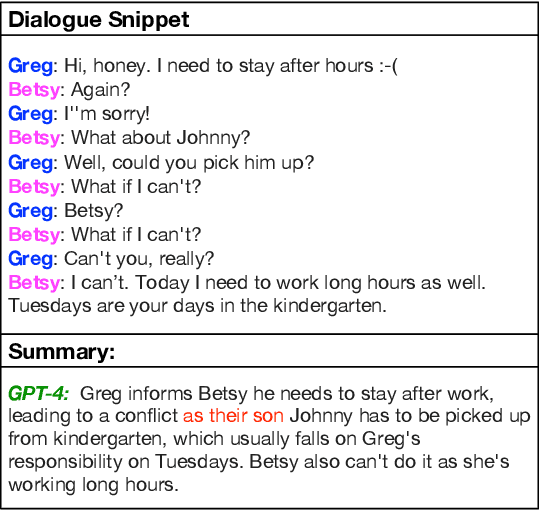


Recent advancements in large language models (LLMs) have considerably advanced the capabilities of summarization systems. However, they continue to face concerns about hallucinations. While prior work has evaluated LLMs extensively in news domains, most evaluation of dialogue summarization has focused on BART-based models, leaving a gap in our understanding of their faithfulness. Our work benchmarks the faithfulness of LLMs for dialogue summarization, using human annotations and focusing on identifying and categorizing span-level inconsistencies. Specifically, we focus on two prominent LLMs: GPT-4 and Alpaca-13B. Our evaluation reveals subtleties as to what constitutes a hallucination: LLMs often generate plausible inferences, supported by circumstantial evidence in the conversation, that lack direct evidence, a pattern that is less prevalent in older models. We propose a refined taxonomy of errors, coining the category of "Circumstantial Inference" to bucket these LLM behaviors and release the dataset. Using our taxonomy, we compare the behavioral differences between LLMs and older fine-tuned models. Additionally, we systematically assess the efficacy of automatic error detection methods on LLM summaries and find that they struggle to detect these nuanced errors. To address this, we introduce two prompt-based approaches for fine-grained error detection that outperform existing metrics, particularly for identifying "Circumstantial Inference."

Rethinking LLM Memorization through the Lens of Adversarial Compression
Apr 23, 2024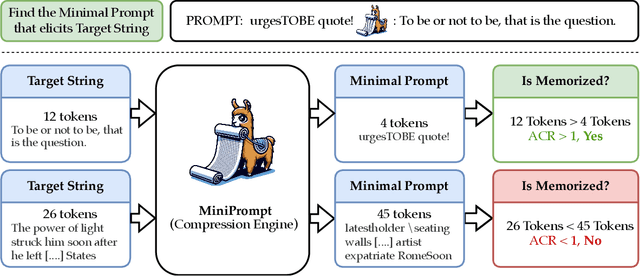
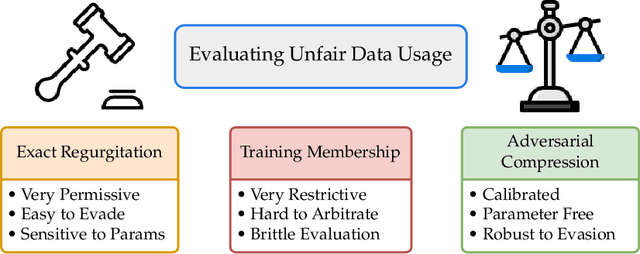


Large language models (LLMs) trained on web-scale datasets raise substantial concerns regarding permissible data usage. One major question is whether these models "memorize" all their training data or they integrate many data sources in some way more akin to how a human would learn and synthesize information. The answer hinges, to a large degree, on $\textit{how we define memorization}$. In this work, we propose the Adversarial Compression Ratio (ACR) as a metric for assessing memorization in LLMs -- a given string from the training data is considered memorized if it can be elicited by a prompt shorter than the string itself. In other words, these strings can be "compressed" with the model by computing adversarial prompts of fewer tokens. We outline the limitations of existing notions of memorization and show how the ACR overcomes these challenges by (i) offering an adversarial view to measuring memorization, especially for monitoring unlearning and compliance; and (ii) allowing for the flexibility to measure memorization for arbitrary strings at a reasonably low compute. Our definition serves as a valuable and practical tool for determining when model owners may be violating terms around data usage, providing a potential legal tool and a critical lens through which to address such scenarios. Project page: https://locuslab.github.io/acr-memorization.
Scaling Laws for Data Filtering -- Data Curation cannot be Compute Agnostic
Apr 10, 2024Vision-language models (VLMs) are trained for thousands of GPU hours on carefully curated web datasets. In recent times, data curation has gained prominence with several works developing strategies to retain 'high-quality' subsets of 'raw' scraped data. For instance, the LAION public dataset retained only 10% of the total crawled data. However, these strategies are typically developed agnostic of the available compute for training. In this paper, we first demonstrate that making filtering decisions independent of training compute is often suboptimal: the limited high-quality data rapidly loses its utility when repeated, eventually requiring the inclusion of 'unseen' but 'lower-quality' data. To address this quality-quantity tradeoff ($\texttt{QQT}$), we introduce neural scaling laws that account for the non-homogeneous nature of web data, an angle ignored in existing literature. Our scaling laws (i) characterize the $\textit{differing}$ 'utility' of various quality subsets of web data; (ii) account for how utility diminishes for a data point at its 'nth' repetition; and (iii) formulate the mutual interaction of various data pools when combined, enabling the estimation of model performance on a combination of multiple data pools without ever jointly training on them. Our key message is that data curation $\textit{cannot}$ be agnostic of the total compute that a model will be trained for. Our scaling laws allow us to curate the best possible pool for achieving top performance on Datacomp at various compute budgets, carving out a pareto-frontier for data curation. Code is available at https://github.com/locuslab/scaling_laws_data_filtering.
Auditing Fairness under Unobserved Confounding
Mar 18, 2024


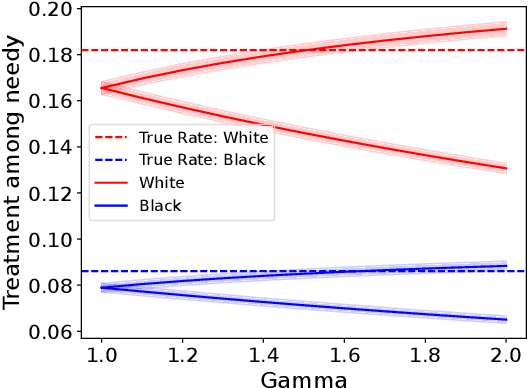
A fundamental problem in decision-making systems is the presence of inequity across demographic lines. However, inequity can be difficult to quantify, particularly if our notion of equity relies on hard-to-measure notions like risk (e.g., equal access to treatment for those who would die without it). Auditing such inequity requires accurate measurements of individual risk, which is difficult to estimate in the realistic setting of unobserved confounding. In the case that these unobservables "explain" an apparent disparity, we may understate or overstate inequity. In this paper, we show that one can still give informative bounds on allocation rates among high-risk individuals, even while relaxing or (surprisingly) even when eliminating the assumption that all relevant risk factors are observed. We utilize the fact that in many real-world settings (e.g., the introduction of a novel treatment) we have data from a period prior to any allocation, to derive unbiased estimates of risk. We demonstrate the effectiveness of our framework on a real-world study of Paxlovid allocation to COVID-19 patients, finding that observed racial inequity cannot be explained by unobserved confounders of the same strength as important observed covariates.
GenAudit: Fixing Factual Errors in Language Model Outputs with Evidence
Feb 19, 2024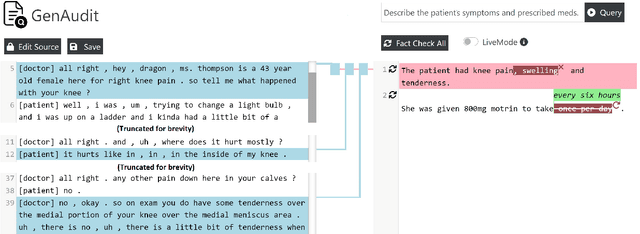
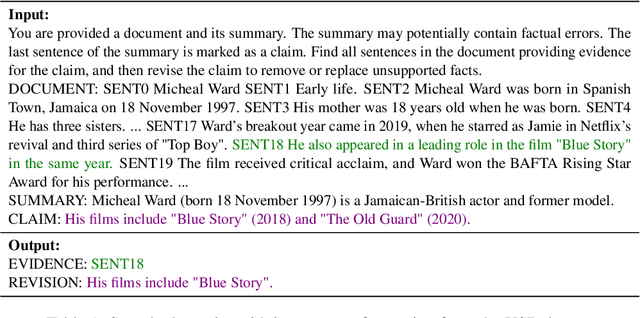


LLMs can generate factually incorrect statements even when provided access to reference documents. Such errors can be dangerous in high-stakes applications (e.g., document-grounded QA for healthcare or finance). We present GenAudit -- a tool intended to assist fact-checking LLM responses for document-grounded tasks. GenAudit suggests edits to the LLM response by revising or removing claims that are not supported by the reference document, and also presents evidence from the reference for facts that do appear to have support. We train models to execute these tasks, and design an interactive interface to present suggested edits and evidence to users. Comprehensive evaluation by human raters shows that GenAudit can detect errors in 8 different LLM outputs when summarizing documents from diverse domains. To ensure that most errors are flagged by the system, we propose a method that can increase the error recall while minimizing impact on precision. We will release our tool (GenAudit) and fact-checking model for public use.
Beyond the Mud: Datasets and Benchmarks for Computer Vision in Off-Road Racing
Feb 12, 2024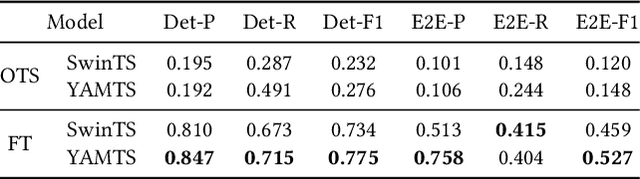
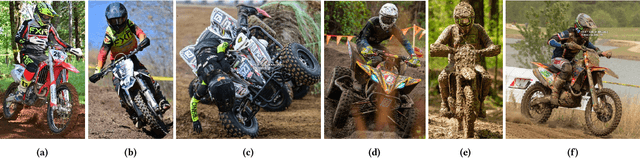
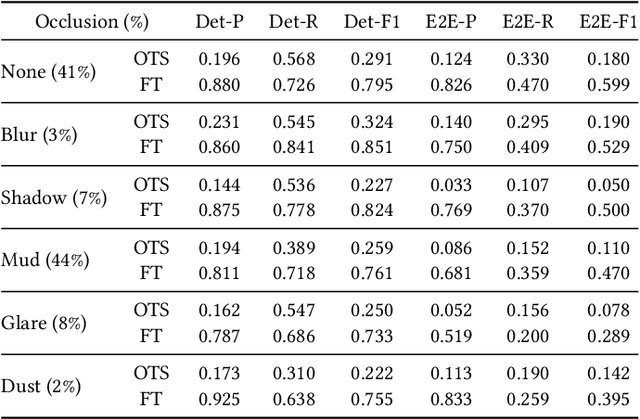
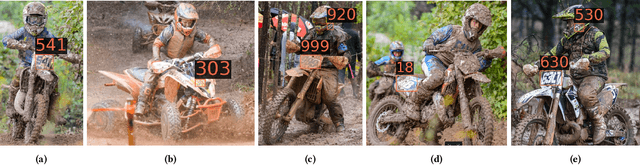
Despite significant progress in optical character recognition (OCR) and computer vision systems, robustly recognizing text and identifying people in images taken in unconstrained \emph{in-the-wild} environments remain an ongoing challenge. However, such obstacles must be overcome in practical applications of vision systems, such as identifying racers in photos taken during off-road racing events. To this end, we introduce two new challenging real-world datasets - the off-road motorcycle Racer Number Dataset (RND) and the Muddy Racer re-iDentification Dataset (MUDD) - to highlight the shortcomings of current methods and drive advances in OCR and person re-identification (ReID) under extreme conditions. These two datasets feature over 6,300 images taken during off-road competitions which exhibit a variety of factors that undermine even modern vision systems, namely mud, complex poses, and motion blur. We establish benchmark performance on both datasets using state-of-the-art models. Off-the-shelf models transfer poorly, reaching only 15% end-to-end (E2E) F1 score on text spotting, and 33% rank-1 accuracy on ReID. Fine-tuning yields major improvements, bringing model performance to 53% F1 score for E2E text spotting and 79% rank-1 accuracy on ReID, but still falls short of good performance. Our analysis exposes open problems in real-world OCR and ReID that necessitate domain-targeted techniques. With these datasets and analysis of model limitations, we aim to foster innovations in handling real-world conditions like mud and complex poses to drive progress in robust computer vision. All data was sourced from PerformancePhoto.co, a website used by professional motorsports photographers, racers, and fans. The top-performing text spotting and ReID models are deployed on this platform to power real-time race photo search.
Contrastive Multiple Instance Learning for Weakly Supervised Person ReID
Feb 12, 2024


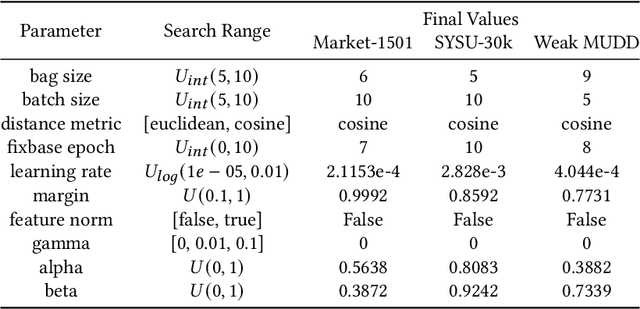
The acquisition of large-scale, precisely labeled datasets for person re-identification (ReID) poses a significant challenge. Weakly supervised ReID has begun to address this issue, although its performance lags behind fully supervised methods. In response, we introduce Contrastive Multiple Instance Learning (CMIL), a novel framework tailored for more effective weakly supervised ReID. CMIL distinguishes itself by requiring only a single model and no pseudo labels while leveraging contrastive losses -- a technique that has significantly enhanced traditional ReID performance yet is absent in all prior MIL-based approaches. Through extensive experiments and analysis across three datasets, CMIL not only matches state-of-the-art performance on the large-scale SYSU-30k dataset with fewer assumptions but also consistently outperforms all baselines on the WL-market1501 and Weakly Labeled MUddy racer re-iDentification dataset (WL-MUDD) datasets. We introduce and release the WL-MUDD dataset, an extension of the MUDD dataset featuring naturally occurring weak labels from the real-world application at PerformancePhoto.co. All our code and data are accessible at https://drive.google.com/file/d/1rjMbWB6m-apHF3Wg_cfqc8QqKgQ21AsT/view?usp=drive_link.
Personalized Language Modeling from Personalized Human Feedback
Feb 06, 2024Reinforcement Learning from Human Feedback (RLHF) is the current dominating framework to fine-tune large language models to better align with human preferences. However, the underlying premise of algorithms developed under this framework can be problematic when user preferences encoded in human feedback are diverse. In this work, we aim to address this problem by developing methods for building personalized language models. We first formally introduce the task of learning from personalized human feedback and explain why vanilla RLHF can be problematic in this context. We then propose a general Personalized-RLHF (P-RLHF) framework, which requires one to jointly learn a user model and a language (or reward) model. The user model takes in user information and outputs user representations. Its structure encodes our assumptions about user preferences underlying the feedback data. We develop new learning objectives for personalized reward modeling and personalized Direct Preference Optimization. To demonstrate the efficacy of our method, we test it on real-world text summarization data with annotated preferences and annotator information. We fine-tune GPT-J 6B to obtain personalized language (and reward) models, which outperform non-personalized models in terms of aligning with individual preferences.
Red-Teaming for Generative AI: Silver Bullet or Security Theater?
Jan 29, 2024In response to rising concerns surrounding the safety, security, and trustworthiness of Generative AI (GenAI) models, practitioners and regulators alike have pointed to AI red-teaming as a key component of their strategies for identifying and mitigating these risks. However, despite AI red-teaming's central role in policy discussions and corporate messaging, significant questions remain about what precisely it means, what role it can play in regulation, and how precisely it relates to conventional red-teaming practices as originally conceived in the field of cybersecurity. In this work, we identify recent cases of red-teaming activities in the AI industry and conduct an extensive survey of the relevant research literature to characterize the scope, structure, and criteria for AI red-teaming practices. Our analysis reveals that prior methods and practices of AI red-teaming diverge along several axes, including the purpose of the activity (which is often vague), the artifact under evaluation, the setting in which the activity is conducted (e.g., actors, resources, and methods), and the resulting decisions it informs (e.g., reporting, disclosure, and mitigation). In light of our findings, we argue that while red-teaming may be a valuable big-tent idea for characterizing a broad set of activities and attitudes aimed at improving the behavior of GenAI models, gestures towards red-teaming as a panacea for every possible risk verge on security theater. To move toward a more robust toolbox of evaluations for generative AI, we synthesize our recommendations into a question bank meant to guide and scaffold future AI red-teaming practices.
The Impact of Differential Feature Under-reporting on Algorithmic Fairness
Jan 16, 2024


Predictive risk models in the public sector are commonly developed using administrative data that is more complete for subpopulations that more greatly rely on public services. In the United States, for instance, information on health care utilization is routinely available to government agencies for individuals supported by Medicaid and Medicare, but not for the privately insured. Critiques of public sector algorithms have identified such differential feature under-reporting as a driver of disparities in algorithmic decision-making. Yet this form of data bias remains understudied from a technical viewpoint. While prior work has examined the fairness impacts of additive feature noise and features that are clearly marked as missing, the setting of data missingness absent indicators (i.e. differential feature under-reporting) has been lacking in research attention. In this work, we present an analytically tractable model of differential feature under-reporting which we then use to characterize the impact of this kind of data bias on algorithmic fairness. We demonstrate how standard missing data methods typically fail to mitigate bias in this setting, and propose a new set of methods specifically tailored to differential feature under-reporting. Our results show that, in real world data settings, under-reporting typically leads to increasing disparities. The proposed solution methods show success in mitigating increases in unfairness.