 Add to Chrome
 Add to Firefox
 Add to Edge
PaperMentor: A Human-Centered Multi-Agent Writing Tutor for AI Research Papers on Overleaf
Jun 07, 2026
Expert writing feedback from experienced researchers is critical for early-career scholars to improve their manuscripts, yet high-quality feedback often remains scarce because reviewing research papers is labor-intensive. Emerging AI-powered writing assistants largely focus on grammar fixes or simulating peer review with final scores, yet they fall short of providing concrete, actionable suggestions that help students improve their papers during drafting. We present PaperMentor, a human-centered writing assistant system that delivers actionable suggestions as Overleaf-native inline comments while leaving the actual writing entirely to human authors. PaperMentor integrates an expert skill library carefully curated from established researchers' writing advice with 12 specialized agents covering different aspects of paper writing, such as formatting compliance, phrasing accuracy, and terminology consistency. In a user study (n=14), 90.6% of the generated comments were rated actionable and 67.5% were rated valid, significantly outperforming a GPT-5.2 baseline uswithout the skill library. We release PaperMentor as open source for public use. Our code is publicly available under the AGPL-3.0 license at https://github.com/jiarui-liu/overleaf

Improving generalization of robot locomotion policies via Sharpness-Aware Reinforcement Learning
Nov 29, 2024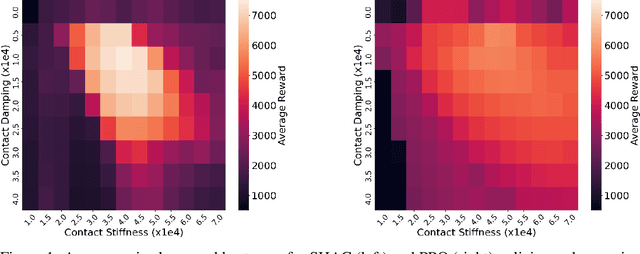
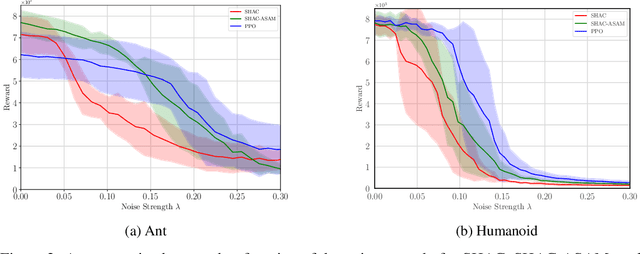
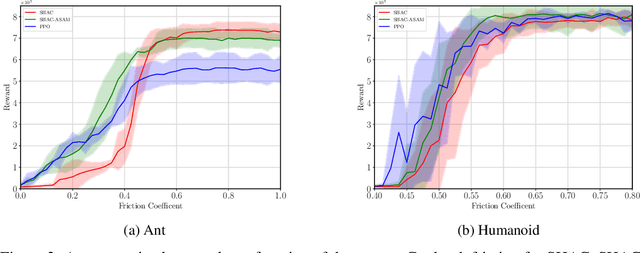
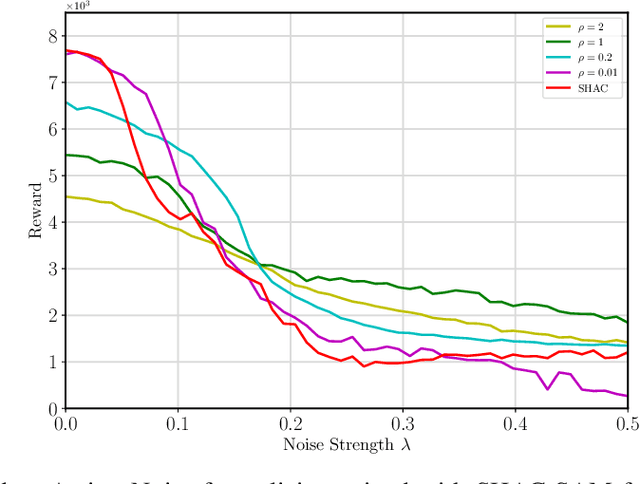
Reinforcement learning often requires extensive training data. Simulation-to-real transfer offers a promising approach to address this challenge in robotics. While differentiable simulators offer improved sample efficiency through exact gradients, they can be unstable in contact-rich environments and may lead to poor generalization. This paper introduces a novel approach integrating sharpness-aware optimization into gradient-based reinforcement learning algorithms. Our simulation results demonstrate that our method, tested on contact-rich environments, significantly enhances policy robustness to environmental variations and action perturbations while maintaining the sample efficiency of first-order methods. Specifically, our approach improves action noise tolerance compared to standard first-order methods and achieves generalization comparable to zeroth-order methods. This improvement stems from finding flatter minima in the loss landscape, associated with better generalization. Our work offers a promising solution to balance efficient learning and robust sim-to-real transfer in robotics, potentially bridging the gap between simulation and real-world performance.