 Add to Chrome
 Add to Firefox
 Add to Edge
Causal Evidence for Attention Head Imbalance in Modality Conflict Hallucination
May 19, 2026
Modality-conflict hallucination occurs when multimodal large language models (MLLMs) prioritize erroneous textual premises over contradictory visual evidence. To understand why visual evidence fails to prevail during generation, we take a mechanistic perspective and examine which internal components drive or resist this failure. We perform head-level causal analysis using path patching across five open-source MLLMs and identify two groups of attention heads with opposing causal roles: hallucination-driving heads and hallucination-resisting heads. We find a consistent asymmetry: driving effects are more broadly distributed and carry greater aggregate weight, whereas resisting effects concentrate in a small number of high-importance heads. Ablation experiments further confirm that these groups exert opposing effects during generation: distributed driving influence and localized resistance together form an imbalanced routing structure that biases generation toward the erroneous premise. Motivated by this finding, we propose MACI (Modality-conflict-Aware Causal Intervention), a conditional intervention that suppresses causally identified hallucination-driving heads only when conflict is detected. Across five MLLMs, MACI achieves the largest hallucination reduction among compared inference-time baselines on the MMMC benchmark with a favorable hallucination-accuracy trade-off, and transfers zero-shot to the SCI-SemanticConflict test.

GePBench: Evaluating Fundamental Geometric Perception for Multimodal Large Language Models
Dec 30, 2024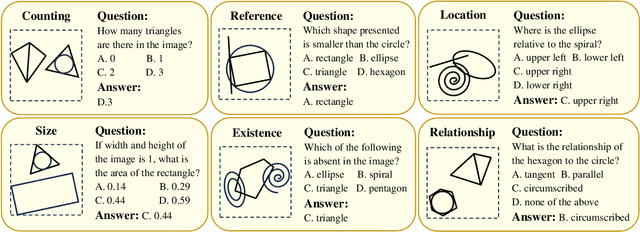
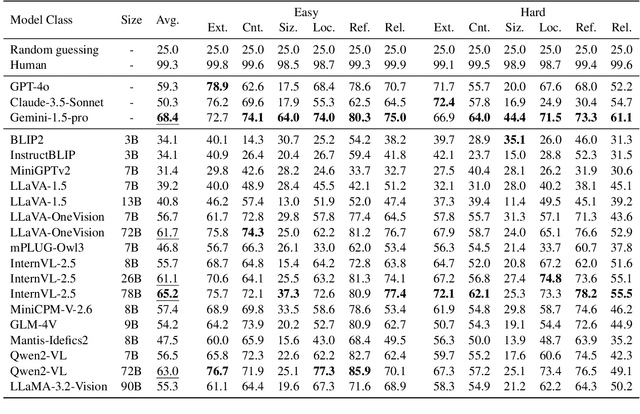
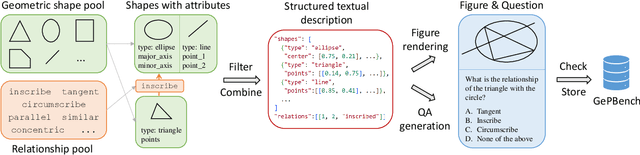
Multimodal large language models (MLLMs) have achieved significant advancements in integrating visual and linguistic understanding. While existing benchmarks evaluate these models in context-rich, real-life scenarios, they often overlook fundamental perceptual skills essential for environments deviating from everyday realism. In particular, geometric perception, the ability to interpret spatial relationships and abstract visual patterns, remains underexplored. To address this limitation, we introduce GePBench, a novel benchmark designed to assess the geometric perception capabilities of MLLMs. Results from extensive evaluations reveal that current state-of-the-art MLLMs exhibit significant deficiencies in such tasks. Additionally, we demonstrate that models trained with data sourced from GePBench show notable improvements on a wide range of downstream tasks, underscoring the importance of geometric perception as a foundation for advanced multimodal applications. Our code and datasets will be publicly available.