 Add to Chrome
 Add to Firefox
 Add to Edge
DisDop: Distillation with Domain Priors for Open-Vocabulary Aerial Object Detection
May 23, 2026
With the widespread application of drones in recent years, object detection of aerial images has attracted increasing attention, especially open-vocabulary aerial detection which is not restricted to predefined categories. Due to the scarcity of drone's viewpoint images and their significant differences from natural images, it is difficult to achieve satisfying results by directly applying vanilla open-vocabulary detection methods designed for natural scenarios. Some studies propose to transfer knowledge from pre-trained models by using lightweight networks or generating pseudo labels, but they tend to rely on models trained on natural images, neglecting the potential of foundation models specifically tailored for remote sensing and aerial imagery. To address this limitation, we propose DisDop, a unified framework that systematically distills multi-level domain priors from remote sensing foundation models (e.g., RemoteCLIP and DINOv3) into a lightweight detector. Specifically, we first distill visual priors through a teacher fusion strategy that combines RemoteCLIP's cross-modal alignment capability with DINOv3's fine-grained local feature extraction ability, transferring their complementary strengths to the detector's backbone. Second, we distill textual priors embedded in RemoteCLIP's text encoder by explicitly modeling inter-category semantic relationships, while incorporating global contextual priors to enhance local feature representation for small objects. Through this multi-level prior distillation framework, our DisDop achieves new state-of-the-art performance on open-vocabulary aerial detection benchmarks. Extensive ablation analysis also demonstrates the rationality and effectiveness of our proposed modules.

Fine-tuning vision foundation model for crack segmentation in civil infrastructures
Dec 15, 2023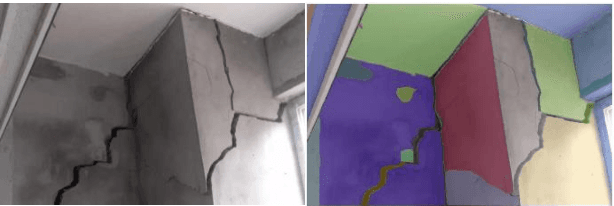
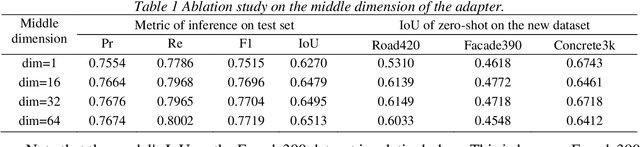
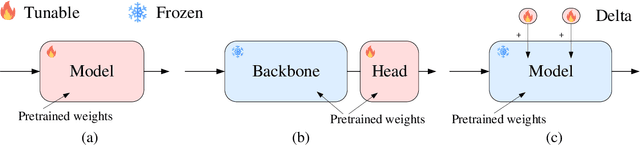
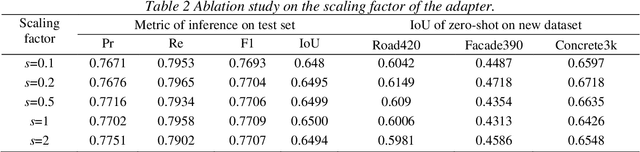
Large-scale foundation models have become the mainstream deep learning method, while in civil engineering, the scale of AI models is strictly limited. In this work, a vision foundation model is introduced for crack segmentation. Two parameter-efficient fine-tuning methods, adapter and low-rank adaptation, are adopted to fine-tune the foundation model in semantic segmentation: the Segment Anything Model (SAM). The fine-tuned CrackSAM model is much larger than all the existing crack segmentation models but shows excellent performance. To test the zero-shot performance of the proposed method, two unique datasets related to road and exterior wall cracks are collected, annotated and open-sourced, for a total of 810 images. Comparative experiments are conducted with twelve mature semantic segmentation models. On datasets with artificial noise and previously unseen datasets, the performance of CrackSAM far exceeds that of all state-of-the-art models. CrackSAM exhibits remarkable superiority, particularly under challenging conditions such as dim lighting, shadows, road markings, construction joints, and other interference factors. These cross-scenario results demonstrate the outstanding zero-shot capability of foundation models and provide new ideas for developing vision models in civil engineering.