 Add to Chrome
 Add to Firefox
 Add to Edge
Robust Backdoor Removal by Reconstructing Trigger-Activated Changes in Latent Representation
Nov 12, 2025
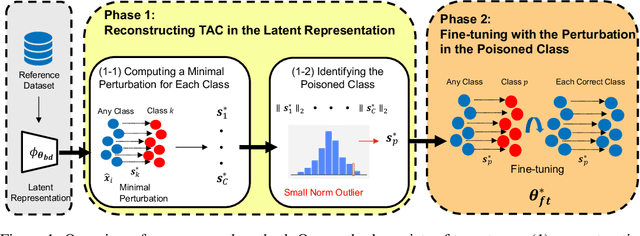
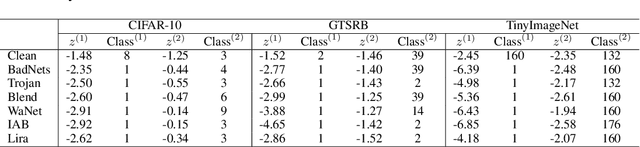
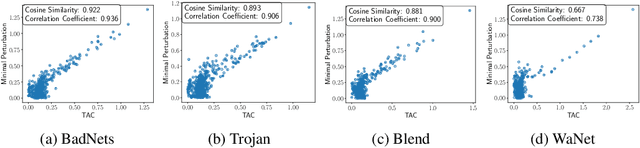
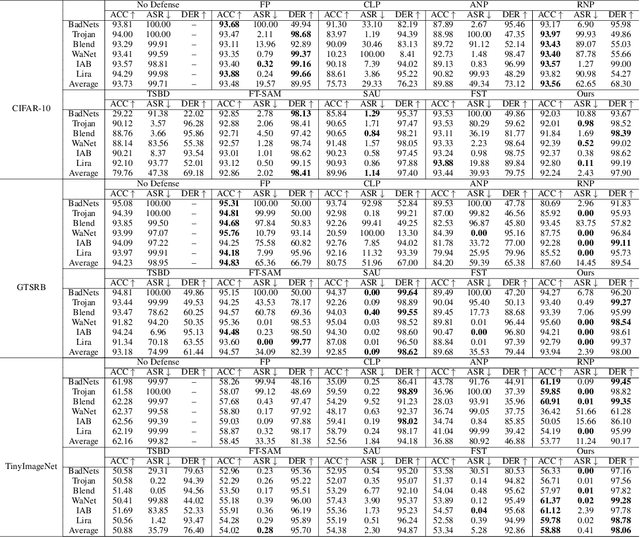
Backdoor attacks pose a critical threat to machine learning models, causing them to behave normally on clean data but misclassify poisoned data into a poisoned class. Existing defenses often attempt to identify and remove backdoor neurons based on Trigger-Activated Changes (TAC) which is the activation differences between clean and poisoned data. These methods suffer from low precision in identifying true backdoor neurons due to inaccurate estimation of TAC values. In this work, we propose a novel backdoor removal method by accurately reconstructing TAC values in the latent representation. Specifically, we formulate the minimal perturbation that forces clean data to be classified into a specific class as a convex quadratic optimization problem, whose optimal solution serves as a surrogate for TAC. We then identify the poisoned class by detecting statistically small $L^2$ norms of perturbations and leverage the perturbation of the poisoned class in fine-tuning to remove backdoors. Experiments on CIFAR-10, GTSRB, and TinyImageNet demonstrated that our approach consistently achieves superior backdoor suppression with high clean accuracy across different attack types, datasets, and architectures, outperforming existing defense methods.

NeurIPS 2023 Competition: Privacy Preserving Federated Learning Document VQA
Nov 06, 2024



The Privacy Preserving Federated Learning Document VQA (PFL-DocVQA) competition challenged the community to develop provably private and communication-efficient solutions in a federated setting for a real-life use case: invoice processing. The competition introduced a dataset of real invoice documents, along with associated questions and answers requiring information extraction and reasoning over the document images. Thereby, it brings together researchers and expertise from the document analysis, privacy, and federated learning communities. Participants fine-tuned a pre-trained, state-of-the-art Document Visual Question Answering model provided by the organizers for this new domain, mimicking a typical federated invoice processing setup. The base model is a multi-modal generative language model, and sensitive information could be exposed through either the visual or textual input modality. Participants proposed elegant solutions to reduce communication costs while maintaining a minimum utility threshold in track 1 and to protect all information from each document provider using differential privacy in track 2. The competition served as a new testbed for developing and testing private federated learning methods, simultaneously raising awareness about privacy within the document image analysis and recognition community. Ultimately, the competition analysis provides best practices and recommendations for successfully running privacy-focused federated learning challenges in the future.