 Add to Chrome
 Add to Firefox
 Add to Edge
AgentCgroup: Understanding and Controlling OS Resources of AI Agents
Feb 10, 2026
AI agents are increasingly deployed in multi-tenant cloud environments, where they execute diverse tool calls within sandboxed containers, each call with distinct resource demands and rapid fluctuations. We present a systematic characterization of OS-level resource dynamics in sandboxed AI coding agents, analyzing 144 software engineering tasks from the SWE-rebench benchmark across two LLM models. Our measurements reveal that (1) OS-level execution (tool calls, container and agent initialization) accounts for 56-74% of end-to-end task latency; (2) memory, not CPU, is the concurrency bottleneck; (3) memory spikes are tool-call-driven with a up to 15.4x peak-to-average ratio; and (4) resource demands are highly unpredictable across tasks, runs, and models. Comparing these characteristics against serverless, microservice, and batch workloads, we identify three mismatches in existing resource controls: a granularity mismatch (container-level policies vs. tool-call-level dynamics), a responsiveness mismatch (user-space reaction vs. sub-second unpredictable bursts), and an adaptability mismatch (history-based prediction vs. non-deterministic stateful execution). We propose AgentCgroup , an eBPF-based resource controller that addresses these mismatches through hierarchical cgroup structures aligned with tool-call boundaries, in-kernel enforcement via sched_ext and memcg_bpf_ops, and runtime-adaptive policies driven by in-kernel monitoring. Preliminary evaluation demonstrates improved multi-tenant isolation and reduced resource waste.

SAIR: Cost-Efficient Multi-Stage ML Pipeline Autoscaling via In-Context Reinforcement Learning
Jan 29, 2026Multi-stage ML inference pipelines are difficult to autoscale due to heterogeneous resources, cross-stage coupling, and dynamic bottleneck migration. We present SAIR, an autoscaling framework that uses an LLM as an in-context reinforcement learning controller, improving its policy online from reward-labeled interaction histories without gradient updates. SAIR combines Pareto-dominance reward shaping with a provable separation margin, surprisal-guided experience retrieval for context efficiency, and fine-grained GPU rate control via user-space CUDA interception. We provide regret analysis decomposing error into retrieval coverage and LLM selection components. On four ML serving pipelines under three workload patterns, SAIR achieves the best or tied-best P99 latency and effective resource cost among deployed baselines, improving P99 by up to 50% and reducing effective cost by up to 97% (under GPU rate-control assumptions), with 86% bottleneck detection accuracy and no offline training.
KEN: Kernel Extensions using Natural Language
Dec 09, 2023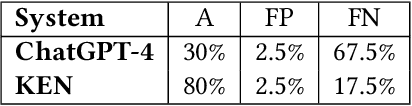
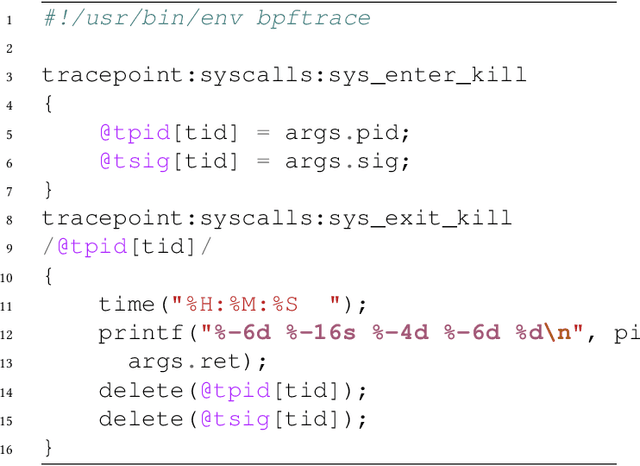
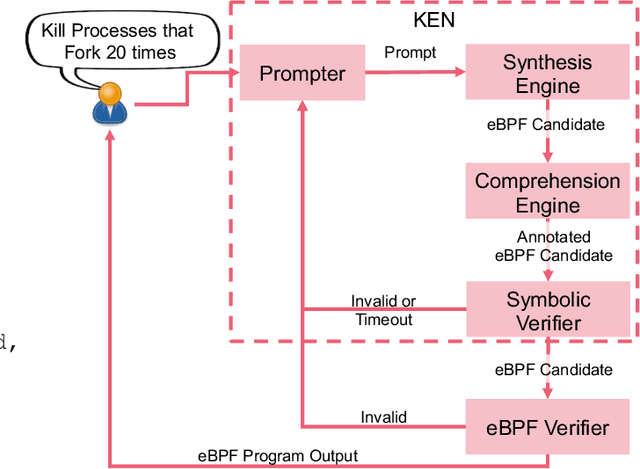
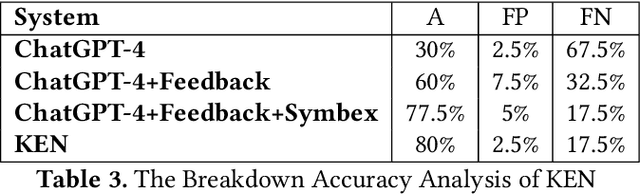
The ability to modify and extend an operating system is an important feature for improving a system's security, reliability, and performance. The extended Berkeley Packet Filters (eBPF) ecosystem has emerged as the standard mechanism for extending the Linux kernel and has recently been ported to Windows. eBPF programs inject new logic into the kernel that the system will execute before or after existing logic. While the eBPF ecosystem provides a flexible mechanism for kernel extension, it is difficult for developers to write eBPF programs today. An eBPF developer must have deep knowledge of the internals of the operating system to determine where to place logic and cope with programming limitations on the control flow and data accesses of their eBPF program enforced by the eBPF verifier. This paper presents KEN, an alternative framework that alleviates the difficulty of writing an eBPF program by allowing Kernel Extensions to be written in Natural language. KEN uses recent advances in large language models (LLMs) to synthesize an eBPF program given a user's English language prompt. To ensure that LLM's output is semantically equivalent to the user's prompt, KEN employs a combination of LLM-empowered program comprehension, symbolic execution, and a series of feedback loops. KEN's key novelty is the combination of these techniques. In particular, the system uses symbolic execution in a novel structure that allows it to combine the results of program synthesis and program comprehension and build on the recent success that LLMs have shown for each of these tasks individually. To evaluate KEN, we developed a new corpus of natural language prompts for eBPF programs. We show that KEN produces correct eBPF programs on 80% which is an improvement of a factor of 2.67 compared to an LLM-empowered program synthesis baseline.