 Add to Chrome
 Add to Firefox
 Add to Edge
OTCache: Optimal Transport for Geometry-Aware Caching in Diffusion Models
Jun 30, 2026
We propose OTCache, a training-free framework for accelerating diffusion sampling via caching schedule prediction. Existing graph-based caching methods reduce redundant computation by optimizing shortest-path objectives, but rely on an additive independence assumption, which often breaks down in the low NFE regime. To address this issue, OTCache models caching schedules across inference budgets as a smooth evolution in policy space, inspired by Optimal Transport (OT). The framework consists of three stages: (1) obtaining a high-fidelity \textbf{reference schedule} using a graph-based caching method under a conservative budget; (2) performing a lightweight anchor search under an extreme low-budget setting via Optuna optimization with an end-to-end perceptual objective; and (3) predicting schedules for target budgets via quantile interpolation between the reference and anchor policies using continuous warping representations. Experiments on FLUX.1 [dev], Qwen-Image, and HunyuanVideo show that OTCache achieves 4.5x, 4.7x, and 3.66x acceleration, respectively, while consistently improving generation fidelity over state-of-the-art caching baselines. This work provides a new perspective on accelerating diffusion models through Optimal-Transport-inspired schedule modeling. Code:https://github.com/UnicomAI/OTCache

MeanCache: From Instantaneous to Average Velocity for Accelerating Flow Matching Inference
Jan 27, 2026We present MeanCache, a training-free caching framework for efficient Flow Matching inference. Existing caching methods reduce redundant computation but typically rely on instantaneous velocity information (e.g., feature caching), which often leads to severe trajectory deviations and error accumulation under high acceleration ratios. MeanCache introduces an average-velocity perspective: by leveraging cached Jacobian--vector products (JVP) to construct interval average velocities from instantaneous velocities, it effectively mitigates local error accumulation. To further improve cache timing and JVP reuse stability, we develop a trajectory-stability scheduling strategy as a practical tool, employing a Peak-Suppressed Shortest Path under budget constraints to determine the schedule. Experiments on FLUX.1, Qwen-Image, and HunyuanVideo demonstrate that MeanCache achieves 4.12X and 4.56X and 3.59X acceleration, respectively, while consistently outperforming state-of-the-art caching baselines in generation quality. We believe this simple yet effective approach provides a new perspective for Flow Matching inference and will inspire further exploration of stability-driven acceleration in commercial-scale generative models.
Towards Improving the Expressiveness of Singing Voice Synthesis with BERT Derived Semantic Information
Aug 31, 2023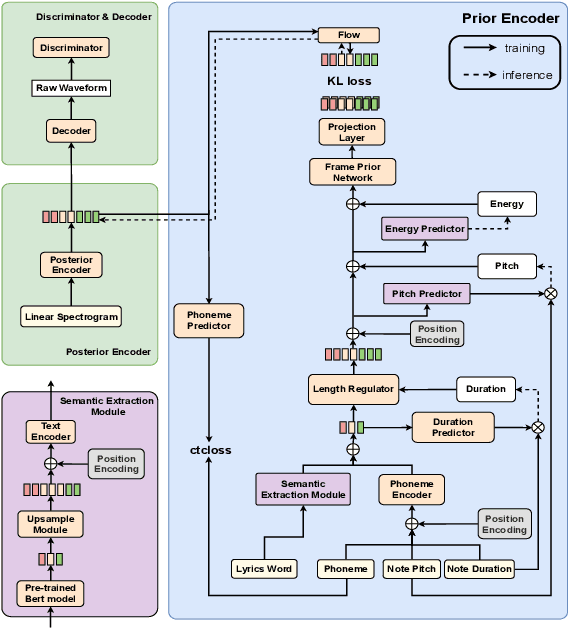
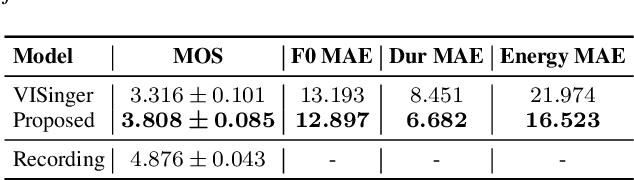

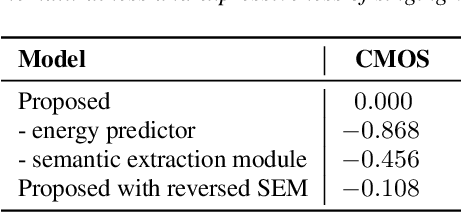
This paper presents an end-to-end high-quality singing voice synthesis (SVS) system that uses bidirectional encoder representation from Transformers (BERT) derived semantic embeddings to improve the expressiveness of the synthesized singing voice. Based on the main architecture of recently proposed VISinger, we put forward several specific designs for expressive singing voice synthesis. First, different from the previous SVS models, we use text representation of lyrics extracted from pre-trained BERT as additional input to the model. The representation contains information about semantics of the lyrics, which could help SVS system produce more expressive and natural voice. Second, we further introduce an energy predictor to stabilize the synthesized voice and model the wider range of energy variations that also contribute to the expressiveness of singing voice. Last but not the least, to attenuate the off-key issues, the pitch predictor is re-designed to predict the real to note pitch ratio. Both objective and subjective experimental results indicate that the proposed SVS system can produce singing voice with higher-quality outperforming VISinger.