 Add to Chrome
 Add to Firefox
 Add to Edge
Omni-Video 2: Scaling MLLM-Conditioned Diffusion for Unified Video Generation and Editing
Feb 09, 2026
We present Omni-Video 2, a scalable and computationally efficient model that connects pretrained multimodal large-language models (MLLMs) with video diffusion models for unified video generation and editing. Our key idea is to exploit the understanding and reasoning capabilities of MLLMs to produce explicit target captions to interpret user instructions. In this way, the rich contextual representations from the understanding model are directly used to guide the generative process, thereby improving performance on complex and compositional editing. Moreover, a lightweight adapter is developed to inject multimodal conditional tokens into pretrained text-to-video diffusion models, allowing maximum reuse of their powerful generative priors in a parameter-efficient manner. Benefiting from these designs, we scale up Omni-Video 2 to a 14B video diffusion model on meticulously curated training data with quality, supporting high quality text-to-video generation and various video editing tasks such as object removal, addition, background change, complex motion editing, \emph{etc.} We evaluate the performance of Omni-Video 2 on the FiVE benchmark for fine-grained video editing and the VBench benchmark for text-to-video generation. The results demonstrate its superior ability to follow complex compositional instructions in video editing, while also achieving competitive or superior quality in video generation tasks.

Uni-cot: Towards Unified Chain-of-Thought Reasoning Across Text and Vision
Aug 07, 2025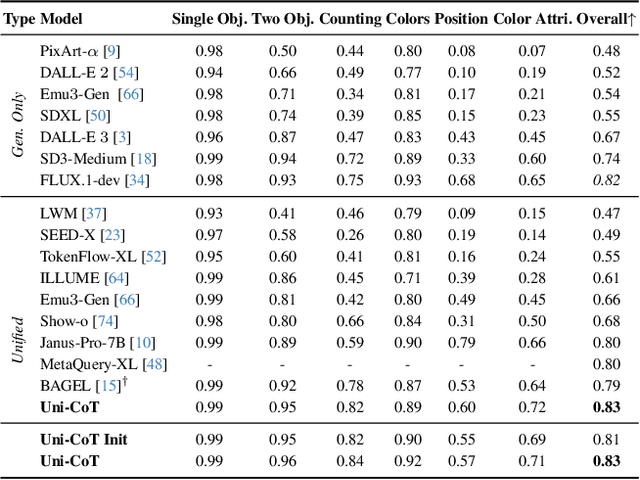
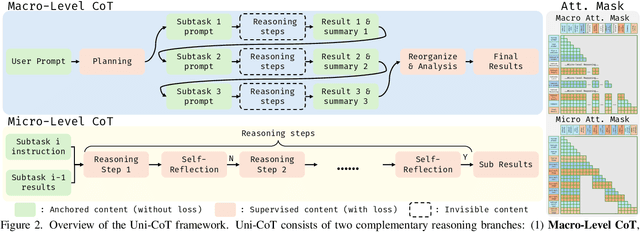
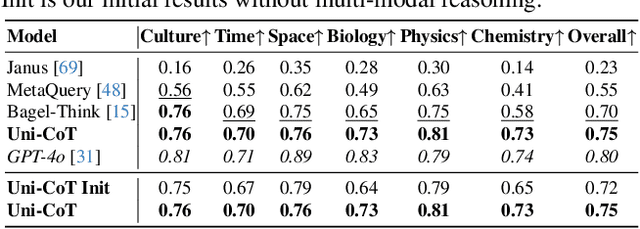
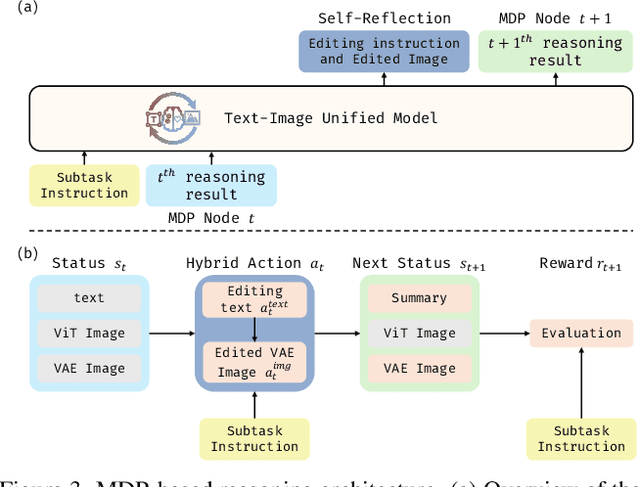
Chain-of-Thought (CoT) reasoning has been widely adopted to enhance Large Language Models (LLMs) by decomposing complex tasks into simpler, sequential subtasks. However, extending CoT to vision-language reasoning tasks remains challenging, as it often requires interpreting transitions of visual states to support reasoning. Existing methods often struggle with this due to limited capacity of modeling visual state transitions or incoherent visual trajectories caused by fragmented architectures. To overcome these limitations, we propose Uni-CoT, a Unified Chain-of-Thought framework that enables coherent and grounded multimodal reasoning within a single unified model. The key idea is to leverage a model capable of both image understanding and generation to reason over visual content and model evolving visual states. However, empowering a unified model to achieve that is non-trivial, given the high computational cost and the burden of training. To address this, Uni-CoT introduces a novel two-level reasoning paradigm: A Macro-Level CoT for high-level task planning and A Micro-Level CoT for subtask execution. This design significantly reduces the computational overhead. Furthermore, we introduce a structured training paradigm that combines interleaved image-text supervision for macro-level CoT with multi-task objectives for micro-level CoT. Together, these innovations allow Uni-CoT to perform scalable and coherent multi-modal reasoning. Furthermore, thanks to our design, all experiments can be efficiently completed using only 8 A100 GPUs with 80GB VRAM each. Experimental results on reasoning-driven image generation benchmark (WISE) and editing benchmarks (RISE and KRIS) indicates that Uni-CoT demonstrates SOTA performance and strong generalization, establishing Uni-CoT as a promising solution for multi-modal reasoning. Project Page and Code: https://sais-fuxi.github.io/projects/uni-cot/