 Add to Chrome
 Add to Firefox
 Add to Edge
MicroVerse: An Instrument for Measuring Self-Authored Identity Drift in Long-Horizon Multi-Agent Language-Model Simulations
Aug 16, 2026
Long-horizon, multi-agent language model (LM) simulations are widely proposed for studying social behavior, yet instruments to measure whether persona-conditioned agents maintain identity fidelity under sustained pressure are lacking. We present MicroVerse, a behavioral-science instrument that measures identity drift in generative agents. Agents carry an immutable "soul file" (core values, moral boundaries, personality, goals) and inhabit a resource-scarce 50 x 50 environment where water is a non-respawning survival constraint. Scarcity is operationalized via a per-tick existence-cost gradient. The eight-verb action space maps directly to moral boundaries (trade, talk, attack, scavenge). Using a three-layer memory architecture, agents periodically revise a mutable current identity against their immutable original soul via importance-triggered reflection. To mitigate survivor bias, MicroVerse decouples measurement from behavior using uniform longitudinal engine snapshots every N ticks alongside a forced-end snapshot of all living and dead agents. Identity drift is scored offline using a paraphrase-aware, value-anchored, multi-register diff rather than raw cosine similarity. We evaluate the instrument via a controlled seed run (n = 25) and a reflection-threshold sweep (thresholds {40, 80, 150}) to determine if drift dynamics are gate artifacts or threshold-robust properties. We report two primary findings: (1) Anti-self-deception emerges unprompted as the single largest semantic category of identity modification (27 of 111 added boundaries, 24%). (2) The system is threshold-robust; lower gates accelerate and increase revision frequency but preserve drift direction. All empirical results are strictly preliminary existence proofs and effect shapes (one model, one seed per arm, n = 25) rather than statistical significance claims.

DSL-LLaDA: Scaling Continuous Denoising to 8B Masked Diffusion LMs
May 31, 2026Discrete Masked diffusion language models generate text by iterative parallel decoding, but few-step decoding suffers from a tradeoff between length and quality: with a fixed step budget, standard methods can generate a short, high-quality output, or they can produce long but repetitive text. Continuous denoising can sidestep this tradeoff by evolving all positions jointly in embedding space, but building such a model from scratch at scale remains an open problem. We show that a pretrained masked DLM can instead be lightly adapted to support continuous embedding-space denoising. Starting from LLaDA-8B-Instruct, we continue-pretrain for only 1,000 steps with Discrete Stochastic Localization (DSL), replacing binary masking with continuous per-token Gaussian noise as a soft mask. The adapted model supports continuous inference that evolves all positions jointly in embedding space and defers hard token commitment to the final step. On zero-shot summarization at low step budgets (<=16 forward passes), DSL-LLaDA-SDE achieves the best ROUGE-1 on all four benchmarks and largely avoids the premature-termination / repetition tradeoff of iterative unmasking. The same adaptation also yields selective noisy-state robustness: the model corrects corrupted tokens while preserving clean ones. Control experiments using standard masked diffusion training with the same compute demonstrate neither behavior.
Spectral Regularization for Diffusion Models
Mar 02, 2026Diffusion models are typically trained using pointwise reconstruction objectives that are agnostic to the spectral and multi-scale structure of natural signals. We propose a loss-level spectral regularization framework that augments standard diffusion training with differentiable Fourier- and wavelet-domain losses, without modifying the diffusion process, model architecture, or sampling procedure. The proposed regularizers act as soft inductive biases that encourage appropriate frequency balance and coherent multi-scale structure in generated samples. Our approach is compatible with DDPM, DDIM, and EDM formulations and introduces negligible computational overhead. Experiments on image and audio generation demonstrate consistent improvements in sample quality, with the largest gains observed on higher-resolution, unconditional datasets where fine-scale structure is most challenging to model.
Discrete Stochastic Localization for Non-autoregressive Generation
Feb 18, 2026Non-autoregressive (NAR) generation reduces decoding latency by predicting many tokens in parallel, but iterative refinement often suffers from error accumulation and distribution shift under self-generated drafts. Masked diffusion language models (MDLMs) and their remasking samplers (e.g., ReMDM) can be viewed as modern NAR iterative refinement, where generation repeatedly revises a partially observed draft. In this work we show that \emph{training alone} can substantially improve the step-efficiency of MDLM/ReMDM sampling. We propose \textsc{DSL} (Discrete Stochastic Localization), which trains a single SNR-invariant denoiser across a continuum of corruption levels, bridging intermediate draft noise and mask-style endpoint corruption within one Diffusion Transformer. On OpenWebText, \textsc{DSL} fine-tuning yields large MAUVE gains at low step budgets, surpassing the MDLM+ReMDM baseline with \(\sim\)4$\times$ fewer denoiser evaluations, and matches autoregressive quality at high budgets. Analyses show improved self-correction and uncertainty calibration, making remasking markedly more compute-efficient.
Measurement-aligned Flow for Inverse Problem
Jun 13, 2025Diffusion models provide a powerful way to incorporate complex prior information for solving inverse problems. However, existing methods struggle to correctly incorporate guidance from conflicting signals in the prior and measurement, especially in the challenging setting of non-Gaussian or unknown noise. To bridge these gaps, we propose Measurement-Aligned Sampling (MAS), a novel framework for linear inverse problem solving that can more flexibly balance prior and measurement information. MAS unifies and extends existing approaches like DDNM and DAPS, and offers a new optimization perspective. MAS can generalize to handle known Gaussian noise, unknown or non-Gaussian noise types. Extensive experiments show that MAS consistently outperforms state-of-the-art methods across a range of tasks.
Your Diffusion Model is Secretly a Noise Classifier and Benefits from Contrastive Training
Jul 12, 2024


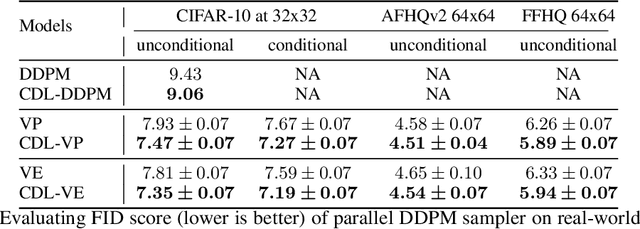
Diffusion models learn to denoise data and the trained denoiser is then used to generate new samples from the data distribution. In this paper, we revisit the diffusion sampling process and identify a fundamental cause of sample quality degradation: the denoiser is poorly estimated in regions that are far Outside Of the training Distribution (OOD), and the sampling process inevitably evaluates in these OOD regions. This can become problematic for all sampling methods, especially when we move to parallel sampling which requires us to initialize and update the entire sample trajectory of dynamics in parallel, leading to many OOD evaluations. To address this problem, we introduce a new self-supervised training objective that differentiates the levels of noise added to a sample, leading to improved OOD denoising performance. The approach is based on our observation that diffusion models implicitly define a log-likelihood ratio that distinguishes distributions with different amounts of noise, and this expression depends on denoiser performance outside the standard training distribution. We show by diverse experiments that the proposed contrastive diffusion training is effective for both sequential and parallel settings, and it improves the performance and speed of parallel samplers significantly.
Less is More for Long Document Summary Evaluation by LLMs
Sep 14, 2023Large Language Models (LLMs) have shown promising performance in summary evaluation tasks, yet they face challenges such as high computational costs and the Lost-in-the-Middle problem where important information in the middle of long documents is often overlooked. To address these issues, this paper introduces a novel approach, Extract-then-Evaluate, which involves extracting key sentences from a long source document and then evaluating the summary by prompting LLMs. The results reveal that the proposed method not only significantly reduces evaluation costs but also exhibits a higher correlation with human evaluations. Furthermore, we provide practical recommendations for optimal document length and sentence extraction methods, contributing to the development of cost-effective yet more accurate methods for LLM-based text generation evaluation.