 Add to Chrome
 Add to Firefox
 Add to Edge
A Zero-Shot Deep Image Prior Framework for Denoising and Deconvolution in Fluorescence Microscopy
Jun 26, 2026
Fluorescence microscopy images are degraded by noise and diffraction-induced blur, which compromise structural fidelity and limit quantitative analysis. Supervised deep learning methods achieve impressive restoration performance but require large-scale paired datasets that are difficult to obtain in practice. To address this issue, we propose SDIP, a zero-shot deep image prior (DIP) framework that sequentially performs denoising and deconvolution without external training data. An aSeqDIP-based module first suppresses noise while preserving fine structures through sequential autoencoding regularization. In the deconvolution stage, a wavelet-based background correction step is incorporated before the proposed RLG-DIP module performs artifact-reduced deconvolution. RLG-DIP uses the Richardson-Lucy deconvolution result as a physically consistent guidance prior, integrating the imaging model with the implicit prior of DIP to stabilize the ill-posed deconvolution process. Experiments on the BioSR dataset across multiple cellular structures demonstrate that SDIP improves both signal-to-noise ratio and resolution, achieving superior visual quality and improved quantitative performance on most evaluated structures. The proposed framework may also provide useful insights for designing physically guided DIP methods for other inverse problems.

Deep learning EPI-TIRF cross-modality enables background subtraction and axial super-resolution for widefield fluorescence microscopy
Nov 10, 2025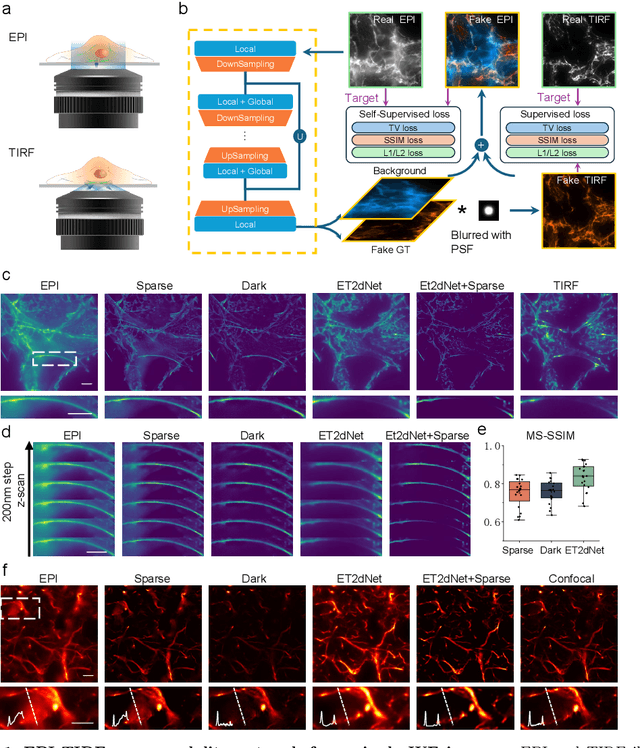
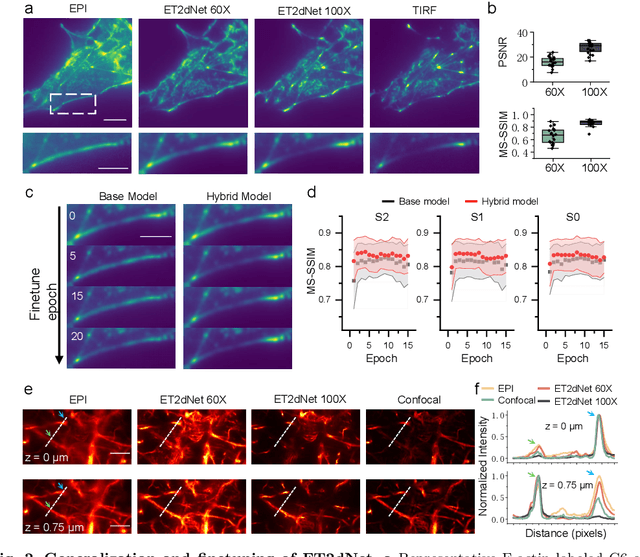
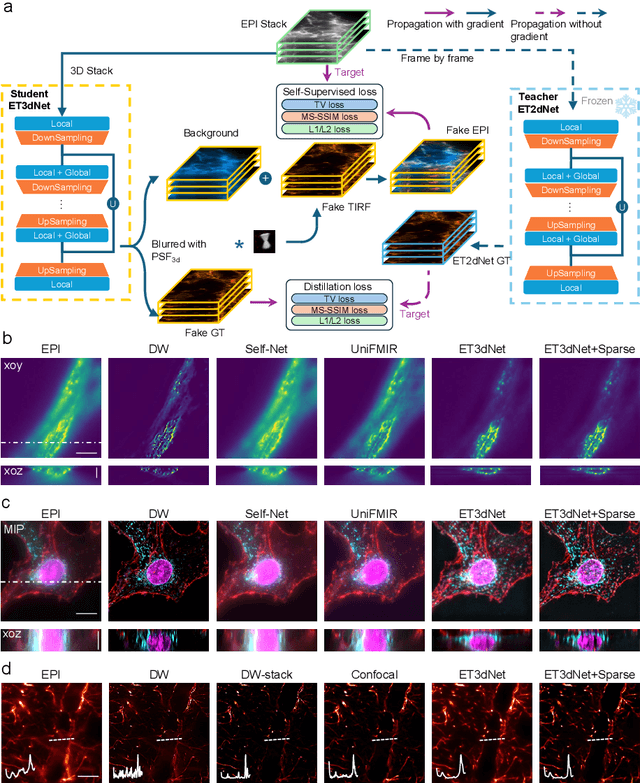
The resolving ability of wide-field fluorescence microscopy is fundamentally limited by out-of-focus background owing to its low axial resolution, particularly for densely labeled biological samples. To address this, we developed ET2dNet, a deep learning-based EPI-TIRF cross-modality network that achieves TIRF-comparable background subtraction and axial super-resolution from a single wide-field image without requiring hardware modifications. The model employs a physics-informed hybrid architecture, synergizing supervised learning with registered EPI-TIRF image pairs and self-supervised physical modeling via convolution with the point spread function. This framework ensures exceptional generalization across microscope objectives, enabling few-shot adaptation to new imaging setups. Rigorous validation on cellular and tissue samples confirms ET2dNet's superiority in background suppression and axial resolution enhancement, while maintaining compatibility with deconvolution techniques for lateral resolution improvement. Furthermore, by extending this paradigm through knowledge distillation, we developed ET3dNet, a dedicated three-dimensional reconstruction network that produces artifact-reduced volumetric results. ET3dNet effectively removes out-of-focus background signals even when the input image stack lacks the source of background. This framework makes axial super-resolution imaging more accessible by providing an easy-to-deploy algorithm that avoids additional hardware costs and complexity, showing great potential for live cell studies and clinical histopathology.