 Add to Chrome
 Add to Firefox
 Add to Edge
Deep learning EPI-TIRF cross-modality enables background subtraction and axial super-resolution for widefield fluorescence microscopy
Nov 10, 2025
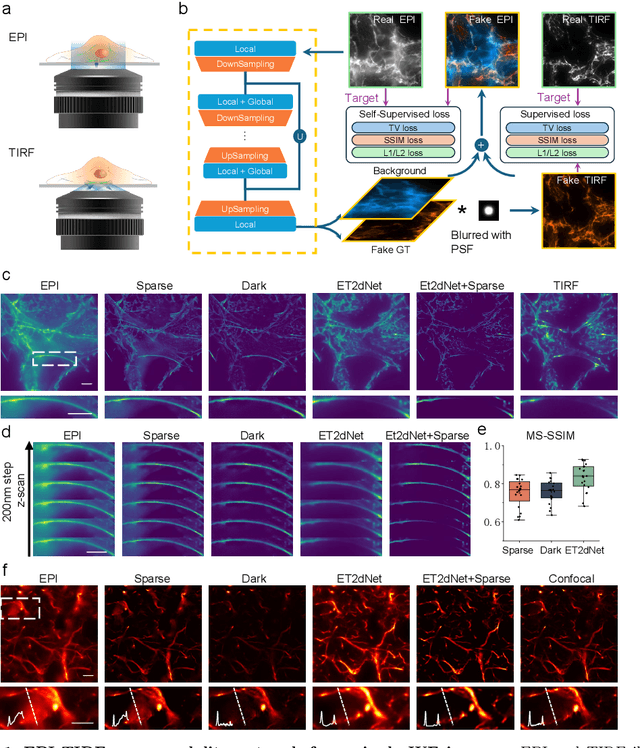
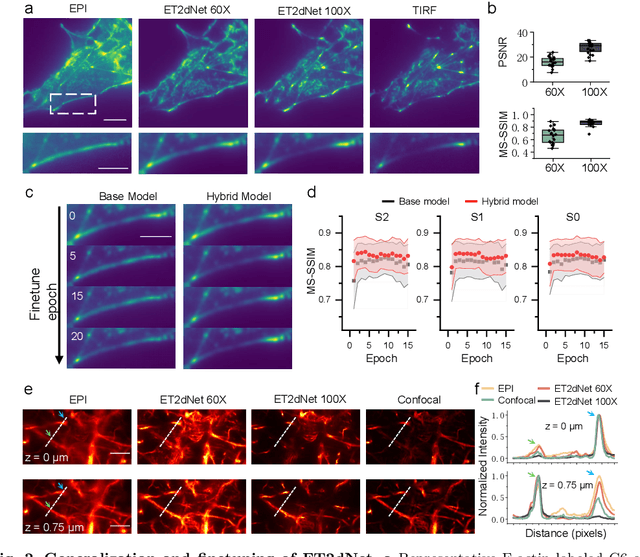
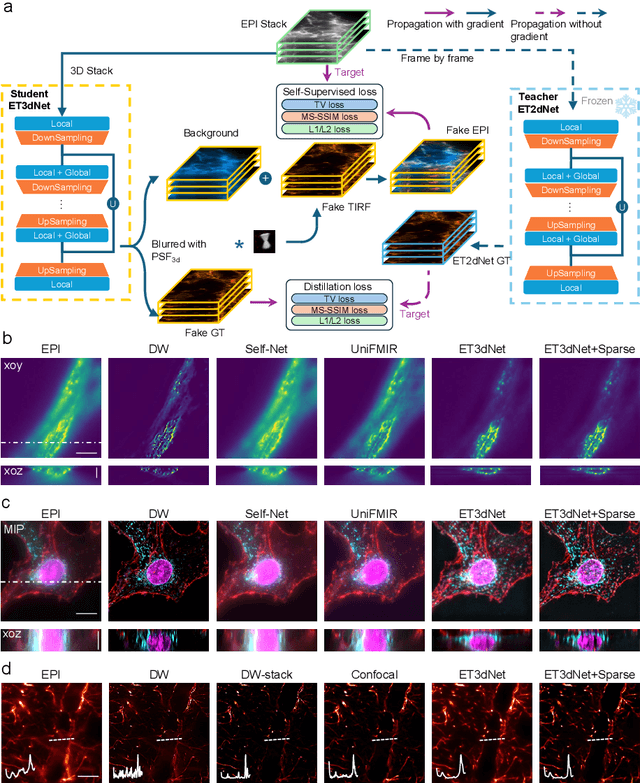
The resolving ability of wide-field fluorescence microscopy is fundamentally limited by out-of-focus background owing to its low axial resolution, particularly for densely labeled biological samples. To address this, we developed ET2dNet, a deep learning-based EPI-TIRF cross-modality network that achieves TIRF-comparable background subtraction and axial super-resolution from a single wide-field image without requiring hardware modifications. The model employs a physics-informed hybrid architecture, synergizing supervised learning with registered EPI-TIRF image pairs and self-supervised physical modeling via convolution with the point spread function. This framework ensures exceptional generalization across microscope objectives, enabling few-shot adaptation to new imaging setups. Rigorous validation on cellular and tissue samples confirms ET2dNet's superiority in background suppression and axial resolution enhancement, while maintaining compatibility with deconvolution techniques for lateral resolution improvement. Furthermore, by extending this paradigm through knowledge distillation, we developed ET3dNet, a dedicated three-dimensional reconstruction network that produces artifact-reduced volumetric results. ET3dNet effectively removes out-of-focus background signals even when the input image stack lacks the source of background. This framework makes axial super-resolution imaging more accessible by providing an easy-to-deploy algorithm that avoids additional hardware costs and complexity, showing great potential for live cell studies and clinical histopathology.

Towards Realistic Example-based Modeling via 3D Gaussian Stitching
Aug 28, 2024Using parts of existing models to rebuild new models, commonly termed as example-based modeling, is a classical methodology in the realm of computer graphics. Previous works mostly focus on shape composition, making them very hard to use for realistic composition of 3D objects captured from real-world scenes. This leads to combining multiple NeRFs into a single 3D scene to achieve seamless appearance blending. However, the current SeamlessNeRF method struggles to achieve interactive editing and harmonious stitching for real-world scenes due to its gradient-based strategy and grid-based representation. To this end, we present an example-based modeling method that combines multiple Gaussian fields in a point-based representation using sample-guided synthesis. Specifically, as for composition, we create a GUI to segment and transform multiple fields in real time, easily obtaining a semantically meaningful composition of models represented by 3D Gaussian Splatting (3DGS). For texture blending, due to the discrete and irregular nature of 3DGS, straightforwardly applying gradient propagation as SeamlssNeRF is not supported. Thus, a novel sampling-based cloning method is proposed to harmonize the blending while preserving the original rich texture and content. Our workflow consists of three steps: 1) real-time segmentation and transformation of a Gaussian model using a well-tailored GUI, 2) KNN analysis to identify boundary points in the intersecting area between the source and target models, and 3) two-phase optimization of the target model using sampling-based cloning and gradient constraints. Extensive experimental results validate that our approach significantly outperforms previous works in terms of realistic synthesis, demonstrating its practicality. More demos are available at https://ingra14m.github.io/gs_stitching_website.