 Add to Chrome
 Add to Firefox
 Add to Edge
Predicting Functions, Not Features: KANs with Function-Space Joint-Embedding Predictive Learning for Medical Image Segmentation
Aug 12, 2026
Kolmogorov--Arnold Networks (KANs) introduce explicit functional representations by parameterizing each network edge as a learnable univariate function. However, existing KAN-based segmentation models optimize edge functions only through objectives defined after edge aggregation, leaving individual functions without an explicit pre-aggregation learning target. To address this limitation, we propose Function-Space Joint-Embedding Predictive Learning (FS-JEPA) for medical image segmentation. Our FS-JEPA framework moves predictive learning into the pre-aggregation function space of KANs. A masked online branch predicts structured signatures of sampled KAN edge functions generated by a full-context exponential moving average target branch, while shared edge indices preserve correspondence between predictions and targets. Rather than predicting an isolated edge response, we represent each sampled edge function using a multi-radius signature composed of function evaluations around its input anchor. This structured representation captures local functional variations that cannot be characterized by a single response and provides a more informative predictive target. The function-space objective is jointly optimized with the segmentation loss during training, while the predictive branch is removed at inference. Experiments on five medical image segmentation benchmarks show that our FS-JEPA achieves the best average Dice and outperforms the strongest competing KAN-based method by +2.25 percentage points.

Decoupling Language Guidance from Backbones for Text-Guided Medical Segmentation
Jul 10, 2026Text-guided medical image segmentation leverages clinical semantics to improve lesion delineation, yet many existing models bind cross-modal fusion, supervision, and decoder design into a task-specific architecture. Such tight coupling makes it difficult to reuse language guidance modules across heterogeneous vision and text backbones, and often requires redesigning the network when the encoder pair changes. This paper presents BTHA, a backbone-transferable hierarchical adapter framework for text-guided medical image segmentation. BTHA is built around a stable feature-level interface: given multi-scale visual features and a text representation, it injects semantic guidance through shape-preserving adapters while maintaining the decoder-side tensor contract. To make this interface effective, we introduce a Hierarchical Coarse-to-Fine Supervision Strategy that decomposes learning into global image-text alignment, multi-scale auxiliary localization, and boundary-aware final mask refinement. We further design a Scale-Adaptive Gated Semantic Guidance (SAGSG) adapter, where resolution-specific gates adaptively control textual injection and channel recalibration suppresses redundant cross-modal responses. Evaluations across diverse vision and text backbones show that the same adapter and supervision design remains effective across convolutional and transformer-based visual encoders as well as different language encoders. Experiments on four public datasets further demonstrate that BTHA improves strong text-guided baselines with modest computational overhead.
Agentic Flow Steering and Parallel Rollout Search for Spatially Grounded Text-to-Image Generation
Mar 19, 2026Precise Text-to-Image (T2I) generation has achieved great success but is hindered by the limited relational reasoning of static text encoders and the error accumulation in open-loop sampling. Without real-time feedback, initial semantic ambiguities during the Ordinary Differential Equation trajectory inevitably escalate into stochastic deviations from spatial constraints. To bridge this gap, we introduce AFS-Search (Agentic Flow Steering and Parallel Rollout Search), a training-free closed-loop framework built upon FLUX.1-dev. AFS-Search incorporates a training-free closed-loop parallel rollout search and flow steering mechanism, which leverages a Vision-Language Model (VLM) as a semantic critic to diagnose intermediate latents and dynamically steer the velocity field via precise spatial grounding. Complementarily, we formulate T2I generation as a sequential decision-making process, exploring multiple trajectories through lookahead simulations and selecting the optimal path based on VLM-guided rewards. Further, we provide AFS-Search-Pro for higher performance and AFS-Search-Fast for quicker generation. Experimental results show that our AFS-Search-Pro greatly boosts the performance of the original FLUX.1-dev, achieving state-of-the-art results across three different benchmarks. Meanwhile, AFS-Search-Fast also significantly enhances performance while maintaining fast generation speed.
HSI-VAR: Rethinking Hyperspectral Restoration through Spatial-Spectral Visual Autoregression
Jan 31, 2026Hyperspectral images (HSIs) capture richer spatial-spectral information beyond RGB, yet real-world HSIs often suffer from a composite mix of degradations, such as noise, blur, and missing bands. Existing generative approaches for HSI restoration like diffusion models require hundreds of iterative steps, making them computationally impractical for high-dimensional HSIs. While regression models tend to produce oversmoothed results, failing to preserve critical structural details. We break this impasse by introducing HSI-VAR, rethinking HSI restoration as an autoregressive generation problem, where spectral and spatial dependencies can be progressively modeled rather than globally reconstructed. HSI-VAR incorporates three key innovations: (1) Latent-condition alignment, which couples semantic consistency between latent priors and conditional embeddings for precise reconstruction; (2) Degradation-aware guidance, which uniquely encodes mixed degradations as linear combinations in the embedding space for automatic control, remarkably achieving a nearly $50\%$ reduction in computational cost at inference; (3) A spatial-spectral adaptation module that refines details across both domains in the decoding phase. Extensive experiments on nine all-in-one HSI restoration benchmarks confirm HSI-VAR's state-of-the-art performance, achieving a 3.77 dB PSNR improvement on \textbf{\textit{ICVL}} and offering superior structure preservation with an inference speed-up of up to $95.5 \times$ compared with diffusion-based methods, making it a highly practical solution for real-world HSI restoration.
Vision-Language Controlled Deep Unfolding for Joint Medical Image Restoration and Segmentation
Jan 30, 2026We propose VL-DUN, a principled framework for joint All-in-One Medical Image Restoration and Segmentation (AiOMIRS) that bridges the gap between low-level signal recovery and high-level semantic understanding. While standard pipelines treat these tasks in isolation, our core insight is that they are fundamentally synergistic: restoration provides clean anatomical structures to improve segmentation, while semantic priors regularize the restoration process. VL-DUN resolves the sub-optimality of sequential processing through two primary innovations. (1) We formulate AiOMIRS as a unified optimization problem, deriving an interpretable joint unfolding mechanism where restoration and segmentation are mathematically coupled for mutual refinement. (2) We introduce a frequency-aware Mamba mechanism to capture long-range dependencies for global segmentation while preserving the high-frequency textures necessary for restoration. This allows for efficient global context modeling with linear complexity, effectively mitigating the spectral bias of standard architectures. As a pioneering work in the AiOMIRS task, VL-DUN establishes a new state-of-the-art across multi-modal benchmarks, improving PSNR by 0.92 dB and the Dice coefficient by 9.76\%. Our results demonstrate that joint collaborative learning offers a superior, more robust solution for complex clinical workflows compared to isolated task processing. The codes are provided in https://github.com/cipi666/VLDUN.
TourSynbio: A Multi-Modal Large Model and Agent Framework to Bridge Text and Protein Sequences for Protein Engineering
Aug 27, 2024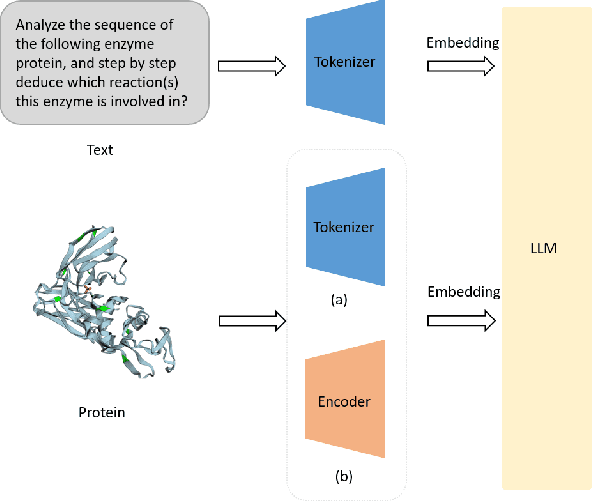


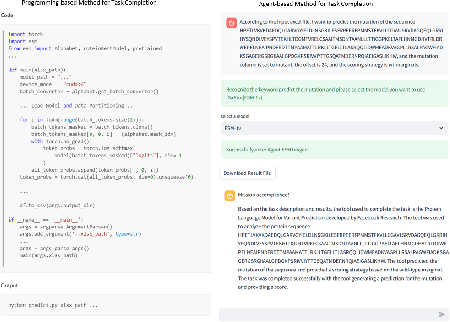
The structural similarities between protein sequences and natural languages have led to parallel advancements in deep learning across both domains. While large language models (LLMs) have achieved much progress in the domain of natural language processing, their potential in protein engineering remains largely unexplored. Previous approaches have equipped LLMs with protein understanding capabilities by incorporating external protein encoders, but this fails to fully leverage the inherent similarities between protein sequences and natural languages, resulting in sub-optimal performance and increased model complexity. To address this gap, we present TourSynbio-7B, the first multi-modal large model specifically designed for protein engineering tasks without external protein encoders. TourSynbio-7B demonstrates that LLMs can inherently learn to understand proteins as language. The model is post-trained and instruction fine-tuned on InternLM2-7B using ProteinLMDataset, a dataset comprising 17.46 billion tokens of text and protein sequence for self-supervised pretraining and 893K instructions for supervised fine-tuning. TourSynbio-7B outperforms GPT-4 on the ProteinLMBench, a benchmark of 944 manually verified multiple-choice questions, with 62.18% accuracy. Leveraging TourSynbio-7B's enhanced protein sequence understanding capability, we introduce TourSynbio-Agent, an innovative framework capable of performing various protein engineering tasks, including mutation analysis, inverse folding, protein folding, and visualization. TourSynbio-Agent integrates previously disconnected deep learning models in the protein engineering domain, offering a unified conversational user interface for improved usability. Finally, we demonstrate the efficacy of TourSynbio-7B and TourSynbio-Agent through two wet lab case studies on vanilla key enzyme modification and steroid compound catalysis.