 Add to Chrome
 Add to Firefox
 Add to Edge
Role-Aware Neural Convex Divergence Heads for Asymmetric Representation Learning
Jul 02, 2026
Many representation learning problems involve directed relations, such as lexical entailment, sentence entailment, ontology hierarchy, and citation links. Standard Euclidean, cosine, and Mahalanobis heads are symmetric, while generic neural scorers can model directionality but provide limited geometric structure. This paper proposes a role-aware neural convex divergence head for asymmetric representation learning. The head applies source- and target-role projections before evaluating an input-convex neural Bregman divergence, yielding a nonnegative structured score in the role-projected space. We characterize its projected-space identity, source-role convexity, directional-gap decomposition, and Hessian-based local curvature. Experiments on lexical, sentence, ontology, and directed graph benchmarks compare symmetric distances, unstructured asymmetric scorers, order/hyperbolic baselines, plain ICNN-Bregman heads, and the proposed role-aware variant. Across ten random seeds on the main semantic and ontology benchmarks, role-aware projections consistently improve directional accuracy over plain ICNN-Bregman heads while preserving zero observed negative divergence rate. The results also identify a boundary case: on large fixed-feature citation prediction, specialized symmetric or hyperbolic baselines remain stronger in ranking accuracy. Overall, the proposed head is best understood as a structured and interpretable plug-in distance module for tasks where directional relations matter.

Real-World Image Datasets for Federated Learning
Oct 14, 2019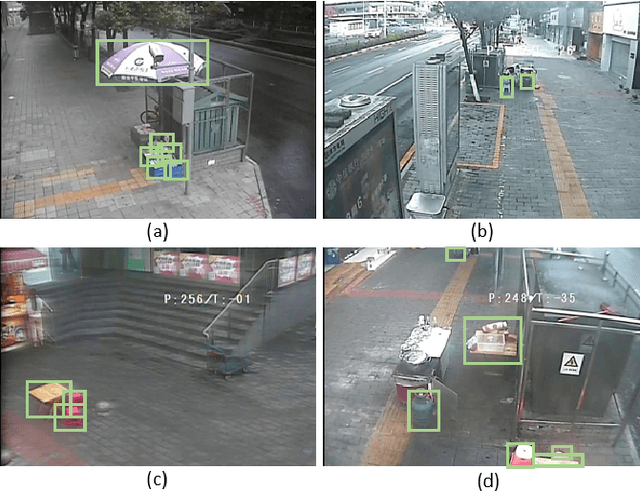
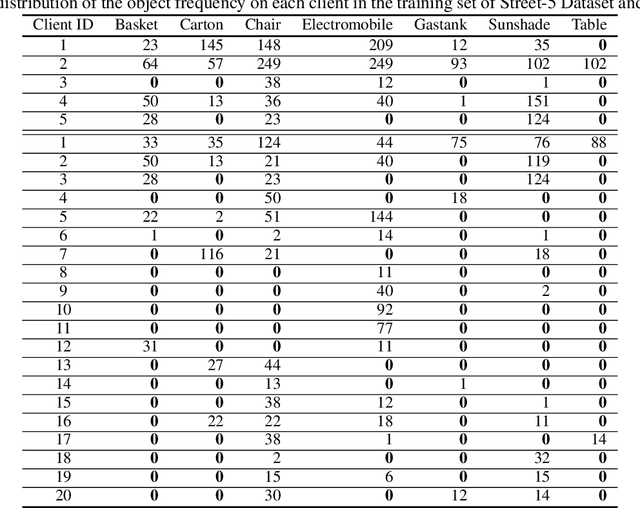
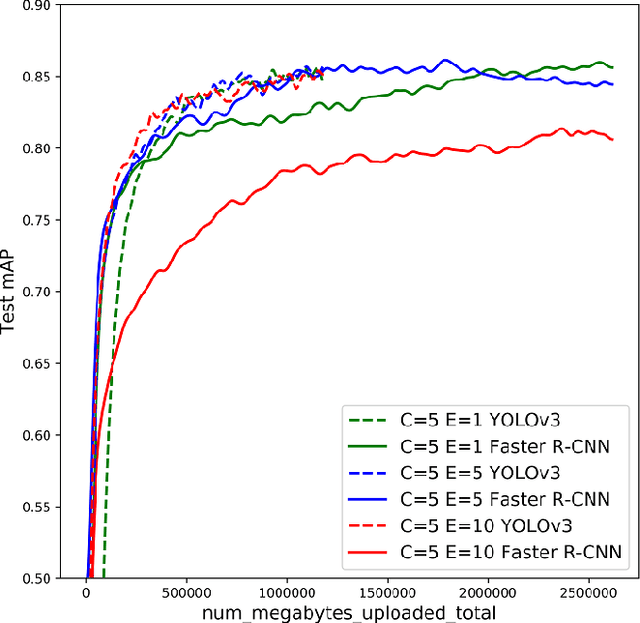
Federated learning is a new machine learning paradigm which allows data parties to build machine learning models collaboratively while keeping their data secure and private. While research efforts on federated learning have been growing tremendously in the past two years, most existing works still depend on pre-existing public datasets and artificial partitions to simulate data federations due to the lack of high-quality labeled data generated from real-world edge applications. Consequently, advances on benchmark and model evaluations for federated learning have been lagging behind. In this paper, we introduce a real-world image dataset. The dataset contains more than 900 images generated from 26 street cameras and 7 object categories annotated with detailed bounding box. The data distribution is non-IID and unbalanced, reflecting the characteristic real-world federated learning scenarios. Based on this dataset, we implemented two mainstream object detection algorithms (YOLO and Faster R-CNN) and provided an extensive benchmark on model performance, efficiency, and communication in a federated learning setting. Both the dataset and algorithms are made publicly available.