 Add to Chrome
 Add to Firefox
 Add to Edge
Akashic: A Low-Overhead LLM Inference Service with MemAttention
Jul 07, 2026
Recent LLM-based agent systems continuously accumulate context across multi-turn interactions, tool invocations, and cross-session workflows. Replaying the full history for every request quickly becomes impractical: long contexts increase prefill cost, may exceed context limits, and often bury task-relevant evidence in irrelevant content, degrading both serving efficiency and output quality. We propose Akashic, a low-overhead memory system built around MemAttention, which organizes context into bounded chunks and models semantic relationships across chunks, preserving cross-chunk evidence without repeatedly rewriting the full history. Akashic further applies hardware-software co-designed memory placement to co-locate likely co-retrieved chunks, reducing retrieval fragmentation and I/O overhead. Across four representative workloads and three model sizes, Akashic improves task accuracy by up to 10.2 points, throughput by up to 1.21x, and sustainable request rate by up to 1.88x over strong prior memory baselines.

Reservoir Computing based Neural Image Filters
Sep 07, 2018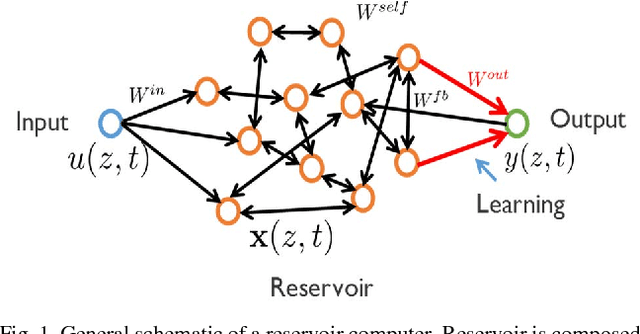
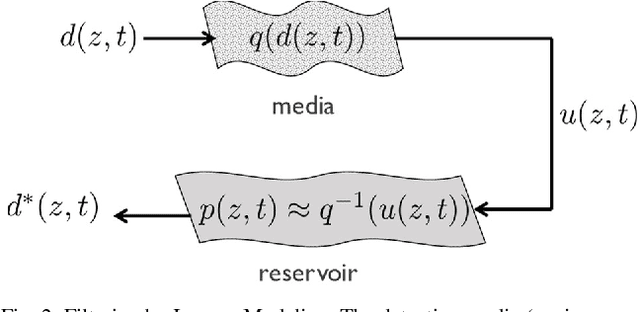
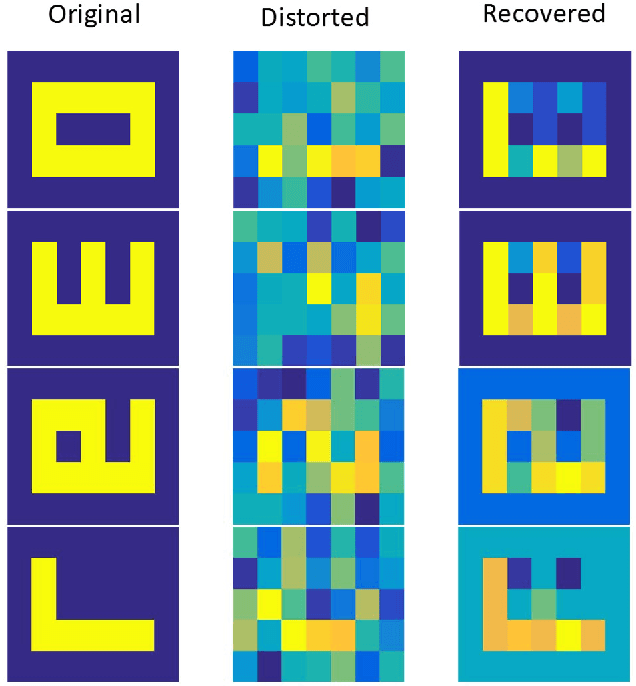
Clean images are an important requirement for machine vision systems to recognize visual features correctly. However, the environment, optics, electronics of the physical imaging systems can introduce extreme distortions and noise in the acquired images. In this work, we explore the use of reservoir computing, a dynamical neural network model inspired from biological systems, in creating dynamic image filtering systems that extracts signal from noise using inverse modeling. We discuss the possibility of implementing these networks in hardware close to the sensors.
Hardware based Spatio-Temporal Neural Processing Backend for Imaging Sensors: Towards a Smart Camera
Mar 23, 2018In this work we show how we can build a technology platform for cognitive imaging sensors using recent advances in recurrent neural network architectures and training methods inspired from biology. We demonstrate learning and processing tasks specific to imaging sensors, including enhancement of sensitivity and signal-to-noise ratio (SNR) purely through neural filtering beyond the fundamental limits sensor materials, and inferencing and spatio-temporal pattern recognition capabilities of these networks with applications in object detection, motion tracking and prediction. We then show designs of unit hardware cells built using complementary metal-oxide semiconductor (CMOS) and emerging materials technologies for ultra-compact and energy-efficient embedded neural processors for smart cameras.