 Add to Chrome
 Add to Firefox
 Add to Edge
Generating Humanless Environment Walkthroughs from Egocentric Walking Tour Videos
Mar 30, 2026
Egocentric "walking tour" videos provide a rich source of image data to develop rich and diverse visual models of environments around the world. However, the significant presence of humans in frames of these videos due to crowds and eye-level camera perspectives mitigates their usefulness in environment modeling applications. We focus on addressing this challenge by developing a generative algorithm that can realistically remove (i.e., inpaint) humans and their associated shadow effects from walking tour videos. Key to our approach is the construction of a rich semi-synthetic dataset of video clip pairs to train this generative model. Each pair in the dataset consists of an environment-only background clip, and a composite clip of walking humans with simulated shadows overlaid on the background. We randomly sourced both foreground and background components from real egocentric walking tour videos around the world to maintain visual diversity. We then used this dataset to fine-tune the state-of-the-art Casper video diffusion model for object and effects inpainting, and demonstrate that the resulting model performs far better than Casper both qualitatively and quantitatively at removing humans from walking tour clips with significant human presence and complex backgrounds. Finally, we show that the resulting generated clips can be used to build successful 3D/4D models of urban locations.

EgoGroups: A Benchmark For Detecting Social Groups of People in the Wild
Mar 23, 2026Social group detection, or the identification of humans involved in reciprocal interpersonal interactions (e.g., family members, friends, and customers and merchants), is a crucial component of social intelligence needed for agents transacting in the world. The few existing benchmarks for social group detection are limited by low scene diversity and reliance on third-person camera sources (e.g., surveillance footage). Consequently, these benchmarks generally lack real-world evaluation on how groups form and evolve in diverse cultural contexts and unconstrained settings. To address this gap, we introduce EgoGroups, a first-person view dataset that captures social dynamics in cities around the world. EgoGroups spans 65 countries covering low, medium, and high-crowd settings under four weather/time-of-day conditions. We include dense human annotations for person and social groups, along with rich geographic and scene metadata. Using this dataset, we performed an extensive evaluation of state-of-the-art VLM/LLMs and supervised models on their group detection capabilities. We found several interesting findings, including VLMs and LLMs can outperform supervised baselines in a zero-shot setting, while crowd density and cultural regions clearly influence model performance.
DRAGON: Drone and Ground Gaussian Splatting for 3D Building Reconstruction
Jul 01, 2024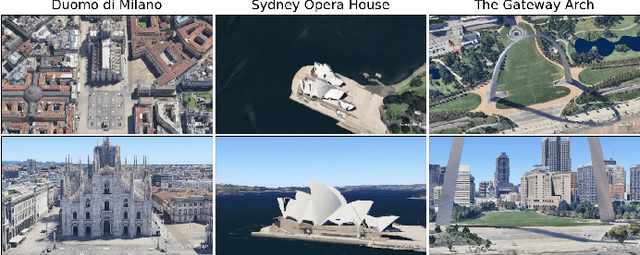

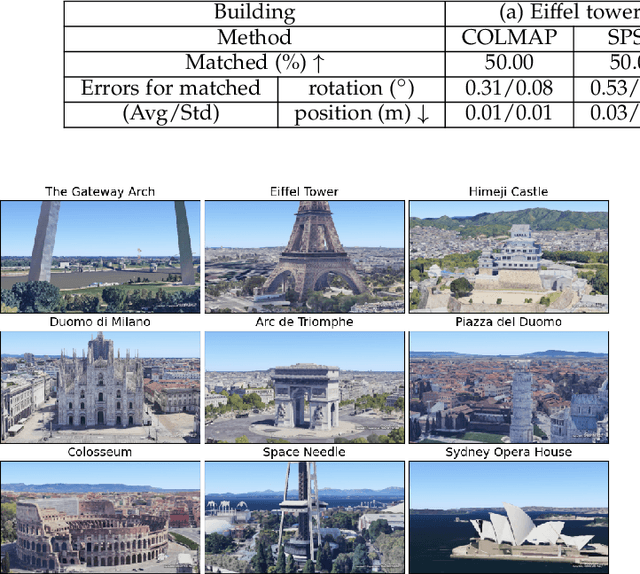
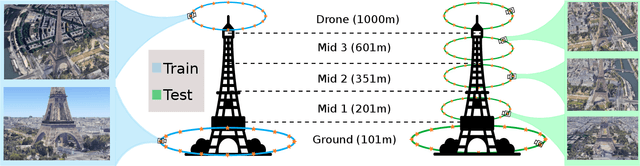
3D building reconstruction from imaging data is an important task for many applications ranging from urban planning to reconnaissance. Modern Novel View synthesis (NVS) methods like NeRF and Gaussian Splatting offer powerful techniques for developing 3D models from natural 2D imagery in an unsupervised fashion. These algorithms generally require input training views surrounding the scene of interest, which, in the case of large buildings, is typically not available across all camera elevations. In particular, the most readily available camera viewpoints at scale across most buildings are at near-ground (e.g., with mobile phones) and aerial (drones) elevations. However, due to the significant difference in viewpoint between drone and ground image sets, camera registration - a necessary step for NVS algorithms - fails. In this work we propose a method, DRAGON, that can take drone and ground building imagery as input and produce a 3D NVS model. The key insight of DRAGON is that intermediate elevation imagery may be extrapolated by an NVS algorithm itself in an iterative procedure with perceptual regularization, thereby bridging the visual feature gap between the two elevations and enabling registration. We compiled a semi-synthetic dataset of 9 large building scenes using Google Earth Studio, and quantitatively and qualitatively demonstrate that DRAGON can generate compelling renderings on this dataset compared to baseline strategies.