 Add to Chrome
 Add to Firefox
 Add to Edge
Chatting about Conditional Trajectory Prediction
Apr 20, 2026
Human behavior has the nature of mutual dependencies, which requires human-robot interactive systems to predict surrounding agents trajectories by modeling complex social interactions, avoiding collisions and executing safe path planning. While there exist many trajectory prediction methods, most of them do not incorporate the own motion of the ego agent and only model interactions based on static information. We are inspired by the humans theory of mind during trajectory selection and propose a Cross time domain intention-interactive method for conditional Trajectory prediction(CiT). Our proposed CiT conducts joint analysis of behavior intentions over time, and achieves information complementarity and integration across different time domains. The intention in its own time domain can be corrected by the social interaction information from the other time domain to obtain a more precise intention representation. In addition, CiT is designed to closely integrate with robotic motion planning and control modules, capable of generating a set of optional trajectory prediction results for all surrounding agents based on potential motions of the ego agent. Extensive experiments demonstrate that the proposed CiT significantly outperforms the existing methods, achieving state-of-the-art performance in the benchmarks.

Chatting about Upper-Body Expressive Human Pose and Shape Estimation
Apr 20, 2026Expressive Human Pose and Shape Estimation (EHPS) plays a crucial role in various AR/VR applications and has witnessed significant progress in recent years. However, current state-of-the-art methods still struggle with accurate parameter estimation for facial and hand regions and exhibit limited generalization to wild images. To address these challenges, we present CoEvoer, a novel one-stage synergistic cross-dependency transformer framework tailored for upper-body EHPS. CoEvoer enables explicit feature-level interaction across different body parts, allowing for mutual enhancement through contextual information exchange. Specifically, larger and more easily estimated regions such as the torso provide global semantics and positional priors to guide the estimation of finer, more complex regions like the face and hands. Conversely, the localized details captured in facial and hand regions help refine and calibrate adjacent body parts. To the best of our knowledge, CoEvoer is the first framework designed specifically for upper-body EHPS, with the goal of capturing the strong coupling and semantic dependencies among the face, hands, and torso through joint parameter regression. Extensive experiments demonstrate that CoEvoer achieves state-of-the-art performance on upper-body benchmarks and exhibits strong generalization capability even on unseen wild images.
Extrinsic Factors Affecting the Accuracy of Biomedical NER
May 29, 2023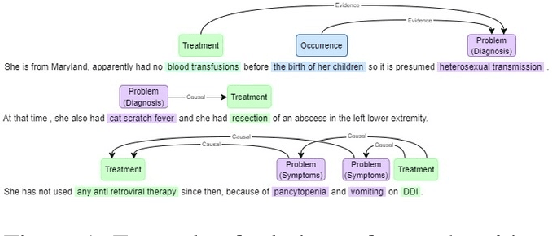

Biomedical named entity recognition (NER) is a critial task that aims to identify structured information in clinical text, which is often replete with complex, technical terms and a high degree of variability. Accurate and reliable NER can facilitate the extraction and analysis of important biomedical information, which can be used to improve downstream applications including the healthcare system. However, NER in the biomedical domain is challenging due to limited data availability, as the high expertise, time, and expenses are required to annotate its data. In this paper, by using the limited data, we explore various extrinsic factors including the corpus annotation scheme, data augmentation techniques, semi-supervised learning and Brill transformation, to improve the performance of a NER model on a clinical text dataset (i2b2 2012, \citet{sun-rumshisky-uzuner:2013}). Our experiments demonstrate that these approaches can significantly improve the model's F1 score from original 73.74 to 77.55. Our findings suggest that considering different extrinsic factors and combining these techniques is a promising approach for improving NER performance in the biomedical domain where the size of data is limited.