 Add to Chrome
 Add to Firefox
 Add to Edge
GraRe: Grasp Candidate Re-Ranking for Frozen 6-DoF Grasp Detectors
Aug 02, 2026
Existing 6-DoF grasp detectors typically rank grasp candidates by detector confidence. However, our analysis on GraspNet-1Billion shows that detector confidence is often poorly aligned with grasp quality, causing successful grasp candidates to be ranked too low during execution. Motivated by this observation, we formulate grasp candidate re-ranking as a separate task for frozen detectors, aiming to improve candidate ordering without changing the detector or its grasp candidates. We propose GraRe, which estimates grasp quality from candidate attributes, shell-stratified local geometry, and object context. Candidate attributes condition the local geometric and object-context representations, and a Transformer fuses all three feature types. The predicted quality is combined with detector confidence to produce the final ranking. Experiments on GraspNet-1Billion with three frozen detectors show consistent improvements, with gains of up to 13.60 points in Average AP. Real-robot experiments further demonstrate robust grasping in cluttered scenes. These results show that improving candidate ranking provides a practical way to enhance frozen 6-DoF grasp detectors.

Deep Collaborative Embedding for information cascade prediction
Jan 18, 2020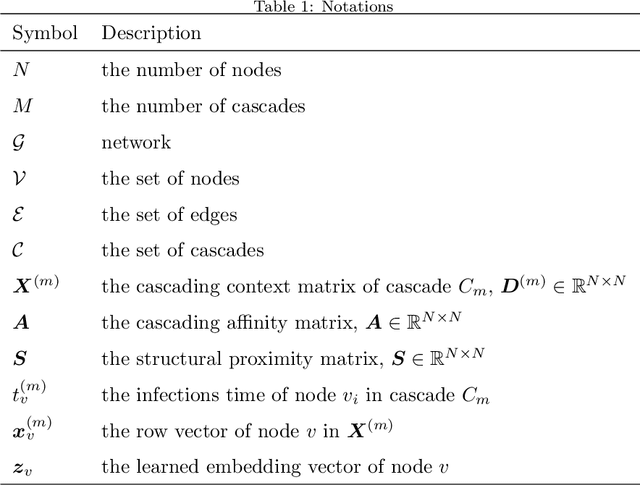
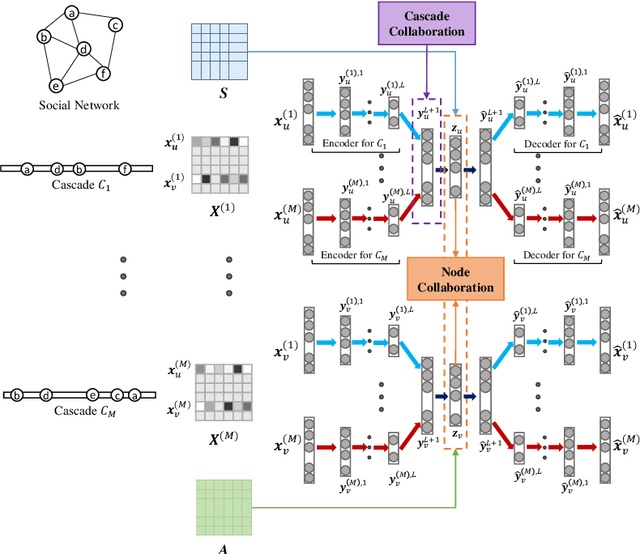
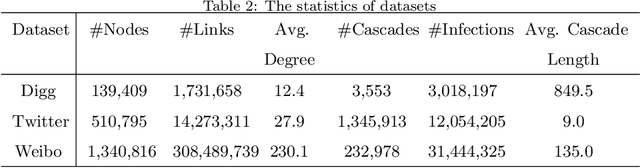
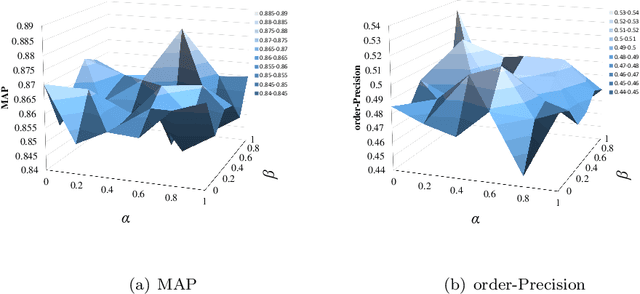
Recently, information cascade prediction has attracted increasing interest from researchers, but it is far from being well solved partly due to the three defects of the existing works. First, the existing works often assume an underlying information diffusion model, which is impractical in real world due to the complexity of information diffusion. Second, the existing works often ignore the prediction of the infection order, which also plays an important role in social network analysis. At last, the existing works often depend on the requirement of underlying diffusion networks which are likely unobservable in practice. In this paper, we aim at the prediction of both node infection and infection order without requirement of the knowledge about the underlying diffusion mechanism and the diffusion network, where the challenges are two-fold. The first is what cascading characteristics of nodes should be captured and how to capture them, and the second is that how to model the non-linear features of nodes in information cascades. To address these challenges, we propose a novel model called Deep Collaborative Embedding (DCE) for information cascade prediction, which can capture not only the node structural property but also two kinds of node cascading characteristics. We propose an auto-encoder based collaborative embedding framework to learn the node embeddings with cascade collaboration and node collaboration, in which way the non-linearity of information cascades can be effectively captured. The results of extensive experiments conducted on real-world datasets verify the effectiveness of our approach.