 Add to Chrome
 Add to Firefox
 Add to Edge
Diagnosing JEPA World Models with Action-Conditioned Predictive Consistency
Aug 13, 2026
Joint-embedding predictive architectures (JEPAs) learn world models that predict in a compact latent space rather than in pixels, reducing the pressure to model nuisance appearance. Yet this provides no guarantee against visual perturbations: they can still alter the encoded representation and affect subsequent action-conditioned predictions. Bisimulation captures this requirement precisely: two observations should be treated as the same state only when their action-conditioned consequences agree. Guided by this criterion, we introduce Action-Conditioned Predictive Consistency (ACPC), a diagnostic that measures how far a clean history and a visually perturbed view of it diverge after being rolled forward under the same action sequence. We prove that this divergence bounds the perturbation-induced change in multi-step prediction error and planner cost. Building on pairwise ACPC, we define two complementary measures: the Invariance Radius (IR) summarizes clean-perturbed rollout spread, while the Separation Rate (SR) checks whether different states remain distinguishable after rollout. Experiments on four visual control tasks show that pairwise ACPC predicts perturbation-induced prediction and cost changes. On LeWM, the IR-SR screen transfers across tasks, and the joint diagnostic remains informative under blur and resize. PLDM exhibits similar diagnostic trends under a different architecture.

MedGEN-Bench: Contextually entangled benchmark for open-ended multimodal medical generation
Nov 18, 2025As Vision-Language Models (VLMs) increasingly gain traction in medical applications, clinicians are progressively expecting AI systems not only to generate textual diagnoses but also to produce corresponding medical images that integrate seamlessly into authentic clinical workflows. Despite the growing interest, existing medical visual benchmarks present notable limitations. They often rely on ambiguous queries that lack sufficient relevance to image content, oversimplify complex diagnostic reasoning into closed-ended shortcuts, and adopt a text-centric evaluation paradigm that overlooks the importance of image generation capabilities. To address these challenges, we introduce MedGEN-Bench, a comprehensive multimodal benchmark designed to advance medical AI research. MedGEN-Bench comprises 6,422 expert-validated image-text pairs spanning six imaging modalities, 16 clinical tasks, and 28 subtasks. It is structured into three distinct formats: Visual Question Answering, Image Editing, and Contextual Multimodal Generation. What sets MedGEN-Bench apart is its focus on contextually intertwined instructions that necessitate sophisticated cross-modal reasoning and open-ended generative outputs, moving beyond the constraints of multiple-choice formats. To evaluate the performance of existing systems, we employ a novel three-tier assessment framework that integrates pixel-level metrics, semantic text analysis, and expert-guided clinical relevance scoring. Using this framework, we systematically assess 10 compositional frameworks, 3 unified models, and 5 VLMs.
Streaming Sparse Linear Regression
Nov 11, 2022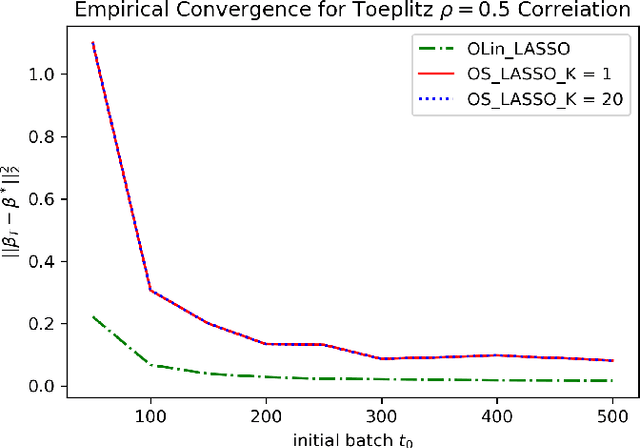
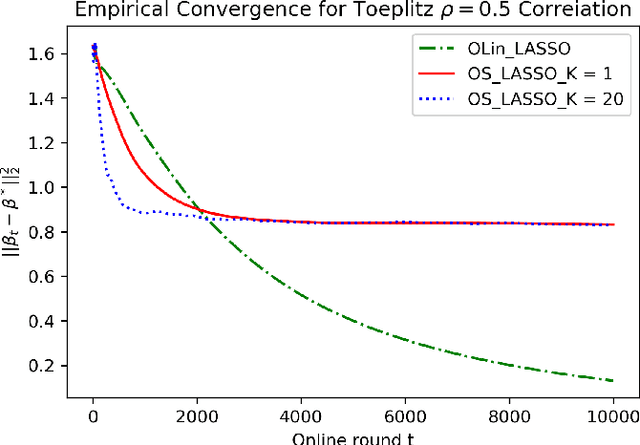
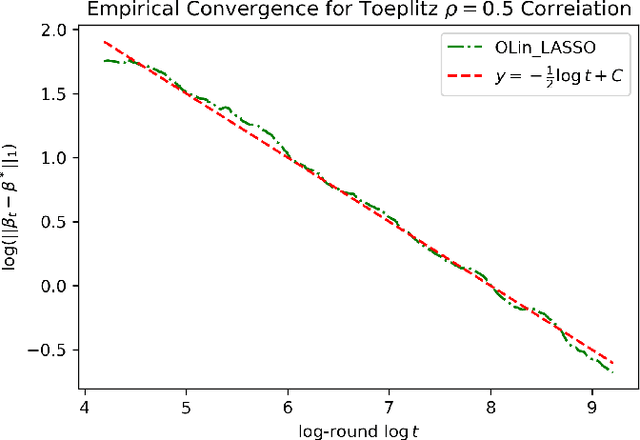
Sparse regression has been a popular approach to perform variable selection and enhance the prediction accuracy and interpretability of the resulting statistical model. Existing approaches focus on offline regularized regression, while the online scenario has rarely been studied. In this paper, we propose a novel online sparse linear regression framework for analyzing streaming data when data points arrive sequentially. Our proposed method is memory efficient and requires less stringent restricted strong convexity assumptions. Theoretically, we show that with a properly chosen regularization parameter, the $\ell_2$-norm statistical error of our estimator diminishes to zero in the optimal order of $\tilde{O}({\sqrt{s/t}})$, where $s$ is the sparsity level, $t$ is the streaming sample size, and $\tilde{O}(\cdot)$ hides logarithmic terms. Numerical experiments demonstrate the practical efficiency of our algorithm.