 Add to Chrome
 Add to Firefox
 Add to Edge
SAGE: An LLM-driven Self Reflective Agentic Framework for Fraud Detection
Jun 06, 2026
Fraud detection in payment, e-commerce, and telecommunications systems requires accuracy at the individual level, robustness under severe class imbalance, and ease of understanding for risk managers. Existing methods fall at least one of these requirements: automated machine learning systems search a fixed numerical space without semantic awareness of the dataset; graph neural network-based methods require pre-defined relational graphs and remain opaque at the individual-decision level; and the design of general-purpose large language model (LLM) agents does not consider the recall and precision constraints specific to real-world fraud detection. In this paper, we propose SAGE, the first end-to-end LLM-driven multi-agent framework for fraud detection. SAGE coordinates three dedicated agents that make decisions based on a six-layer Data Diagnostic Tree (DDT) and a Markov decision process guided by natural-language gradients, automatically optimizing the model under a fraud-specific reward. On five fraud datasets and five LLM backbones, SAGE wins $96.00\%$ of method--dataset comparisons and improves F1 by an average of $40.86\%$ over baselines. The code is available at https://github.com/yichenC1c/SAGE.

Light-Weight Fault Tolerant Attention for Large Language Model Training
Oct 15, 2024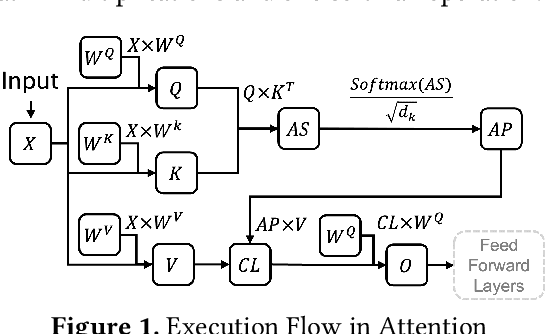
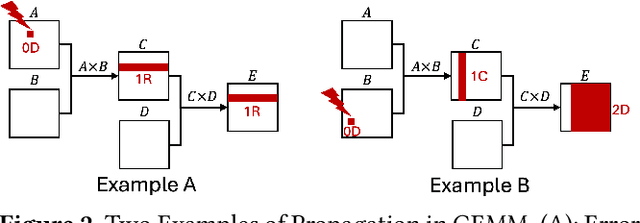
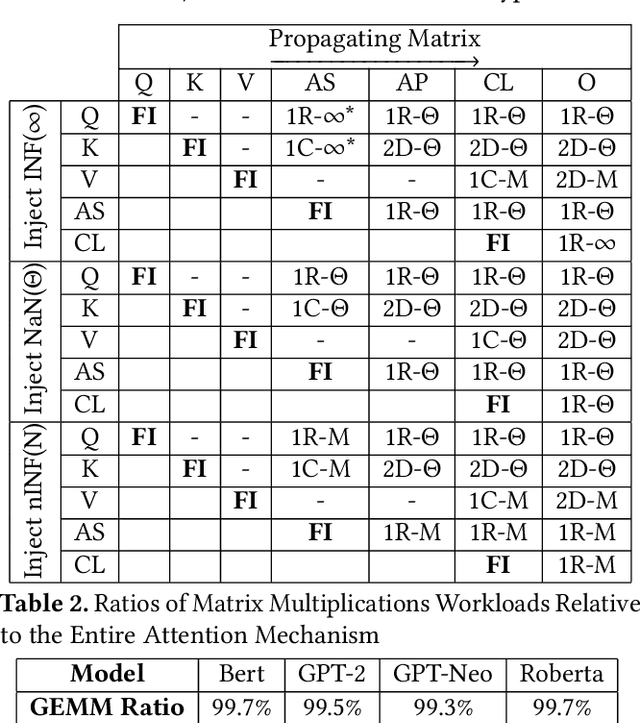
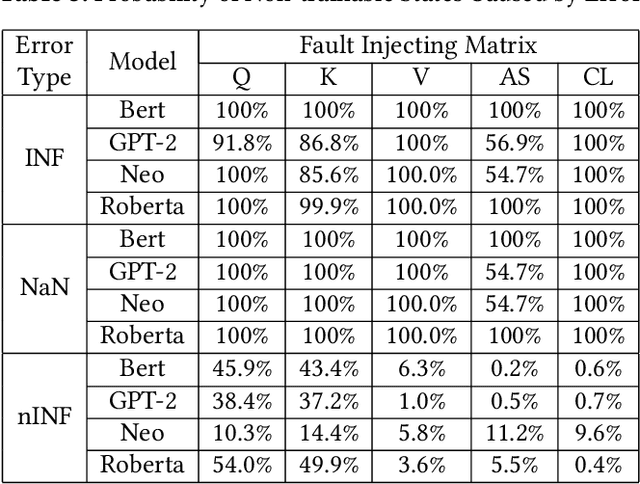
Large Language Models (LLMs) have demonstrated remarkable performance in various natural language processing tasks. However, the training of these models is computationally intensive and susceptible to faults, particularly in the attention mechanism, which is a critical component of transformer-based LLMs. In this paper, we investigate the impact of faults on LLM training, focusing on INF, NaN, and near-INF values in the computation results with systematic fault injection experiments. We observe the propagation patterns of these errors, which can trigger non-trainable states in the model and disrupt training, forcing the procedure to load from checkpoints.To mitigate the impact of these faults, we propose ATTNChecker, the first Algorithm-Based Fault Tolerance (ABFT) technique tailored for the attention mechanism in LLMs. ATTNChecker is designed based on fault propagation patterns of LLM and incorporates performance optimization to adapt to both system reliability and model vulnerability while providing lightweight protection for fast LLM training. Evaluations on four LLMs show that ATTNChecker on average incurs on average 7% overhead on training while detecting and correcting all extreme errors. Compared with the state-of-the-art checkpoint/restore approach, ATTNChecker reduces recovery overhead by up to 49x.