 Add to Chrome
 Add to Firefox
 Add to Edge
Generating Roadside LiDAR Datasets from Vehicle-Side Datasets via Novel View Synthesis
May 07, 2026
Intelligent Transportation Systems (ITS) require reliable environmental perception to support safe and efficient transportation. With the rapid development of Vehicle-to-everything (V2X), roadside perception has become an effective means to extend sensing coverage and improve traffic safety. However, the scarcity of large-scale annotated roadside LiDAR datasets poses a major challenge for training high-performance roadside perception models. In this paper, we introduce Vehicle-to-Roadside LiDAR Synthesis (VRS), a data synthesis framework that generates labeled roadside LiDAR datasets from vehicle-side datasets via LiDAR novel view synthesis. To mitigate the vehicle-to-roadside domain gap, VRS employs vehicle point cloud completion to compensate for missing geometry in vehicle-side observations, and introduces an occupancy-based visibility constraint to handle large viewpoint changes during cross-view rendering. The proposed framework enables flexible multi-view rendering for scalable roadside data generation. Extensive experiments on roadside 3D object detection demonstrate that the synthesized data effectively complements real roadside data, mitigates the limitations of limited real-world roadside data, and improves generalization to unseen roadside viewpoints.

Learn to Select: Exploring Label Distribution Divergence for In-Context Demonstration Selection in Text Classification
Nov 10, 2025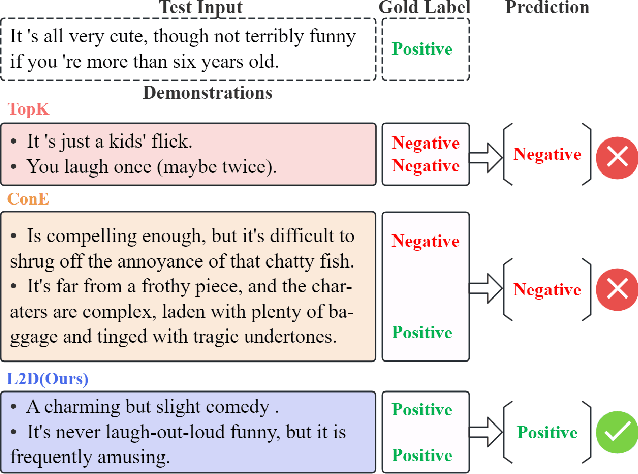
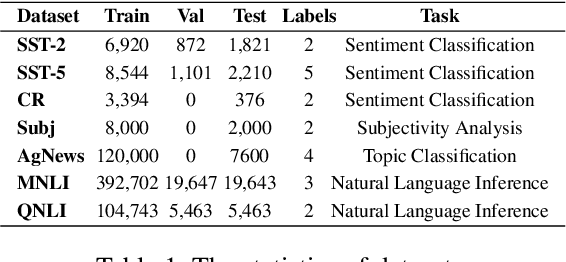
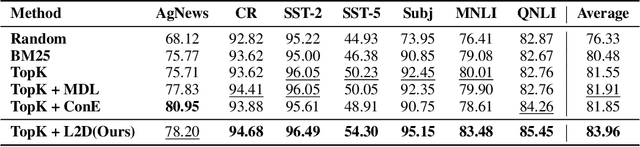
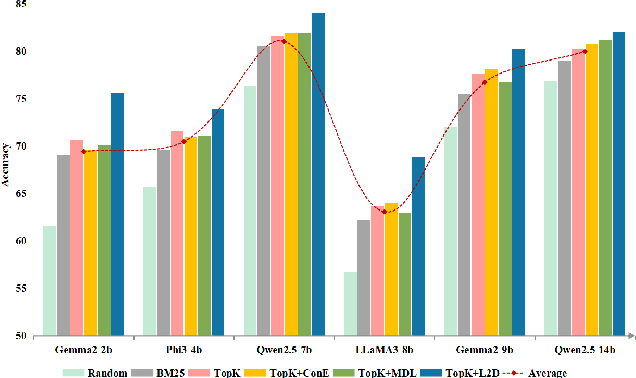
In-context learning (ICL) for text classification, which uses a few input-label demonstrations to describe a task, has demonstrated impressive performance on large language models (LLMs). However, the selection of in-context demonstrations plays a crucial role and can significantly affect LLMs' performance. Most existing demonstration selection methods primarily focus on semantic similarity between test inputs and demonstrations, often overlooking the importance of label distribution alignment. To address this limitation, we propose a two-stage demonstration selection method, TopK + Label Distribution Divergence (L2D), which leverages a fine-tuned BERT-like small language model (SLM) to generate label distributions and calculate their divergence for both test inputs and candidate demonstrations. This enables the selection of demonstrations that are not only semantically similar but also aligned in label distribution with the test input. Extensive experiments across seven text classification benchmarks show that our method consistently outperforms previous demonstration selection strategies. Further analysis reveals a positive correlation between the performance of LLMs and the accuracy of the underlying SLMs used for label distribution estimation.
Irony Detection, Reasoning and Understanding in Zero-shot Learning
Jan 28, 2025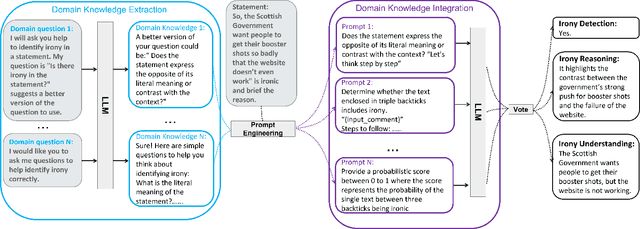

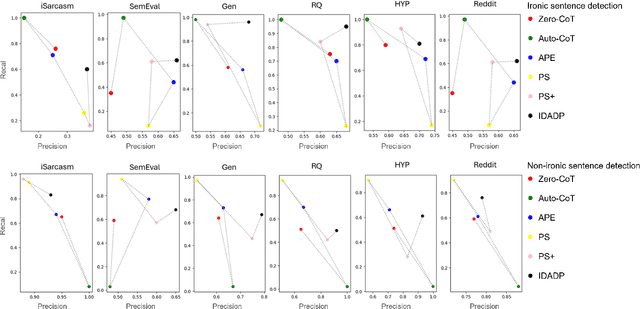
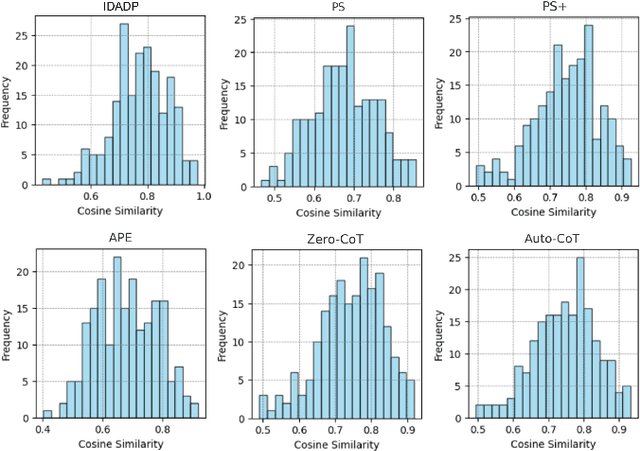
Irony is a powerful figurative language (FL) on social media that can potentially mislead various NLP tasks, such as recommendation systems, misinformation checks, and sentiment analysis. Understanding the implicit meaning of this kind of subtle language is essential to mitigate irony's negative impact on NLP tasks. However, building models to understand irony presents a unique set of challenges, because irony is a complex form of language that often relies on context, tone, and subtle cues to convey meaning that is opposite or different from the literal interpretation. Large language models, such as ChatGPT, are increasingly able to capture implicit and contextual information. In this study, we investigate the generalization, reasoning and understanding ability of ChatGPT on irony detection across six different genre irony detection datasets. Our findings suggest that ChatGPT appears to show an enhanced language understanding and reasoning ability. But it needs to be very careful in prompt engineering design. Thus, we propose a prompt engineering design framework IDADP to achieve higher irony detection accuracy, improved understanding of irony, and more effective explanations compared to other state-of-the-art ChatGPT zero-shot approaches. And ascertain via experiments that the practice generated under the framework is likely to be the promised solution to resolve the generalization issues of LLMs.
Augmenting emotion features in irony detection with Large language modeling
Apr 18, 2024This study introduces a novel method for irony detection, applying Large Language Models (LLMs) with prompt-based learning to facilitate emotion-centric text augmentation. Traditional irony detection techniques typically fall short due to their reliance on static linguistic features and predefined knowledge bases, often overlooking the nuanced emotional dimensions integral to irony. In contrast, our methodology augments the detection process by integrating subtle emotional cues, augmented through LLMs, into three benchmark pre-trained NLP models - BERT, T5, and GPT-2 - which are widely recognized as foundational in irony detection. We assessed our method using the SemEval-2018 Task 3 dataset and observed substantial enhancements in irony detection capabilities.
SensoryT5: Infusing Sensorimotor Norms into T5 for Enhanced Fine-grained Emotion Classification
Mar 22, 2024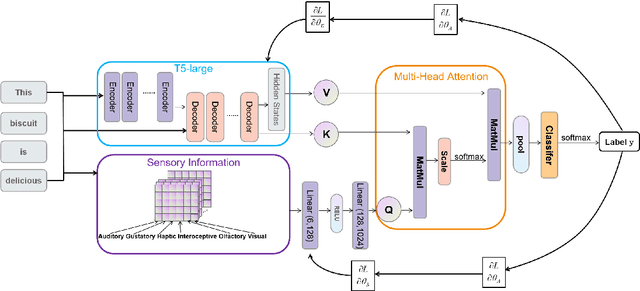
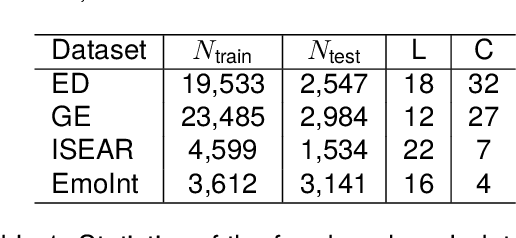

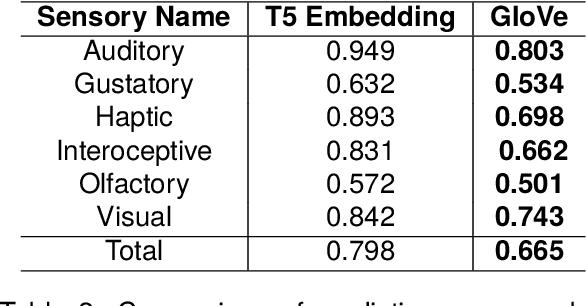
In traditional research approaches, sensory perception and emotion classification have traditionally been considered separate domains. Yet, the significant influence of sensory experiences on emotional responses is undeniable. The natural language processing (NLP) community has often missed the opportunity to merge sensory knowledge with emotion classification. To address this gap, we propose SensoryT5, a neuro-cognitive approach that integrates sensory information into the T5 (Text-to-Text Transfer Transformer) model, designed specifically for fine-grained emotion classification. This methodology incorporates sensory cues into the T5's attention mechanism, enabling a harmonious balance between contextual understanding and sensory awareness. The resulting model amplifies the richness of emotional representations. In rigorous tests across various detailed emotion classification datasets, SensoryT5 showcases improved performance, surpassing both the foundational T5 model and current state-of-the-art works. Notably, SensoryT5's success signifies a pivotal change in the NLP domain, highlighting the potential influence of neuro-cognitive data in refining machine learning models' emotional sensitivity.