 Add to Chrome
 Add to Firefox
 Add to Edge
Fishing Out Free Riders: Shapley-Based Reward Attribution for Parallel Reasoning via Reinforcement Learning
Jul 21, 2026
Large Language Models (LLMs) excel at multi-step reasoning, yet current parallel reasoning approaches often fail to distinguish the contributions of individual reasoning paths. Many paths may be redundant, misleading, or even detrimental, but outcome-level rewards assign uniform reward, leading to ambiguous learning signals and unstable training. We propose Parallel Shapley, a reinforcement learning framework that attributes fine-grained, path-level contributions in multi-path reasoning. Treating each path as a player in a cooperative game, we leverage Shapley values to quantify marginal contributions, using a generative reward model to evaluate path utilities and Monte Carlo sampling for efficient approximation. Experiments on mathematical reasoning benchmarks show that Parallel Shapley outperforms existing baselines while providing more stable and interpretable training. Our framework effectively "fishes out the free riders," assigning reward proportionally and improving multi-path reasoning in LLMs.

LT-DARTS: An Architectural Approach to Enhance Deep Long-Tailed Learning
Nov 13, 2024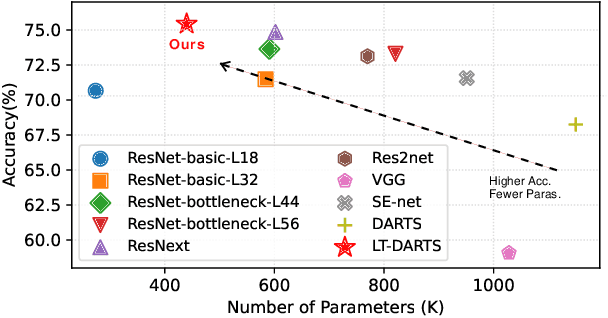
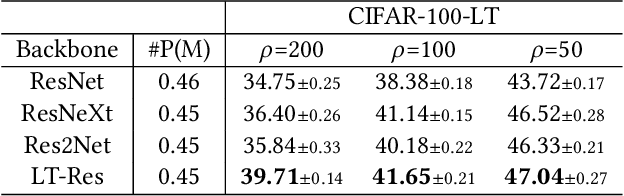
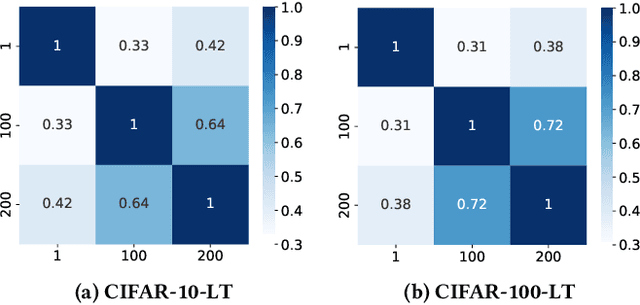
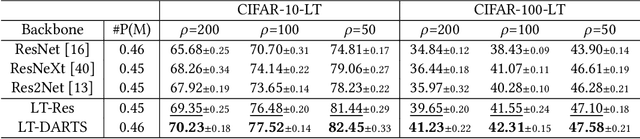
Deep long-tailed recognition has been widely studied to address the issue of imbalanced data distributions in real-world scenarios. However, there has been insufficient focus on the design of neural architectures, despite empirical evidence suggesting that architecture can significantly impact performance. In this paper, we attempt to mitigate long-tailed issues through architectural improvements. To simplify the design process, we utilize Differential Architecture Search (DARTS) to achieve this goal. Unfortunately, existing DARTS methods struggle to perform well in long-tailed scenarios. To tackle this challenge, we introduce Long-Tailed Differential Architecture Search (LT-DARTS). Specifically, we conduct extensive experiments to explore architectural components that demonstrate better performance on long-tailed data and propose a new search space based on our observations. This ensures that the architecture obtained through our search process incorporates superior components. Additionally, we propose replacing the learnable linear classifier with an Equiangular Tight Frame (ETF) classifier to further enhance our method. This classifier effectively alleviates the biased search process and prevents performance collapse. Extensive experimental evaluations demonstrate that our approach consistently improves upon existing methods from an orthogonal perspective and achieves state-of-the-art results with simple enhancements.