 Add to Chrome
 Add to Firefox
 Add to Edge
V-STC: A Time-Efficient Multi-Vehicle Coordinated Trajectory Planning Approach
Apr 24, 2026
Coordinating the motions of multiple autonomous vehicles (AVs) requires planning frameworks that ensure safety while making efficient use of space and time. This paper presents a new approach, termed variable-time-step spatio-temporal corridor (V-STC), that enhances the temporal efficiency of multi-vehicle coordination. An optimization model is formulated to construct a V-STC for each AV, in which both the spatial configuration of the corridor cubes and their time durations are treated as decision variables. By allowing the corridor's spatial position and time step to vary, the constructed V-STC reduces the overall temporal occupancy of each AV while maintaining collision-free separation in the spatio-temporal domain. Based on the generated V-STC, a dynamically feasible trajectory is then planned independently for each AV. Simulation studies demonstrate that the proposed method achieves safe multi-vehicle coordination and yields more time-efficient motion compared with existing STC approaches.

DiscreteCommunication and ControlUpdating in Event-Triggered Consensus
Oct 26, 2022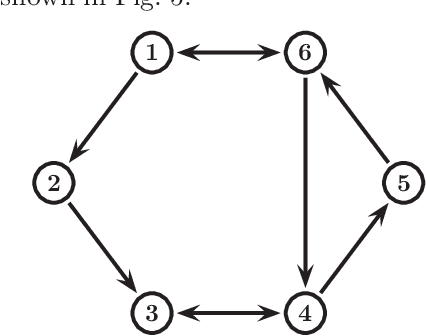
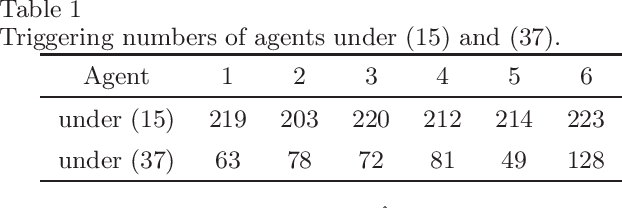
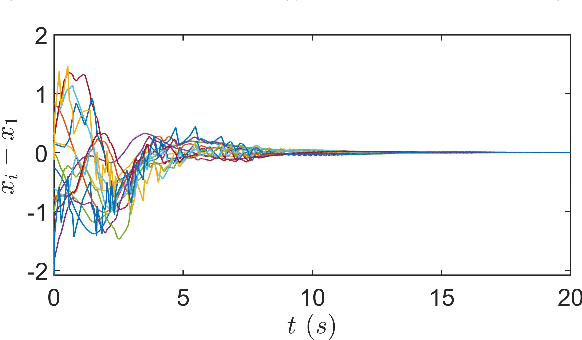
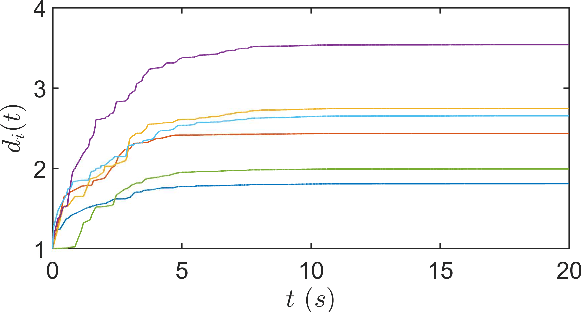
This paper studies the consensus control problem faced with three essential demands, namely, discrete control updating for each agent, discrete-time communications among neighboring agents, and the fully distributed fashion of the controller implementation without requiring any global information of the whole network topology. Noting that the existing related results only meeting one or two demands at most are essentially not applicable, in this paper we establish a novel framework to solve the problem of fully distributed consensus with discrete communication and control. The first key point in this framework is the design of controllers that are only updated at discrete event instants and do not depend on global information by introducing time-varying gains inspired by the adaptive control technique. Another key point is the invention of novel dynamic triggering functions that are independent of relative information among neighboring agents. Under the established framework, we propose fully distributed state-feedback event-triggered protocols for undirected graphs and also further study the more complexed cases of output-feedback control and directed graphs. Finally, numerical examples are provided to verify the effectiveness of the proposed event-triggered protocols.