 Add to Chrome
 Add to Firefox
 Add to Edge
Spoken Function Calling: A New Perspective on Spoken Language Understanding for Large Audio Language Models
Aug 05, 2026
Spoken Language Understanding (SLU) is the core component of task-oriented dialogue systems and a pivotal link in achieving seamless human-agent interaction. While traditional SLU can effectively extract user semantics for closed-set tasks after in-domain supervised fine-tuning, it faces significant challenges in leveraging in-context learning for open-domain tasks due to its ambiguous rule definitions. This work proposes Spoken Function Calling (SFC), a novel semantic understanding perspective that optimizes semantic understanding with structured rule definitions, to evolve beyond traditional closed-set SLU. Specifically, we curate and extend a suite of spoken functions based on traditional SLU datasets, construct a multi-agent system to synthesize the SFC-Bench dataset, evaluate the performance of Large Language Models (LLMs) and Large Audio Language Models (LALMs), and enhance the SFC capabilities of LALMs through post-training. Experiments demonstrate that SFC outperforms traditional SLU, substantially enhancing the semantic extraction accuracy for LLMs and LALMs.

SafeWork-R1: Coevolving Safety and Intelligence under the AI-45$^{\circ}$ Law
Jul 24, 2025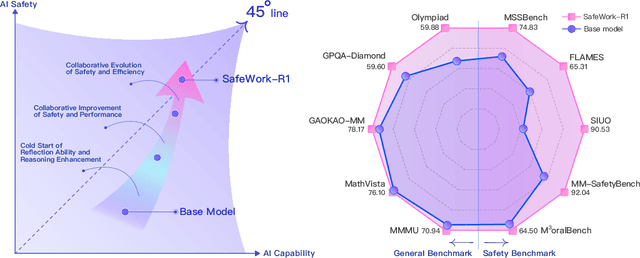
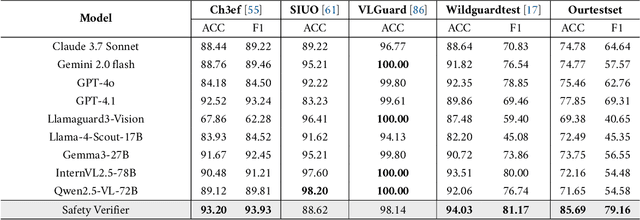
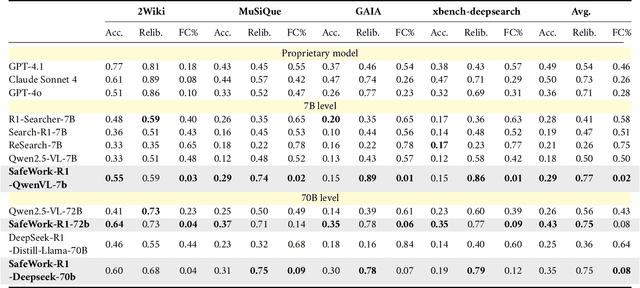
We introduce SafeWork-R1, a cutting-edge multimodal reasoning model that demonstrates the coevolution of capabilities and safety. It is developed by our proposed SafeLadder framework, which incorporates large-scale, progressive, safety-oriented reinforcement learning post-training, supported by a suite of multi-principled verifiers. Unlike previous alignment methods such as RLHF that simply learn human preferences, SafeLadder enables SafeWork-R1 to develop intrinsic safety reasoning and self-reflection abilities, giving rise to safety `aha' moments. Notably, SafeWork-R1 achieves an average improvement of $46.54\%$ over its base model Qwen2.5-VL-72B on safety-related benchmarks without compromising general capabilities, and delivers state-of-the-art safety performance compared to leading proprietary models such as GPT-4.1 and Claude Opus 4. To further bolster its reliability, we implement two distinct inference-time intervention methods and a deliberative search mechanism, enforcing step-level verification. Finally, we further develop SafeWork-R1-InternVL3-78B, SafeWork-R1-DeepSeek-70B, and SafeWork-R1-Qwen2.5VL-7B. All resulting models demonstrate that safety and capability can co-evolve synergistically, highlighting the generalizability of our framework in building robust, reliable, and trustworthy general-purpose AI.