 Add to Chrome
 Add to Firefox
 Add to Edge
JoyAI-LLM Flash: Advancing Mid-Scale LLMs with Token Efficiency
Apr 03, 2026
We introduce JoyAI-LLM Flash, an efficient Mixture-of-Experts (MoE) language model designed to redefine the trade-off between strong performance and token efficiency in the sub-50B parameter regime. JoyAI-LLM Flash is pretrained on a massive corpus of 20 trillion tokens and further optimized through a rigorous post-training pipeline, including supervised fine-tuning (SFT), Direct Preference Optimization (DPO), and large-scale reinforcement learning (RL) across diverse environments. To improve token efficiency, JoyAI-LLM Flash strategically balances \emph{thinking} and \emph{non-thinking} cognitive modes and introduces FiberPO, a novel RL algorithm inspired by fibration theory that decomposes trust-region maintenance into global and local components, providing unified multi-scale stability control for LLM policy optimization. To enhance architectural sparsity, the model comprises 48B total parameters while activating only 2.7B parameters per forward pass, achieving a substantially higher sparsity ratio than contemporary industry leading models of comparable scale. To further improve inference throughput, we adopt a joint training-inference co-design that incorporates dense Multi-Token Prediction (MTP) and Quantization-Aware Training (QAT). We release the checkpoints for both JoyAI-LLM-48B-A3B Base and its post-trained variants on Hugging Face to support the open-source community.

PYRA: Parallel Yielding Re-Activation for Training-Inference Efficient Task Adaptation
Mar 14, 2024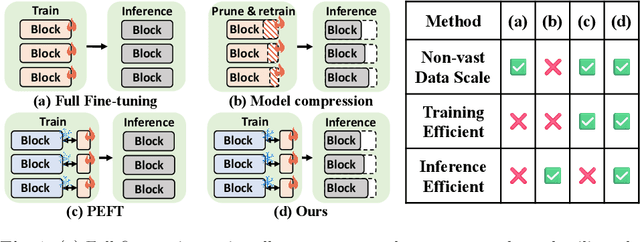
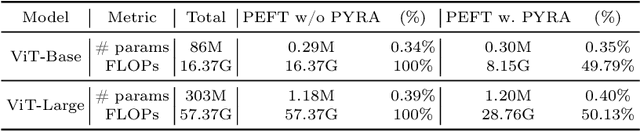
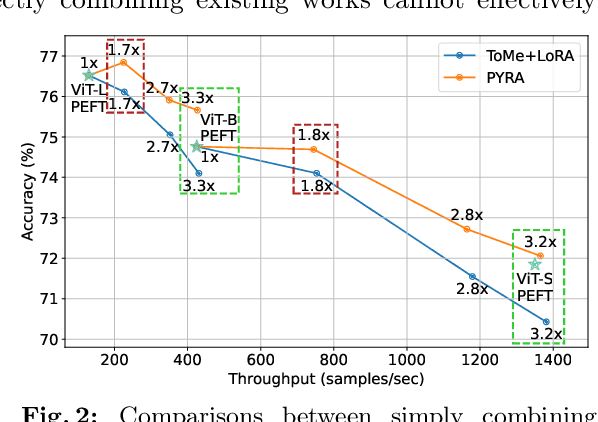
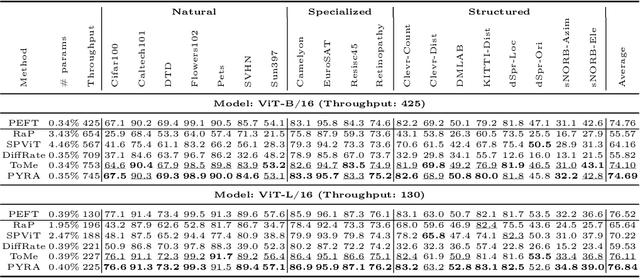
Recently, the scale of transformers has grown rapidly, which introduces considerable challenges in terms of training overhead and inference efficiency in the scope of task adaptation. Existing works, namely Parameter-Efficient Fine-Tuning (PEFT) and model compression, have separately investigated the challenges. However, PEFT cannot guarantee the inference efficiency of the original backbone, especially for large-scale models. Model compression requires significant training costs for structure searching and re-training. Consequently, a simple combination of them cannot guarantee accomplishing both training efficiency and inference efficiency with minimal costs. In this paper, we propose a novel Parallel Yielding Re-Activation (PYRA) method for such a challenge of training-inference efficient task adaptation. PYRA first utilizes parallel yielding adaptive weights to comprehensively perceive the data distribution in downstream tasks. A re-activation strategy for token modulation is then applied for tokens to be merged, leading to calibrated token features. Extensive experiments demonstrate that PYRA outperforms all competing methods under both low compression rate and high compression rate, demonstrating its effectiveness and superiority in maintaining both training efficiency and inference efficiency for large-scale foundation models. Our code will be released to the public.