 Add to Chrome
 Add to Firefox
 Add to Edge
Towards Training-free Multimodal Hate Localisation with Large Language Models
Feb 10, 2026
The proliferation of hateful content in online videos poses severe threats to individual well-being and societal harmony. However, existing solutions for video hate detection either rely heavily on large-scale human annotations or lack fine-grained temporal precision. In this work, we propose LELA, the first training-free Large Language Model (LLM) based framework for hate video localization. Distinct from state-of-the-art models that depend on supervised pipelines, LELA leverages LLMs and modality-specific captioning to detect and temporally localize hateful content in a training-free manner. Our method decomposes a video into five modalities, including image, speech, OCR, music, and video context, and uses a multi-stage prompting scheme to compute fine-grained hateful scores for each frame. We further introduce a composition matching mechanism to enhance cross-modal reasoning. Experiments on two challenging benchmarks, HateMM and MultiHateClip, demonstrate that LELA outperforms all existing training-free baselines by a large margin. We also provide extensive ablations and qualitative visualizations, establishing LELA as a strong foundation for scalable and interpretable hate video localization.

Conversational Recommendation System with Unsupervised Learning
Sep 22, 2016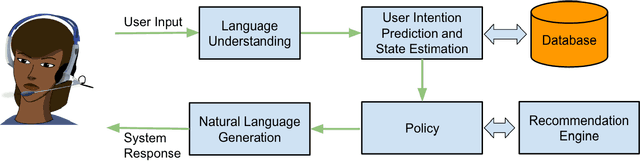
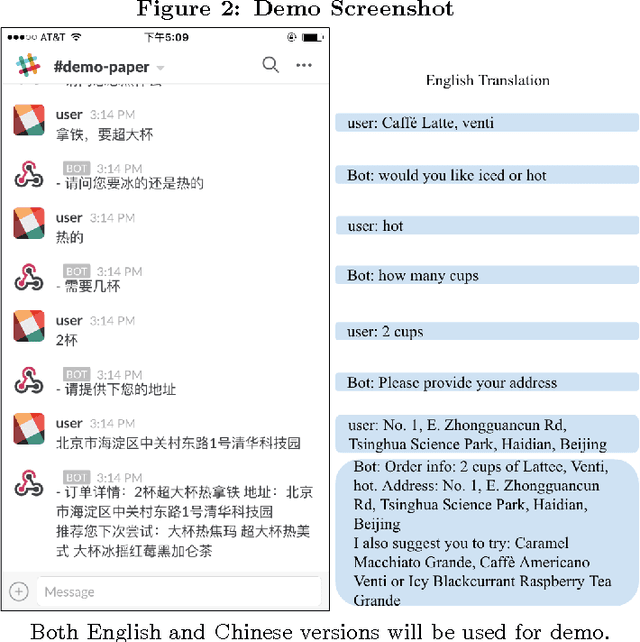
We will demonstrate a conversational products recommendation agent. This system shows how we combine research in personalized recommendation systems with research in dialogue systems to build a virtual sales agent. Based on new deep learning technologies we developed, the virtual agent is capable of learning how to interact with users, how to answer user questions, what is the next question to ask, and what to recommend when chatting with a human user. Normally a descent conversational agent for a particular domain requires tens of thousands of hand labeled conversational data or hand written rules. This is a major barrier when launching a conversation agent for a new domain. We will explore and demonstrate the effectiveness of the learning solution even when there is no hand written rules or hand labeled training data.
Towards Evidence-Based Ontology for Supporting Systematic Literature Review
Sep 22, 2016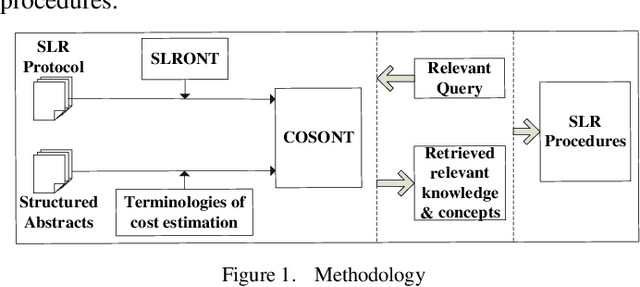
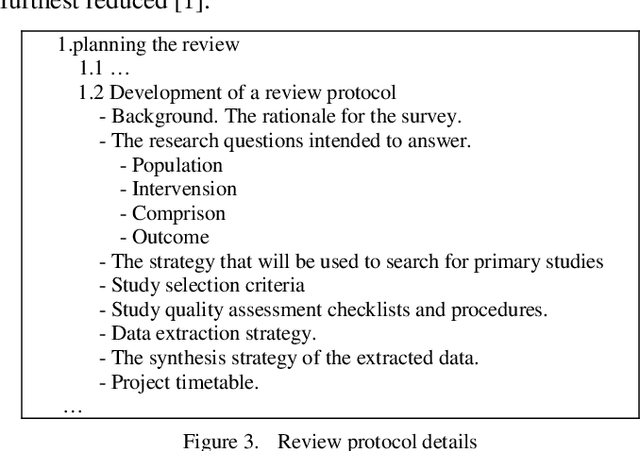
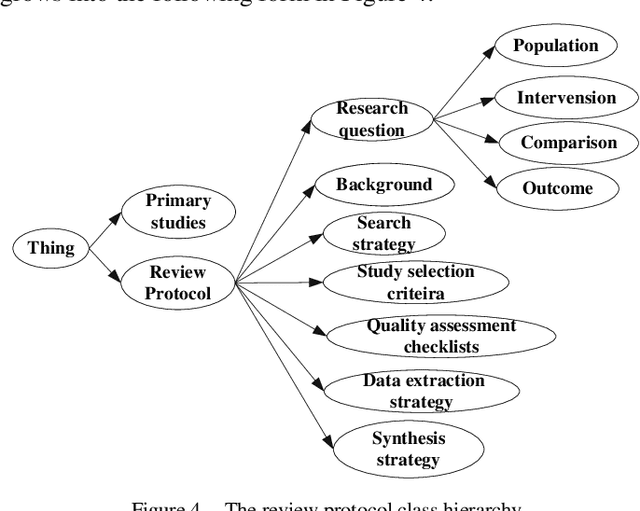
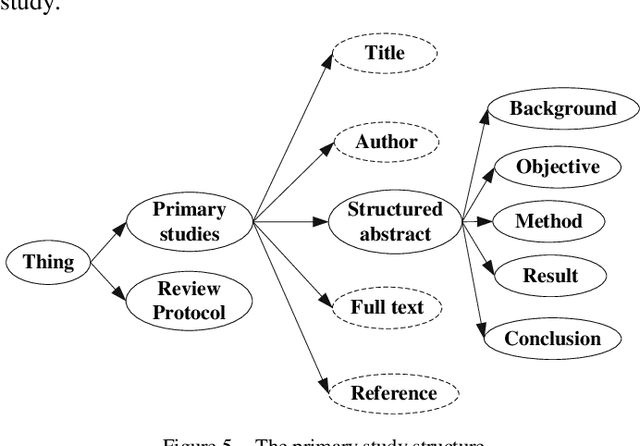
[Background]: Systematic Literature Review (SLR) has become an important software engineering research method but costs tremendous efforts. [Aim]: This paper proposes an approach to leverage on empirically evolved ontology to support automating key SLR activities. [Method]: First, we propose an ontology, SLRONT, built on SLR experiences and best practices as a groundwork to capture common terminologies and their relationships during SLR processes; second, we present an extended version of SLRONT, the COSONT and instantiate it with the knowledge and concepts extracted from structured abstracts. Case studies illustrate the details of applying it for supporting SLR steps. [Results]: Results show that through using COSONT, we acquire the same conclusion compared with sheer manual works, but the efforts involved is significantly reduced. [Conclusions]: The approach of using ontology could effectively and efficiently support the conducting of systematic literature review.