 Add to Chrome
 Add to Firefox
 Add to Edge
Text Analytics Evaluation Framework: A Case Study on LLMs and Social Media
May 20, 2026
LLMs have demonstrated exceptional proficiency in a wide range of NLP tasks. However, a notable gap remains in practical data analysis scenarios, particularly when LLMs are required to process long sequences of unstructured documents, such as news feeds or, as specifically addressed in this paper, social media posts. To empirically assess the effectiveness of LLMs in this setting, we introduce a question-based evaluation framework comprising 470 manually curated questions designed to evaluate LLMs' semantic understanding and reasoning abilities over aggregated text data. We apply our benchmark on diverse Twitter datasets covering various NLP tasks, including sentiment analysis, hate speech detection, and emotion recognition. Our results reveal that the performance depends heavily on input scale and the complexity of the data sources, declining noticeably in multi-label or target-dependent scenarios. In addition, as task complexity increases, performance drops progressively from basic semantic existence identification to more demanding operations such as comparison, counting, and calculation. Furthermore, as the input size grows beyond 500 instances, we identify a common limitation across LLMs, particularly Open-weights models: performance degrades substantially, especially on numerical tasks. These findings highlight critical architectural bottlenecks in current LLMs for performing rigorous quantitative analysis over large text collections.

Exploiting Sentiment and Common Sense for Zero-shot Stance Detection
Aug 18, 2022
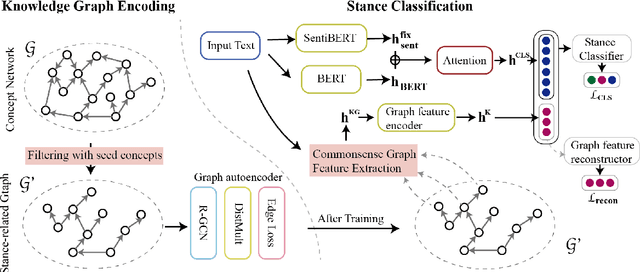
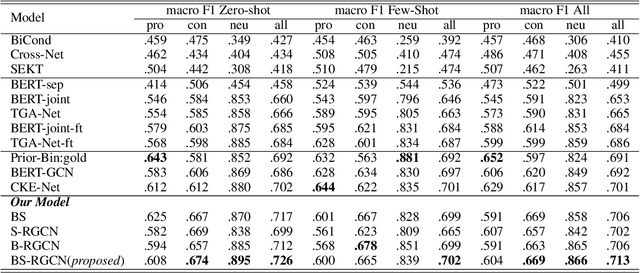
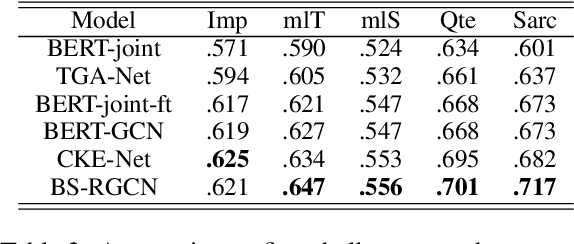
The stance detection task aims to classify the stance toward given documents and topics. Since the topics can be implicit in documents and unseen in training data for zero-shot settings, we propose to boost the transferability of the stance detection model by using sentiment and commonsense knowledge, which are seldom considered in previous studies. Our model includes a graph autoencoder module to obtain commonsense knowledge and a stance detection module with sentiment and commonsense. Experimental results show that our model outperforms the state-of-the-art methods on the zero-shot and few-shot benchmark dataset--VAST. Meanwhile, ablation studies prove the significance of each module in our model. Analysis of the relations between sentiment, common sense, and stance indicates the effectiveness of sentiment and common sense.
A Pilot Study for Chinese SQL Semantic Parsing
Oct 16, 2019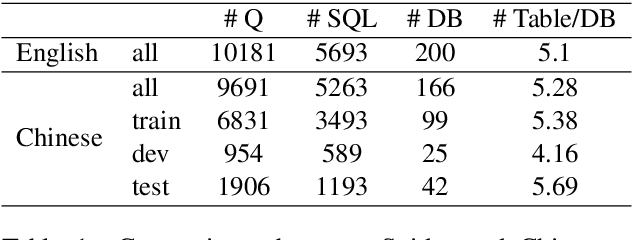
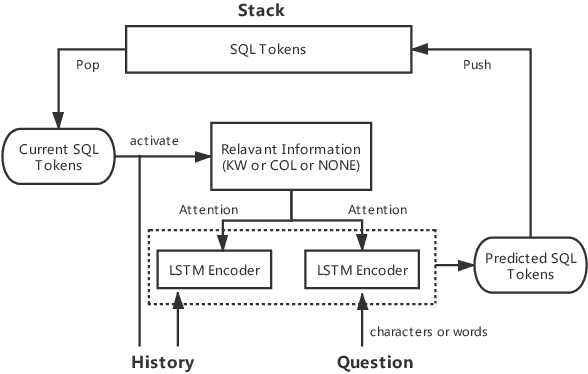
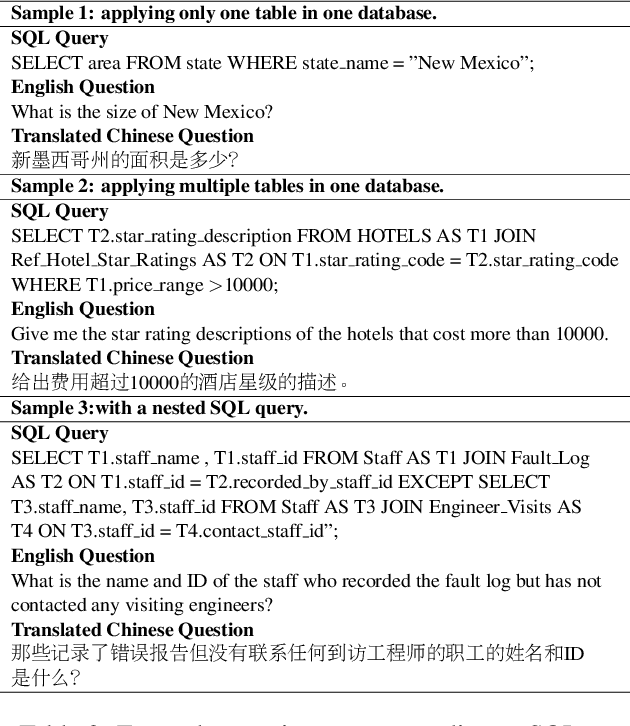
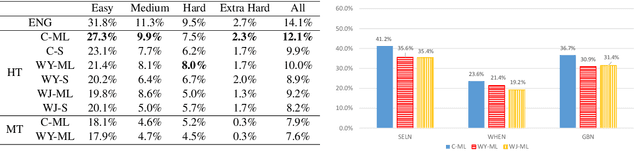
The task of semantic parsing is highly useful for dialogue and question answering systems. Many datasets have been proposed to map natural language text into SQL, among which the recent Spider dataset provides cross-domain samples with multiple tables and complex queries. We build a Spider dataset for Chinese, which is currently a low-resource language in this task area. Interesting research questions arise from the uniqueness of the language, which requires word segmentation, and also from the fact that SQL keywords and columns of DB tables are typically written in English. We compare character- and word-based encoders for a semantic parser, and different embedding schemes. Results show that word-based semantic parser is subject to segmentation errors and cross-lingual word embeddings are useful for text-to-SQL.