 Add to Chrome
 Add to Firefox
 Add to Edge
FM-LLM: A frequency-enhanced mixture-of-experts framework for adapting LLMs to time series forecasting
Aug 12, 2026
Recent advances in Large Language Models (LLMs) have spurred cross-modal solutions for time-series forecasting. However, existing methods rely heavily on textual prompts for modality alignment-introducing nontrivial computational overhead and failing to leverage the rich spectral dynamics inherent in time-series data. To enable prompt-free, frequency-aware adaptation of frozen LLMs, we propose FM-LLM (Frequency-Enhanced Mixture-of-Experts for adapting LLMs to Time Series Forecasting), an autoregressive framework grounded in constrained asymmetric coupling. A Fourier Analysis Network (FAN)-based spectral token aligner injects structured harmonic representations directly into the frozen LLM with numerical compatibility. An asymmetric Mixture-of-Experts (MoE) decoder enforces role separation: shared experts with lightweight FAN layers reconstruct the global periodic backbone, while routed experts-restricted to standard FFNs-specialize in modeling non-periodic residual dynamics. A time-frequency hybrid loss function jointly optimizes temporal accuracy and spectral consistency, mitigating error accumulation during long-horizon autoregressive rollouts. Evaluated across eleven public benchmarks, FM-LLM achieves state-of-the-art performance on 59 out of 78 evaluation metrics. Compared to the strongest autoregressive LLM-based baseline, it delivers average improvements of 5.3% in MSE and 5.6% in MAE, with maximum gains reaching 8.0% for MSE and 8.4% for MAE. FM-LLM also demonstrates robust transferability, maintaining superior performance in 10% few-shot and zero-shot forecasting scenarios.

Link-adaptive digital twin for robust physical-layer modeling in hybrid-amplified ultra-wideband optical networks
Aug 11, 2026Accurate physical-layer modeling is increasingly essential for reliable ultra-wideband operation and capacity optimization, especially under the intensified inter-channel stimulated Raman scattering (ISRS) effect. This paper proposes the link-adaptive digital twin (LA-DT) for hybrid-amplified ultra-wideband links to overcome the generalization and speed limitations of existing methods, achieving accurate modeling and robust generalized signal-to-noise ratio (GSNR) estimation across diverse links. First, to address EDFA heterogeneity, the GSNR modeling task is decomposed into three key power predictions: ASE, NLI, and signal powers before EDFA entry. Second, to enhance cross-scenario generalization, three dedicated DT models are developed using a novel neural architecture with linear modulation layers (LMLs). Third, for rapid adaptation to unseen scenarios with limited data, three domain discriminators guide few-shot fine-tuning of the LMLs. Fourth, the LA-DT explicitly accounts for Raman amplifier (RA) insertion loss, improving practical deployment reliability. Results across 35 scenarios show that LA-DT reduces RMSE for NLI, ASE, and signal power predictions to 0.151, 0.111, and 0.113 dBm with improvements of 56.0%, 58.4%, and 52.7% over the baseline,and achieves an average GSNR estimation RMSE of 0.114 dBm (55.8% improvement). For 12 unseen scenarios, the LA-DT maintains high accuracy through few-shot fine-tuning with only 20 samples per scenario, achieving an average GSNR RMSE of 0.159 dB and demonstrating strong adaptability and robustness.
Machine Learning for Intelligent Optical Networks: A Comprehensive Survey
Mar 11, 2020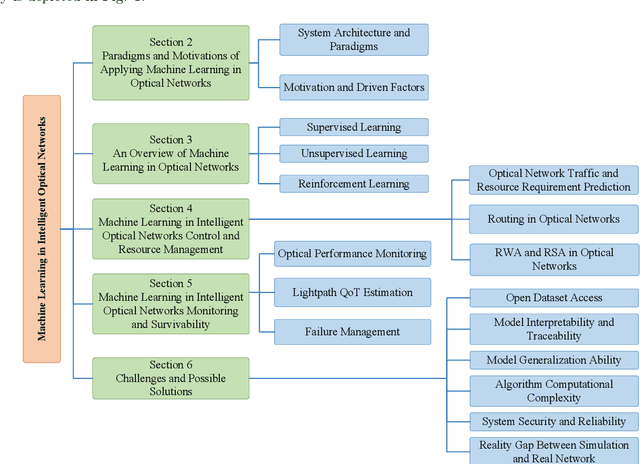
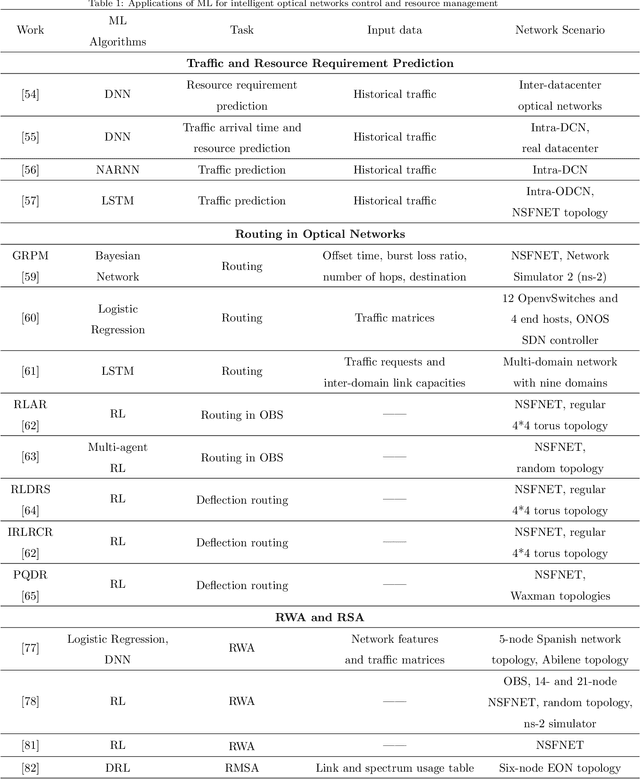
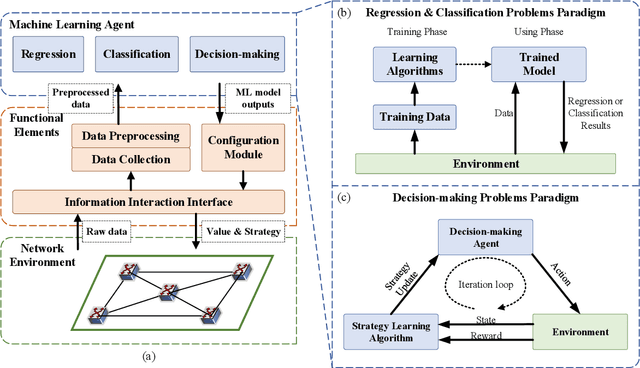
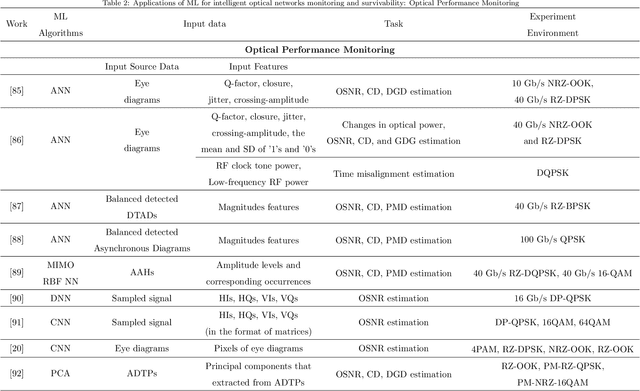
With the rapid development of Internet and communication systems, both in services and technologies, communication networks have been suffering increasing complexity. It is imperative to improve intelligence in communication network, and several aspects have been incorporating with Artificial Intelligence (AI) and Machine Learning (ML). Optical network, which plays an important role both in core and access network in communication networks, also faces great challenges of system complexity and the requirement of manual operations. To overcome the current limitations and address the issues of future optical networks, it is essential to deploy more intelligence capability to enable autonomous and exible network operations. ML techniques are proved to have superiority on solving complex problems; and thus recently, ML techniques have been used for many optical network applications. In this paper, a detailed survey of existing applications of ML for intelligent optical networks is presented. The applications of ML are classified in terms of their use cases, which are categorized into optical network control and resource management, and optical networks monitoring and survivability. The use cases are analyzed and compared according to the used ML techniques. Besides, a tutorial for ML applications is provided from the aspects of the introduction of common ML algorithms, paradigms of ML, and motivations of applying ML. Lastly, challenges and possible solutions of ML application in optical networks are also discussed, which intends to inspire future innovations in leveraging ML to build intelligent optical networks.