 Add to Chrome
 Add to Firefox
 Add to Edge
M-CTX: Exact and Scalable Spatial Context Retrieval for Trajectory Analytics
Jun 13, 2026
Modern trajectory predictors increasingly condition on external spatial context, such as map geometry, signed distance fields (SDFs), and nearby moving agents. While this context improves prediction quality, constructing it for every training anchor has become a hidden systems bottleneck. In a representative maritime AIS pipeline, spatial context construction requires roughly 17 CPU-days for a 5.48M-anchor corpus, dominating the cost of the downstream predictor. We present M-CTX, an exact and scalable spatial context-retrieval framework for trajectory analytics. M-CTX recasts context construction as an ingest-once, query-many spatial database workload and replaces three brute-force stages -- OSM range retrieval, SDF computation, and moving-vessel neighbour lookup -- with composable, index-backed operators. Its learned range-index backend, BR-LZ, provides recall-complete MBR-overlap range retrieval and reduces candidate amplification by 1.1x--2.7x relative to global-expansion one-curve baselines. Across four maritime regions, eight baseline systems, synthetic workloads with up to 40M spatial features, and 10^7-record AIS streams, M-CTX reproduces the reference context exactly. On the 5.48M-anchor corpus, it reduces context construction from about 17 CPU-days to 1.8 hours, a measured 226x end-to-end speed-up. An optional storage mode further compresses SDF context by 64x with only a 0.04 m ADE change. These results establish exact spatial context retrieval as a first-class database problem in modern trajectory analytics. Code and datasets are publicly available at https://github.com/mark000071/M-CTX-Traj.

Learning from Loss Landscape: Generalizable Mixed-Precision Quantization via Adaptive Sharpness-Aware Gradient Aligning
May 08, 2025Mixed Precision Quantization (MPQ) has become an essential technique for optimizing neural network by determining the optimal bitwidth per layer. Existing MPQ methods, however, face a major hurdle: they require a computationally expensive search for quantization policies on large-scale datasets. To resolve this issue, we introduce a novel approach that first searches for quantization policies on small datasets and then generalizes them to large-scale datasets. This approach simplifies the process, eliminating the need for large-scale quantization fine-tuning and only necessitating model weight adjustment. Our method is characterized by three key techniques: sharpness-aware minimization for enhanced quantization generalization, implicit gradient direction alignment to handle gradient conflicts among different optimization objectives, and an adaptive perturbation radius to accelerate optimization. Both theoretical analysis and experimental results validate our approach. Using the CIFAR10 dataset (just 0.5\% the size of ImageNet training data) for MPQ policy search, we achieved equivalent accuracy on ImageNet with a significantly lower computational cost, while improving efficiency by up to 150% over the baselines.
One-Step Forward and Backtrack: Overcoming Zig-Zagging in Loss-Aware Quantization Training
Jan 30, 2024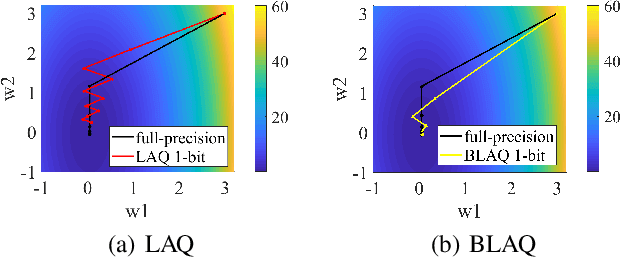

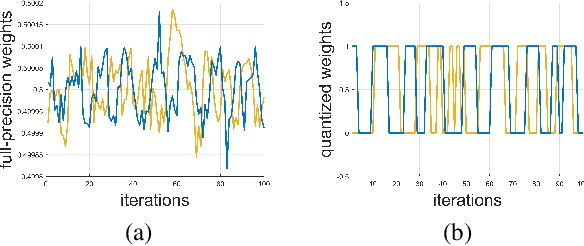
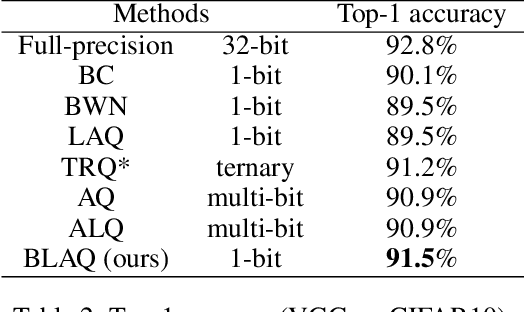
Weight quantization is an effective technique to compress deep neural networks for their deployment on edge devices with limited resources. Traditional loss-aware quantization methods commonly use the quantized gradient to replace the full-precision gradient. However, we discover that the gradient error will lead to an unexpected zig-zagging-like issue in the gradient descent learning procedures, where the gradient directions rapidly oscillate or zig-zag, and such issue seriously slows down the model convergence. Accordingly, this paper proposes a one-step forward and backtrack way for loss-aware quantization to get more accurate and stable gradient direction to defy this issue. During the gradient descent learning, a one-step forward search is designed to find the trial gradient of the next-step, which is adopted to adjust the gradient of current step towards the direction of fast convergence. After that, we backtrack the current step to update the full-precision and quantized weights through the current-step gradient and the trial gradient. A series of theoretical analysis and experiments on benchmark deep models have demonstrated the effectiveness and competitiveness of the proposed method, and our method especially outperforms others on the convergence performance.