 Add to Chrome
 Add to Firefox
 Add to Edge
Heterogeneity-Aware Deep Learning for Tumour Classification from Multiparametric MRI
Aug 18, 2026
Intra-tumoural heterogeneity (ITH) reflects spatial variation in tumour biology and is an important determinant of tumour behaviour, prognosis, and treatment response. Radiomics and deep learning have shown promise for tumour classification from multiparametric MRI (mp-MRI), but radiomics relies on handcrafted features, while most deep learning methods use whole-tumour representations or manually defined sub-regions, limiting scalable modelling of tumour heterogeneity. We propose a Heterogeneity-Aware Deep Learning Classification (HA-DLC) framework that explicitly models imaging-derived tumour sub-regions for lesion-type diagnosis and molecular-status prediction. HA-DLC consists of: (1) a Heterogeneous Sub-region Generation (HSG) module that produces initial pseudo-labelled sub-regions via unsupervised clustering, followed by Cross-Patient Sub-region Alignment (CPSA), which maps cluster-derived regions to a shared label space using soft assignments; and (2) a Dual-Stream Feature Extraction (DSFE) module that integrates local heterogeneity-aware features with global tumour representations. Given the initial clustering masks, CPSA, segmentation, feature extraction, and classification are jointly optimized end-to-end using soft-target segmentation and classification objectives. We evaluate HA-DLC on the LLD-MMRI2023 liver lesion dataset and the RSNA-ASNR-MICCAI 2021 Radiogenomic Brain Tumour dataset. HA-DLC consistently outperforms state-of-the-art radiomics and deep learning baselines, demonstrating the value of cross-patient sub-region alignment and dual-stream heterogeneity modelling for tumour classification from mp-MRI.

SeFoRA: Sketch-Aggregated Federated Low-Rank Adaptation with Heterogeneous Client Ranks
Aug 10, 2026We consider federated parameter efficient fine-tuning of large neural networks with low-rank adaptation (LoRA,~Hu et al.\ 2022). Combining LoRA with federated PEFT introduces challenges absent from either setting alone: clients may use different LoRA ranks, making their factor matrices dimension-incompatible, and factor-wise averaging suffers from a bilinear mismatch. We propose SeFoRA, a sketch-aggregated federated LoRA algorithm in which each client transmits a linear sketch of its local updates, enabling direct aggregation at the federator. As a result, SeFoRA alleviates the bilinear mismatch, and allows for aggregation in a small subspace of the full model. We introduce a rank-homogeneous version called SeFoRA-Ho which allows for direct adapter aggregation in this setting. We prove convergence to a neighborhood of the first-order stationary point at rate $\cO(1/T)$ for the rank-homogeneous setting. Numerical experiments on fine-tuning RoBERTa-Large on GLUE datasets show how our algorithms outperform the state-of-the-art.
EvolveNav: Proactive Preflection and Self-Evolving Memory for Zero-Shot Object Goal Navigation
Jun 16, 2026Zero-Shot Object-Goal Navigation (ZS-OGN) requires embodied agents to explore and locate target objects without any prior training. To this end, recent methods leverage foundation models. But they typically rely on static priors and lack adaptation, which leads to repeated errors and costly trial and error. In this paper, we propose a self-evolving ZS-OGN framework that enables continuous test-time improvement. Specifically, we build an agentic rule memory by extracting actionable knowledge from past trajectories. Then, we propose a retrieval strategy based on upper confidence bound, selecting effective rules by balancing semantic relevance and historical success. In addition, we introduce a memory-guided preflection module that forecasts potential outcomes before action, reducing inefficient exploration. Extensive experiments show that our method outperforms existing zero-shot baselines, achieving a 10.1\% improvement in success rate with fewer unnecessary steps.
Perfect Privacy for Discriminator-Based Byzantine-Resilient Federated Learning
Jun 16, 2025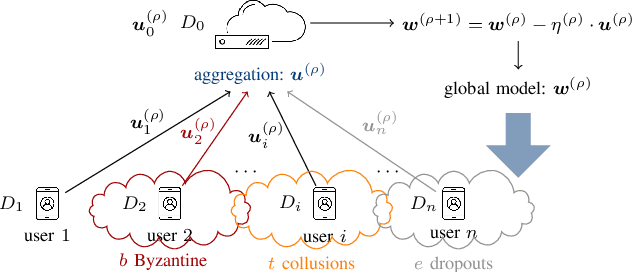
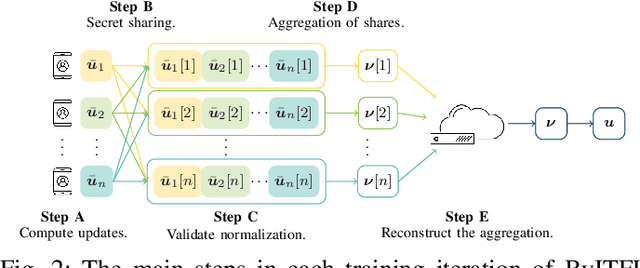
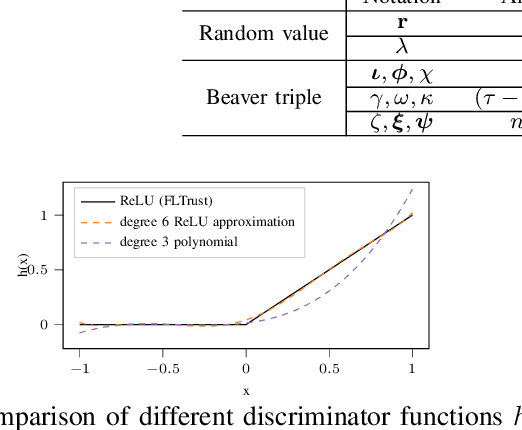
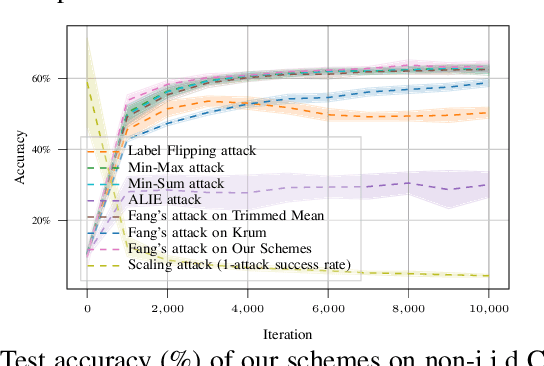
Federated learning (FL) shows great promise in large-scale machine learning but introduces new privacy and security challenges. We propose ByITFL and LoByITFL, two novel FL schemes that enhance resilience against Byzantine users while keeping the users' data private from eavesdroppers. To ensure privacy and Byzantine resilience, our schemes build on having a small representative dataset available to the federator and crafting a discriminator function allowing the mitigation of corrupt users' contributions. ByITFL employs Lagrange coded computing and re-randomization, making it the first Byzantine-resilient FL scheme with perfect Information-Theoretic (IT) privacy, though at the cost of a significant communication overhead. LoByITFL, on the other hand, achieves Byzantine resilience and IT privacy at a significantly reduced communication cost, but requires a Trusted Third Party, used only in a one-time initialization phase before training. We provide theoretical guarantees on privacy and Byzantine resilience, along with convergence guarantees and experimental results validating our findings.
LoByITFL: Low Communication Secure and Private Federated Learning
May 29, 2024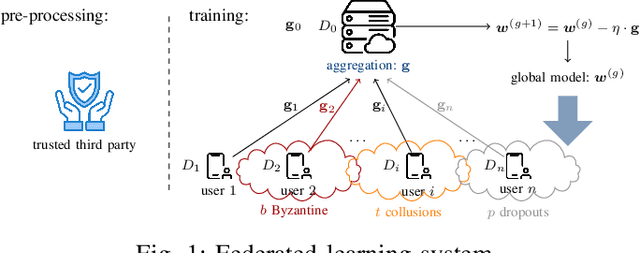
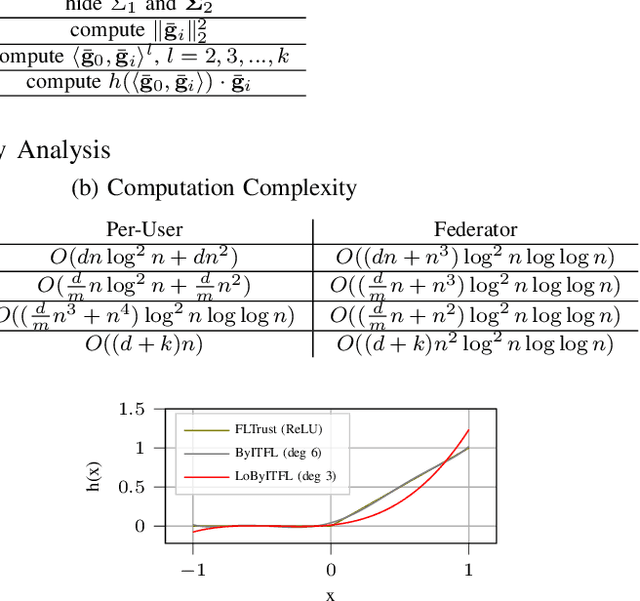
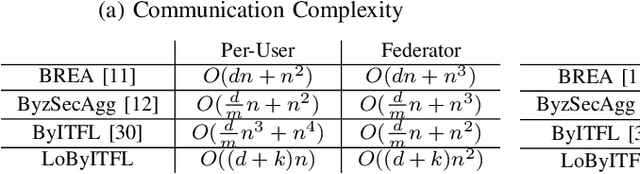
Federated Learning (FL) faces several challenges, such as the privacy of the clients data and security against Byzantine clients. Existing works treating privacy and security jointly make sacrifices on the privacy guarantee. In this work, we introduce LoByITFL, the first communication-efficient Information-Theoretic (IT) private and secure FL scheme that makes no sacrifices on the privacy guarantees while ensuring security against Byzantine adversaries. The key ingredients are a small and representative dataset available to the federator, a careful transformation of the FLTrust algorithm and the use of a trusted third party only in a one-time preprocessing phase before the start of the learning algorithm. We provide theoretical guarantees on privacy and Byzantine-resilience, and provide convergence guarantee and experimental results validating our theoretical findings.
Byzantine-Resilient Secure Aggregation for Federated Learning Without Privacy Compromises
May 14, 2024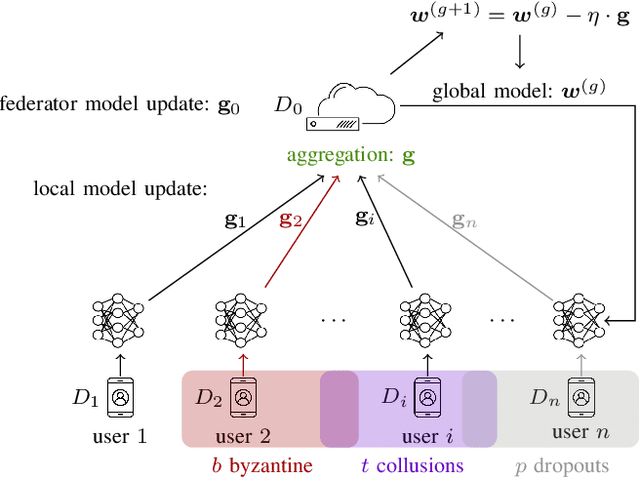
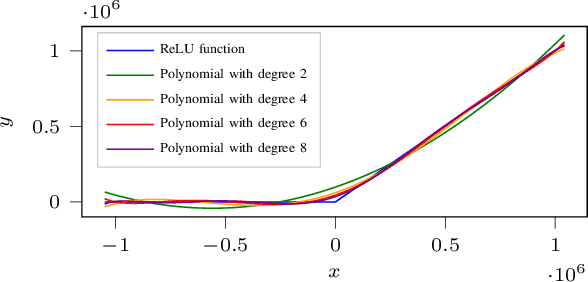
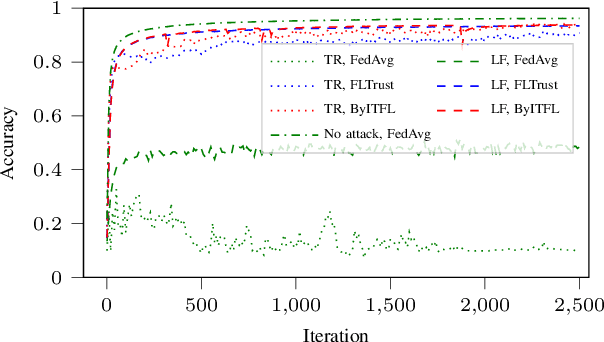

Federated learning (FL) shows great promise in large scale machine learning, but brings new risks in terms of privacy and security. We propose ByITFL, a novel scheme for FL that provides resilience against Byzantine users while keeping the users' data private from the federator and private from other users. The scheme builds on the preexisting non-private FLTrust scheme, which tolerates malicious users through trust scores (TS) that attenuate or amplify the users' gradients. The trust scores are based on the ReLU function, which we approximate by a polynomial. The distributed and privacy-preserving computation in ByITFL is designed using a combination of Lagrange coded computing, verifiable secret sharing and re-randomization steps. ByITFL is the first Byzantine resilient scheme for FL with full information-theoretic privacy.