 Add to Chrome
 Add to Firefox
 Add to Edge
Atrial Fibrillation Detection with Arbitrary Leads via a Codebook-Based Reconstruction-Classification Framework
Aug 19, 2026
\textbf{Background and Objective}: Reliable atrial fibrillation (AF) detection from electrocardiogram (ECG) signals remains challenging in real-world clinical settings due to variable lead configurations, cross-dataset domain shifts, and pervasive physiological and technical artifacts. So we develop a robust and generalizable deep learning model for accurate AF detection.\\ \textbf{Methods}: We propose the Dual-Codebook Graph Collaborative Network (DCGCNet), a novel end-to-end vector-quantized variational autoencoder that jointly performs AF classification and ECG reconstruction. DCGCNet introduces two key components: (1) a Local-Global Contrastive Module for learning noise-invariant representations, and (2) an Adaptive Codebook Vector Quantizer that dynamically refines codebook prototypes to better align with input data distributions, thereby preventing codebook collapse and enhancing generalization.\\ \textbf{Results}: DCGCNet achieves state-of-the-art performance in standard intra-dataset 12-lead evaluation and demonstrates exceptional cross-dataset generalization across seven diverse settings, consistently attaining AUC > 0.98 in all cases. Furthermore, it maintains high diagnostic accuracy under realistic noisy conditions, including baseline wander, powerline interference, and EMG artifacts.\\ \textbf{Conclusions}: DCGCNet establishes a new benchmark for robust, generalizable, and noise-resilient AF detection, showing strong potential for deployment in real-world clinical environments.

Large Language Models for Cryptocurrency Transaction Analysis: A Bitcoin Case Study
Jan 30, 2025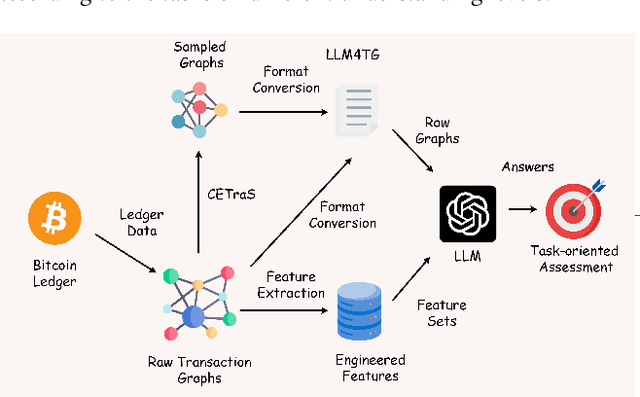
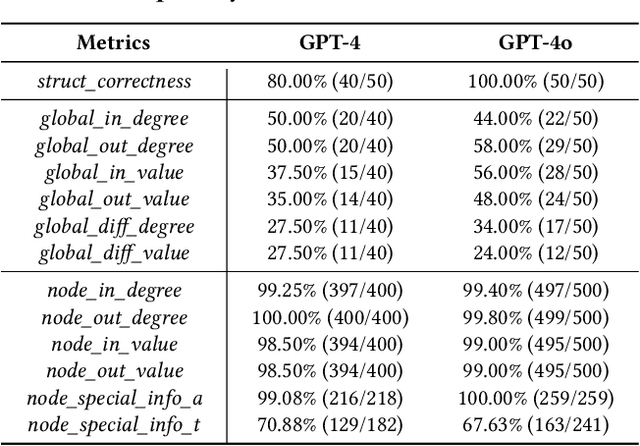
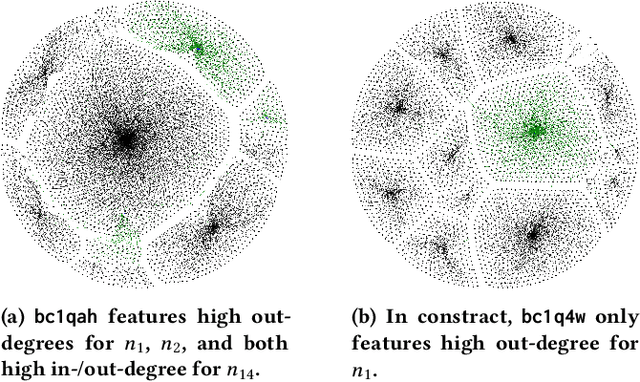
Cryptocurrencies are widely used, yet current methods for analyzing transactions heavily rely on opaque, black-box models. These lack interpretability and adaptability, failing to effectively capture behavioral patterns. Many researchers, including us, believe that Large Language Models (LLMs) could bridge this gap due to their robust reasoning abilities for complex tasks. In this paper, we test this hypothesis by applying LLMs to real-world cryptocurrency transaction graphs, specifically within the Bitcoin network. We introduce a three-tiered framework to assess LLM capabilities: foundational metrics, characteristic overview, and contextual interpretation. This includes a new, human-readable graph representation format, LLM4TG, and a connectivity-enhanced sampling algorithm, CETraS, which simplifies larger transaction graphs. Experimental results show that LLMs excel at foundational metrics and offer detailed characteristic overviews. Their effectiveness in contextual interpretation suggests they can provide useful explanations of transaction behaviors, even with limited labeled data.
BABD: A Bitcoin Address Behavior Dataset for Address Behavior Pattern Analysis
Apr 21, 2022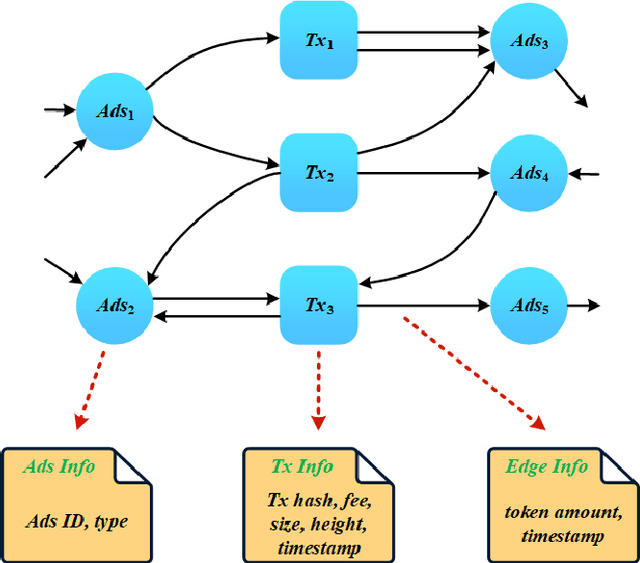
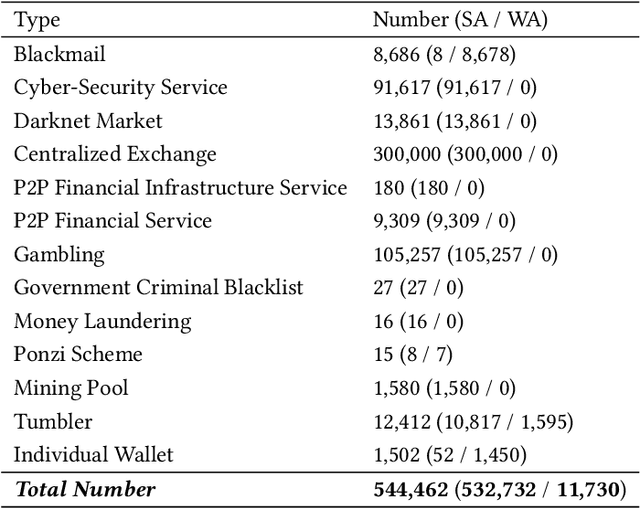
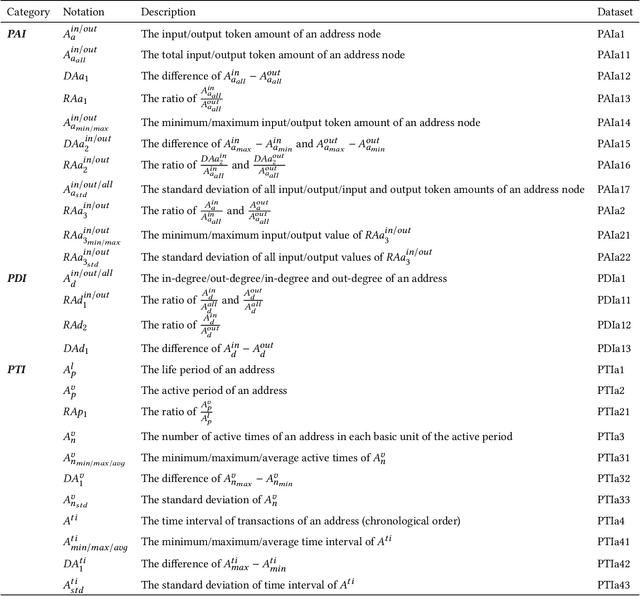
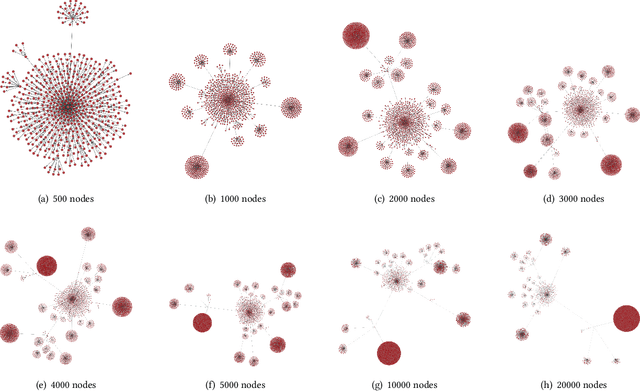
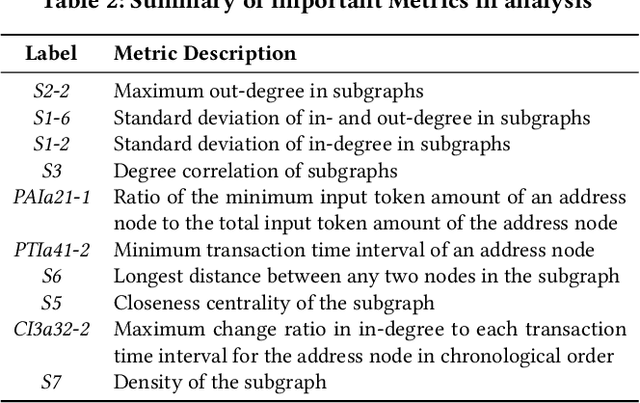
Cryptocurrencies are no longer just the preferred option for cybercriminal activities on darknets, due to the increasing adoption in mainstream applications. This is partly due to the transparency associated with the underpinning ledgers, where any individual can access the record of a transaction record on the public ledger. In this paper, we build a dataset comprising Bitcoin transactions between 12 July 2019 and 26 May 2021. This dataset (hereafter referred to as BABD-13) contains 13 types of Bitcoin addresses, 5 categories of indicators with 148 features, and 544,462 labeled data. We then use our proposed dataset on common machine learning models, namely: k-nearest neighbors algorithm, decision tree, random forest, multilayer perceptron, and XGBoost. The results show that the accuracy rates of these machine learning models on our proposed dataset are between 93.24% and 96.71%. We also analyze the proposed features and their relationships from the experiments, and propose a k-hop subgraph generation algorithm to extract a k-hop subgraph from the entire Bitcoin transaction graph constructed by the directed heterogeneous multigraph starting from a specific Bitcoin address node (e.g., a known transaction associated with a criminal investigation).