 Add to Chrome
 Add to Firefox
 Add to Edge
vla-eval: A Unified Evaluation Harness for Vision-Language-Action Models
Mar 14, 2026
Vision Language Action VLA models are typically evaluated using per benchmark scripts maintained independently by each model repository, leading to duplicated code, dependency conflicts, and underspecified protocols. We present vla eval, an open source evaluation harness that decouples model inference from benchmark execution through a WebSocket msgpack protocol with Docker based environment isolation. Models integrate once by implementing a single predict() method; benchmarks integrate once via a four method interface; the full cross evaluation matrix works automatically. A complete evaluation requires only two commands: vla eval serve and vla eval run. The framework supports 13 simulation benchmarks and six model servers. Parallel evaluation via episode sharding and batch inference achieves a 47x throughput improvement, completing 2000 LIBERO episodes in about 18 minutes. Using this infrastructure, we conduct a reproducibility audit of a published VLA model across three benchmarks, finding that all three closely reproduce published values while uncovering undocumented requirements ambiguous termination semantics and hidden normalization statistics that can silently distort results. We additionally release a VLA leaderboard aggregating 657 published results across 17 benchmarks. Framework, evaluation configs, and all reproduction results are publicly available.

CANVAS: Commonsense-Aware Navigation System for Intuitive Human-Robot Interaction
Oct 02, 2024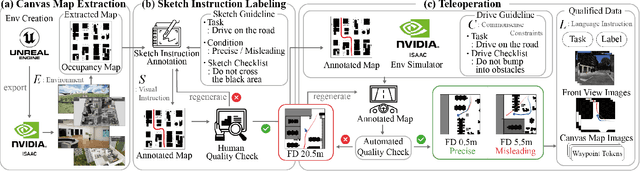
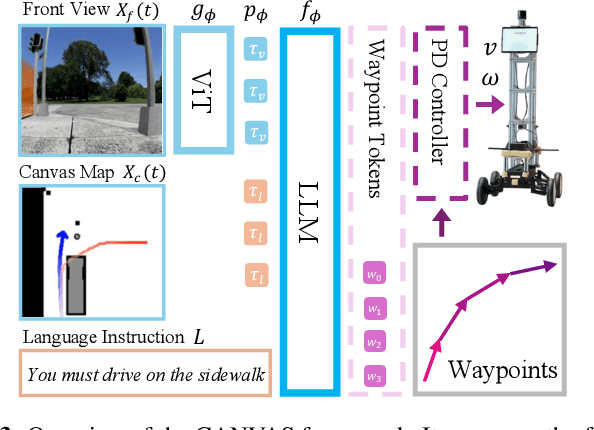
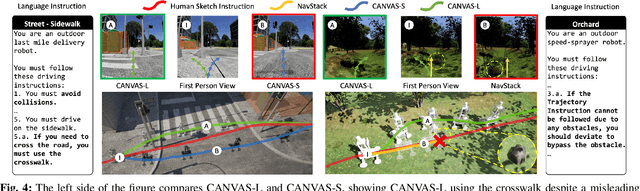
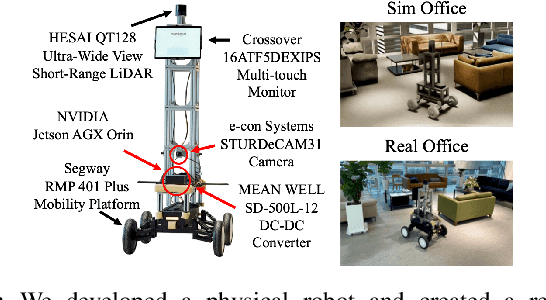
Real-life robot navigation involves more than just reaching a destination; it requires optimizing movements while addressing scenario-specific goals. An intuitive way for humans to express these goals is through abstract cues like verbal commands or rough sketches. Such human guidance may lack details or be noisy. Nonetheless, we expect robots to navigate as intended. For robots to interpret and execute these abstract instructions in line with human expectations, they must share a common understanding of basic navigation concepts with humans. To this end, we introduce CANVAS, a novel framework that combines visual and linguistic instructions for commonsense-aware navigation. Its success is driven by imitation learning, enabling the robot to learn from human navigation behavior. We present COMMAND, a comprehensive dataset with human-annotated navigation results, spanning over 48 hours and 219 km, designed to train commonsense-aware navigation systems in simulated environments. Our experiments show that CANVAS outperforms the strong rule-based system ROS NavStack across all environments, demonstrating superior performance with noisy instructions. Notably, in the orchard environment, where ROS NavStack records a 0% total success rate, CANVAS achieves a total success rate of 67%. CANVAS also closely aligns with human demonstrations and commonsense constraints, even in unseen environments. Furthermore, real-world deployment of CANVAS showcases impressive Sim2Real transfer with a total success rate of 69%, highlighting the potential of learning from human demonstrations in simulated environments for real-world applications.