 Add to Chrome
 Add to Firefox
 Add to Edge
EditCrafter: Tuning-free High-Resolution Image Editing via Pretrained Diffusion Model
Apr 11, 2026
We propose EditCrafter, a high-resolution image editing method that operates without tuning, leveraging pretrained text-to-image (T2I) diffusion models to process images at resolutions significantly exceeding those used during training. Leveraging the generative priors of large-scale T2I diffusion models enables the development of a wide array of novel generation and editing applications. Although numerous image editing methods have been proposed based on diffusion models and exhibit high-quality editing results, they are difficult to apply to images with arbitrary aspect ratios or higher resolutions since they only work at the training resolutions (512x512 or 1024x1024). Naively applying patch-wise editing fails with unrealistic object structures and repetition. To address these challenges, we introduce EditCrafter, a simple yet effective editing pipeline. EditCrafter operates by first performing tiled inversion, which preserves the original identity of the input high-resolution image. We further propose a noise-damped manifold-constrained classifier-free guidance (NDCFG++) that is tailored for high resolution image editing from the inverted latent. Our experiments show that the our EditCrafter can achieve impressive editing results across various resolutions without fine-tuning and optimization.

CANVAS: Commonsense-Aware Navigation System for Intuitive Human-Robot Interaction
Oct 02, 2024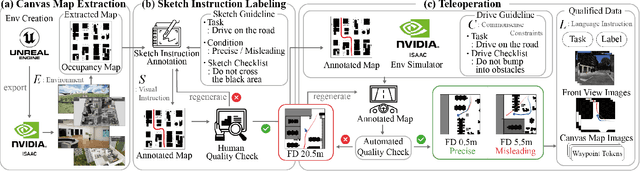
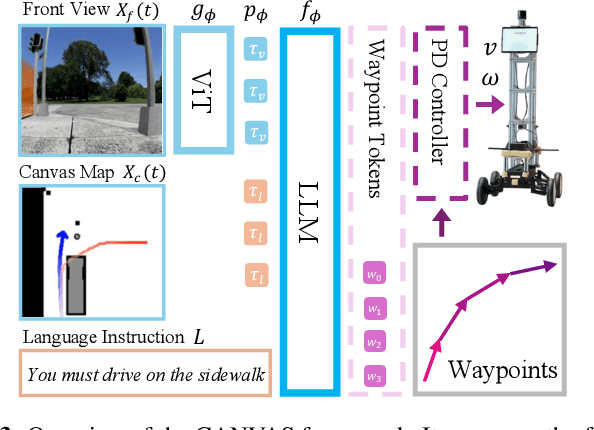
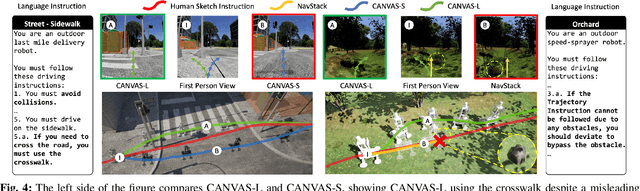
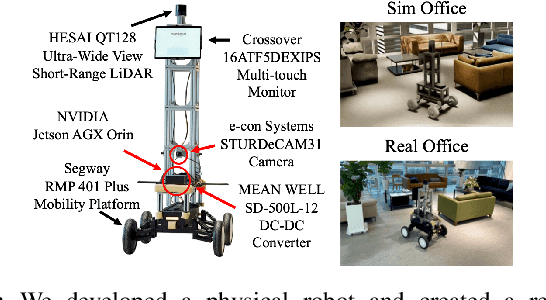
Real-life robot navigation involves more than just reaching a destination; it requires optimizing movements while addressing scenario-specific goals. An intuitive way for humans to express these goals is through abstract cues like verbal commands or rough sketches. Such human guidance may lack details or be noisy. Nonetheless, we expect robots to navigate as intended. For robots to interpret and execute these abstract instructions in line with human expectations, they must share a common understanding of basic navigation concepts with humans. To this end, we introduce CANVAS, a novel framework that combines visual and linguistic instructions for commonsense-aware navigation. Its success is driven by imitation learning, enabling the robot to learn from human navigation behavior. We present COMMAND, a comprehensive dataset with human-annotated navigation results, spanning over 48 hours and 219 km, designed to train commonsense-aware navigation systems in simulated environments. Our experiments show that CANVAS outperforms the strong rule-based system ROS NavStack across all environments, demonstrating superior performance with noisy instructions. Notably, in the orchard environment, where ROS NavStack records a 0% total success rate, CANVAS achieves a total success rate of 67%. CANVAS also closely aligns with human demonstrations and commonsense constraints, even in unseen environments. Furthermore, real-world deployment of CANVAS showcases impressive Sim2Real transfer with a total success rate of 69%, highlighting the potential of learning from human demonstrations in simulated environments for real-world applications.