 Add to Chrome
 Add to Firefox
 Add to Edge
MetaTele: Compact Refractive Metasurface Computational Telephoto Camera
Apr 08, 2026
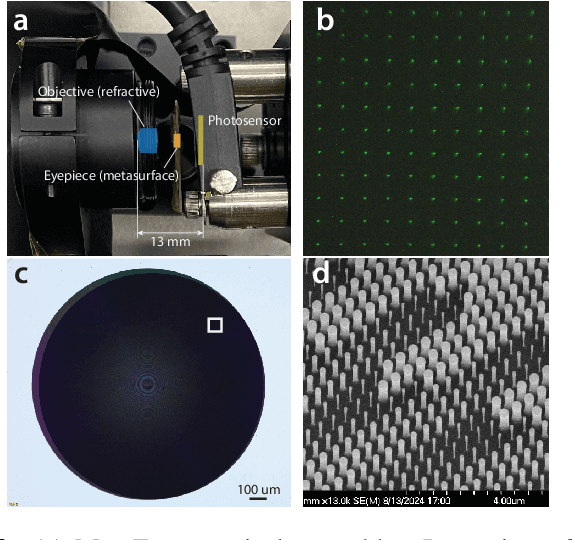
Smartphone cameras face fundamental form-factor constraints that limit their optical magnification, primarily due to the difficulty of reducing a lens assembly's telephoto ratio, the ratio between total track length (TTL) and effective focal length (EFL). Currently, conventional refractive optics struggle to achieve a telephoto ratio below 0.5 without requiring multiple bulky elements to correct optical aberrations. In this paper, we introduce MetaTele, a novel optics-algorithm co-design that breaks this bottleneck. MetaTele explicitly decouples the acquisition of scene structure and color information. First, it utilizes a compact refractive-metasurface optical assembly to capture a fine-detail structure image under a narrow wavelength band, inherently avoiding severe chromatic aberrations. Second, it captures a broadband color cue using the same optics; although this cue is heavily corrupted by chromatic aberrations, it retains sufficient spectral information to guide post-processing. We then employ a custom one-step diffusion model to computationally fuse these two raw measurements, successfully colorizing the structure image while correcting for system aberrations. We demonstrate a MetaTele prototype, achieving an unprecedented telephoto ratio of 0.44 with a TTL of just 13 mm for RGB imaging, paving the way for DSLR-level telephoto capabilities within smartphone form factors.

Diffusion Algorithm for Metalens Optical Aberration Correction
Nov 16, 2025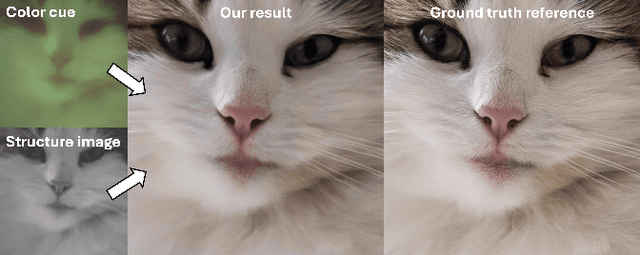
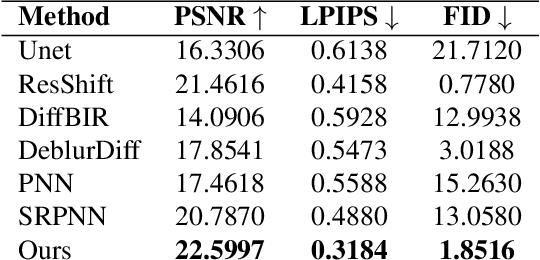
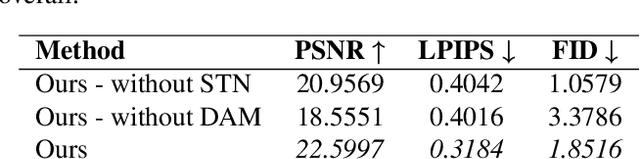
Metalenses offer a path toward creating ultra-thin optical systems, but they inherently suffer from severe, spatially varying optical aberrations, especially chromatic aberration, which makes image reconstruction a significant challenge. This paper presents a novel algorithmic solution to this problem, designed to reconstruct a sharp, full-color image from two inputs: a sharp, bandpass-filtered grayscale ``structure image'' and a heavily distorted ``color cue'' image, both captured by the metalens system. Our method utilizes a dual-branch diffusion model, built upon a pre-trained Stable Diffusion XL framework, to fuse information from the two inputs. We demonstrate through quantitative and qualitative comparisons that our approach significantly outperforms existing deblurring and pansharpening methods, effectively restoring high-frequency details while accurately colorizing the image.