 Add to Chrome
 Add to Firefox
 Add to Edge
FlowPainter: Inpainting Optical Flow via Confidence-Guided Completion
Jul 11, 2026
Existing optical flow methods broadly follow two paradigms: iterative optimization and diffusion-based estimation. Iterative methods, exemplified by RAFT, achieve high accuracy through recurrent refinement, but remain challenged by large displacements and complex motion. Diffusion-based methods introduce generative modeling and show promise in such ambiguous regions. However, existing diffusion models usually denoise the entire dense flow field from Gaussian noise, including simple regions where reliable motion can already be estimated by a lightweight network. This increases the denoising burden and may cause slow convergence and unstable training. To address this issue, we introduce FlowPainter, a diffusion-based optical flow framework that reformulates dense-flow generation as confidence-guided soft inpainting. FlowPainter employs a lightweight confidence-aware network to predict a rough flow and a pixel-wise confidence mask, distinguishing reliable simple regions from uncertain hard regions. The resulting simple-flow prior is used for confidence-based initialization and further injected into iterative denoising through confidence-gated residual guidance. With dynamically decaying guidance strength, FlowPainter stabilizes early denoising while preserving the flexibility of the diffusion model for late-stage detail refinement. Extensive experiments on public benchmarks, including Sintel, KITTI, and Spring, show that FlowPainter achieves strong accuracy under comparable training settings and converges more efficiently than existing diffusion-based optical flow methods, with notable gains on challenging benchmark splits. Our approach offers a practical way to integrate reliable discriminative priors with diffusion-based refinement for optical flow estimation. Our code is publicly available at https://github.com/mya012/FlowPainter.

UltraLED: Learning to See Everything in Ultra-High Dynamic Range Scenes
Oct 09, 2025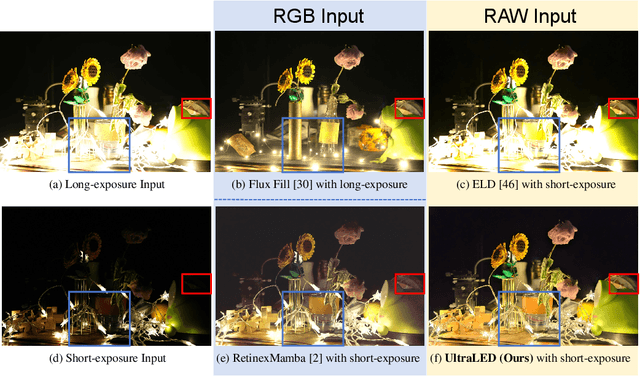
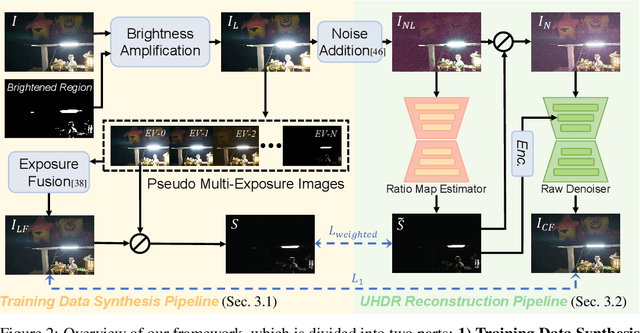

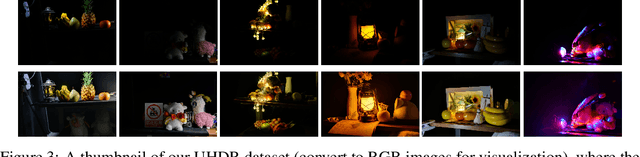
Ultra-high dynamic range (UHDR) scenes exhibit significant exposure disparities between bright and dark regions. Such conditions are commonly encountered in nighttime scenes with light sources. Even with standard exposure settings, a bimodal intensity distribution with boundary peaks often emerges, making it difficult to preserve both highlight and shadow details simultaneously. RGB-based bracketing methods can capture details at both ends using short-long exposure pairs, but are susceptible to misalignment and ghosting artifacts. We found that a short-exposure image already retains sufficient highlight detail. The main challenge of UHDR reconstruction lies in denoising and recovering information in dark regions. In comparison to the RGB images, RAW images, thanks to their higher bit depth and more predictable noise characteristics, offer greater potential for addressing this challenge. This raises a key question: can we learn to see everything in UHDR scenes using only a single short-exposure RAW image? In this study, we rely solely on a single short-exposure frame, which inherently avoids ghosting and motion blur, making it particularly robust in dynamic scenes. To achieve that, we introduce UltraLED, a two-stage framework that performs exposure correction via a ratio map to balance dynamic range, followed by a brightness-aware RAW denoiser to enhance detail recovery in dark regions. To support this setting, we design a 9-stop bracketing pipeline to synthesize realistic UHDR images and contribute a corresponding dataset based on diverse scenes, using only the shortest exposure as input for reconstruction. Extensive experiments show that UltraLED significantly outperforms existing single-frame approaches. Our code and dataset are made publicly available at https://srameo.github.io/projects/ultraled.