 Add to Chrome
 Add to Firefox
 Add to Edge
BalanceRAG: Joint Risk Calibration for Cascaded Retrieval-Augmented Generation
May 19, 2026
Large language models (LLMs) can enhance factuality via retrieval-augmented generation (RAG), but applying RAG to every query is unnecessary when the model-only answer is reliable. This motivates cascaded RAG: each query is first handled by an LLM-only branch, escalated to a RAG fallback only if the primary branch is uncertain, and abstained from when neither branch is sufficiently trustworthy. However, calibrating such cascades stage by stage may be conservative, since the final utility depends on joint uncertainty thresholding of LLM-only and RAG. In this work, we develop BalanceRAG to certify threshold pairs at a target risk level. Given uncertainty scores from the two branches, BalanceRAG frames each threshold pair as an operating point on a two-dimensional lattice and identifies safe operating points using sequential graphical testing. This enables risk-adaptive threshold calibration, controlling the system-level error rate among accepted points, while retaining more examples. Furthermore, BalanceRAG extends to multi-risk calibration, allowing retrieval usage to be bounded together with the selection-conditioned risk. Experiments on three open-domain question answering (QA) benchmarks across multiple LLM backbones demonstrate that BalanceRAG meets prescribed risk levels, preserves higher coverage and more accepted correct examples, and reduces unnecessary retrieval calls compared with always-on RAG.

Set-Valued Prediction for Large Language Models with Feasibility-Aware Coverage Guarantees
Mar 24, 2026Large language models (LLMs) inherently operate over a large generation space, yet conventional usage typically reports the most likely generation (MLG) as a point prediction, which underestimates the model's capability: although the top-ranked response can be incorrect, valid answers may still exist within the broader output space and can potentially be discovered through repeated sampling. This observation motivates moving from point prediction to set-valued prediction, where the model produces a set of candidate responses rather than a single MLG. In this paper, we propose a principled framework for set-valued prediction, which provides feasibility-aware coverage guarantees. We show that, given the finite-sampling nature of LLM generation, coverage is not always achievable: even with multiple samplings, LLMs may fail to yield an acceptable response for certain questions within the sampled candidate set. To address this, we establish a minimum achievable risk level (MRL), below which statistical coverage guarantees cannot be satisfied. Building on this insight, we then develop a data-driven calibration procedure that constructs prediction sets from sampled responses by estimating a rigorous threshold, ensuring that the resulting set contains a correct answer with a desired probability whenever the target risk level is feasible. Extensive experiments on six language generation tasks with five LLMs demonstrate both the statistical validity and the predictive efficiency of our framework.
Data-Driven Calibration of Prediction Sets in Large Vision-Language Models Based on Inductive Conformal Prediction
Apr 24, 2025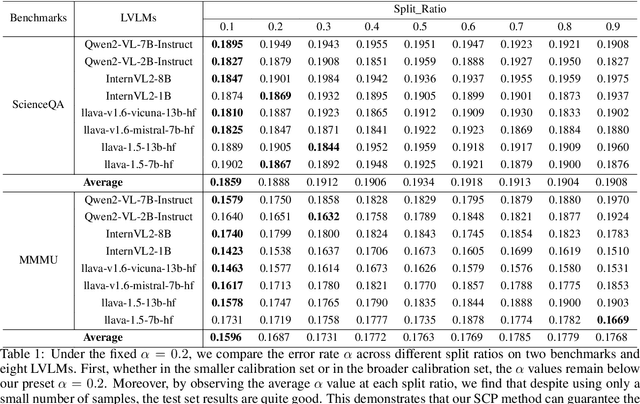
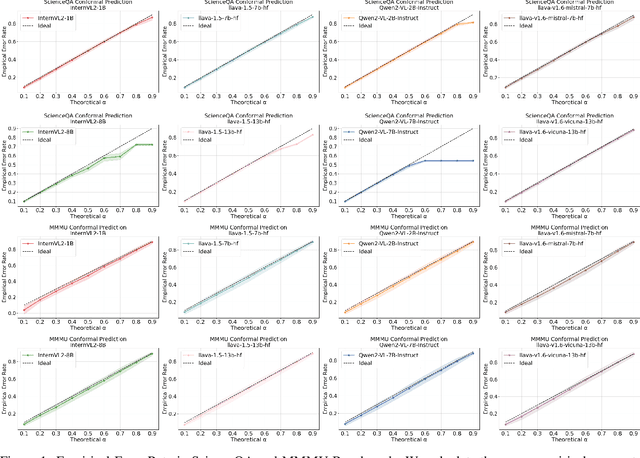

This study addresses the critical challenge of hallucination mitigation in Large Vision-Language Models (LVLMs) for Visual Question Answering (VQA) tasks through a Split Conformal Prediction (SCP) framework. While LVLMs excel in multi-modal reasoning, their outputs often exhibit hallucinated content with high confidence, posing risks in safety-critical applications. We propose a model-agnostic uncertainty quantification method that integrates dynamic threshold calibration and cross-modal consistency verification. By partitioning data into calibration and test sets, the framework computes nonconformity scores to construct prediction sets with statistical guarantees under user-defined risk levels ($\alpha$). Key innovations include: (1) rigorous control of \textbf{marginal coverage} to ensure empirical error rates remain strictly below $\alpha$; (2) dynamic adjustment of prediction set sizes inversely with $\alpha$, filtering low-confidence outputs; (3) elimination of prior distribution assumptions and retraining requirements. Evaluations on benchmarks (ScienceQA, MMMU) with eight LVLMs demonstrate that SCP enforces theoretical guarantees across all $\alpha$ values. The framework achieves stable performance across varying calibration-to-test split ratios, underscoring its robustness for real-world deployment in healthcare, autonomous systems, and other safety-sensitive domains. This work bridges the gap between theoretical reliability and practical applicability in multi-modal AI systems, offering a scalable solution for hallucination detection and uncertainty-aware decision-making.