 Add to Chrome
 Add to Firefox
 Add to Edge
Lilith: Backdoor Generalization under Training-Inference Trigger Shift
Jul 28, 2026
Machine-learning services increasingly rely on public data, third-party providers, and outsourced training, creating opportunities for data-poisoning attacks that implant persistent malicious behavior while preserving benign utility. However, existing backdoor studies largely evaluate exact trigger reuse, training-exposed trigger diversity, or variations along predefined transformation axes. They therefore leave a critical blind spot: whether a backdoor learned from one training-time trigger can generalize to an inference-time trigger family absent from victim training. We formulate this problem as backdoor generalization under training--inference trigger shift and introduce Lilith, a black-box anchor-to-family framework. Using only disjoint surrogate resources, Lilith first induces a compact target-side vulnerability with a single training anchor, then constructs a bounded inference-only family that preserves the anchor-induced representation geometry. We characterize this mechanism through anchor clearance and family reach, deriving sufficient conditions for family-wise target preservation under local regularity and bounded surrogate--victim discrepancy. Experiments across datasets, architectures, poisoning rates, and defenses show that Lilith achieves high family-wise attack success with limited utility degradation and a small trigger generalization gap. Additional analyses show that family activation depends on representation alignment rather than the proposal mechanism, exposing a broader threat overlooked by exact-trigger evaluation.

Learning many-body Hamiltonians with Heisenberg-limited scaling
Oct 06, 2022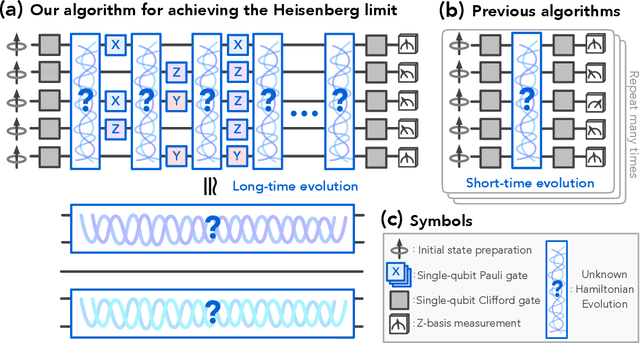
Learning a many-body Hamiltonian from its dynamics is a fundamental problem in physics. In this work, we propose the first algorithm to achieve the Heisenberg limit for learning an interacting $N$-qubit local Hamiltonian. After a total evolution time of $\mathcal{O}(\epsilon^{-1})$, the proposed algorithm can efficiently estimate any parameter in the $N$-qubit Hamiltonian to $\epsilon$-error with high probability. The proposed algorithm is robust against state preparation and measurement error, does not require eigenstates or thermal states, and only uses $\mathrm{polylog}(\epsilon^{-1})$ experiments. In contrast, the best previous algorithms, such as recent works using gradient-based optimization or polynomial interpolation, require a total evolution time of $\mathcal{O}(\epsilon^{-2})$ and $\mathcal{O}(\epsilon^{-2})$ experiments. Our algorithm uses ideas from quantum simulation to decouple the unknown $N$-qubit Hamiltonian $H$ into noninteracting patches, and learns $H$ using a quantum-enhanced divide-and-conquer approach. We prove a matching lower bound to establish the asymptotic optimality of our algorithm.