 Add to Chrome
 Add to Firefox
 Add to Edge
Diversity Matters: Distributional Feature Coverage Sample Selection for Data-Efficient Backdoor Attacks
Aug 10, 2026
Backdoor attacks compromise training data so that a model retains clean accuracy but predicts an attacker-chosen target on triggered inputs. At very low poisoning rates, only a few samples convey the trigger--target association, making poison-sample selection critical. Existing methods typically rank candidates using per-sample scores, which can select redundant samples from similar semantic regions, and many require task-specific surrogate training. We propose Distributional Feature Coverage Sample Selection (DFCS), a training-free, trigger-agnostic method that clusters fixed pretrained features into one region per poisoning slot and selects the centroid-nearest sample from each region. A local first-order analysis relates this allocation to feature-coverage and representative-mass terms. Across BadNets and Blended attacks on CIFAR-10, Tiny-ImageNet, and Imagenette, DFCS achieves the highest mean attack success rate among seven selectors in all six dataset--attack settings, averaging $96.30\%$ and exceeding the strongest comparator in each setting by 4.60 percentage points on average while preserving clean accuracy. These results support distributional feature coverage as an effective selection principle for low-budget dirty-label backdoor attacks.

Prior Knowledge Distillation Network for Face Super-Resolution
Sep 22, 2024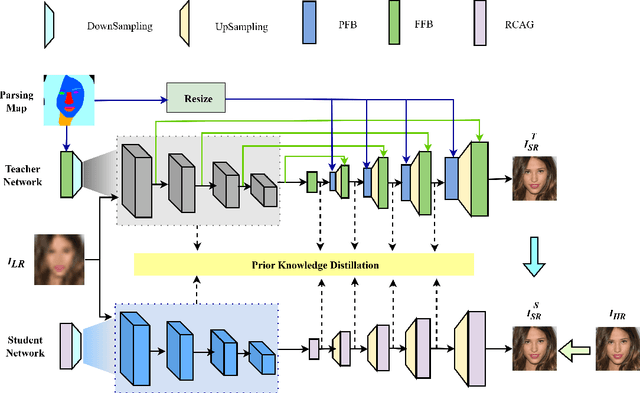
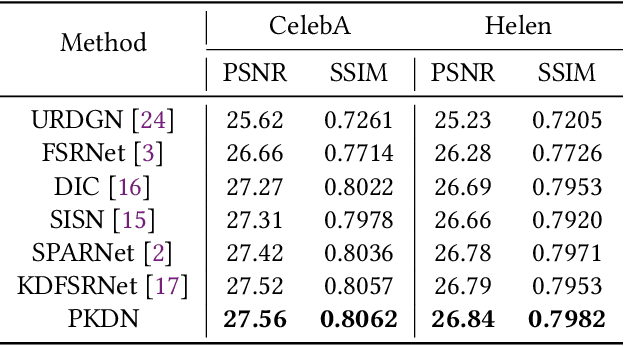
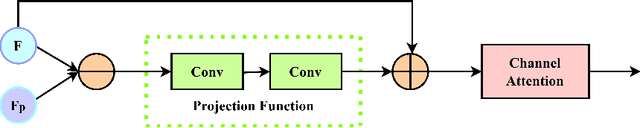
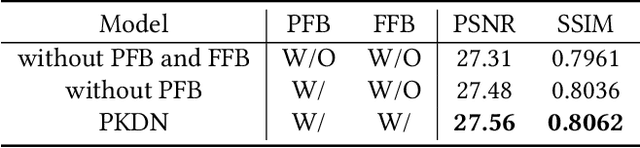
The purpose of face super-resolution (FSR) is to reconstruct high-resolution (HR) face images from low-resolution (LR) inputs. With the continuous advancement of deep learning technologies, contemporary prior-guided FSR methods initially estimate facial priors and then use this information to assist in the super-resolution reconstruction process. However, ensuring the accuracy of prior estimation remains challenging, and straightforward cascading and convolutional operations often fail to fully leverage prior knowledge. Inaccurate or insufficiently utilized prior information inevitably degrades FSR performance. To address this issue, we propose a prior knowledge distillation network (PKDN) for FSR, which involves transferring prior information from the teacher network to the student network. This approach enables the network to learn priors during the training stage while relying solely on low-resolution facial images during the testing stage, thus mitigating the adverse effects of prior estimation inaccuracies. Additionally, we incorporate robust attention mechanisms to design a parsing map fusion block that effectively utilizes prior information. To prevent feature loss, we retain multi-scale features during the feature extraction stage and employ them in the subsequent super-resolution reconstruction process. Experimental results on benchmark datasets demonstrate that our PKDN approach surpasses existing FSR methods in generating high-quality face images.