 Add to Chrome
 Add to Firefox
 Add to Edge
ProText: A benchmark dataset for measuring (mis)gendering in long-form texts
Mar 29, 2026
We introduce ProText, a dataset for measuring gendering and misgendering in stylistically diverse long-form English texts. ProText spans three dimensions: Theme nouns (names, occupations, titles, kinship terms), Theme category (stereotypically male, stereotypically female, gender-neutral/non-gendered), and Pronoun category (masculine, feminine, gender-neutral, none). The dataset is designed to probe (mis)gendering in text transformations such as summarization and rewrites using state-of-the-art Large Language Models, extending beyond traditional pronoun resolution benchmarks and beyond the gender binary. We validated ProText through a mini case study, showing that even with just two prompts and two models, we can draw nuanced insights regarding gender bias, stereotyping, misgendering, and gendering. We reveal systematic gender bias, particularly when inputs contain no explicit gender cues or when models default to heteronormative assumptions.

TofuEval: Evaluating Hallucinations of LLMs on Topic-Focused Dialogue Summarization
Feb 20, 2024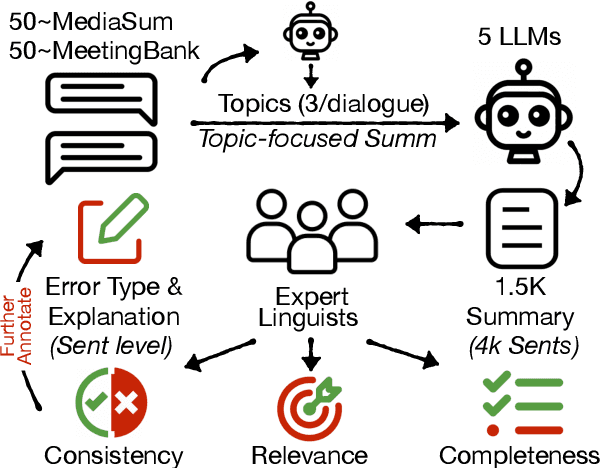

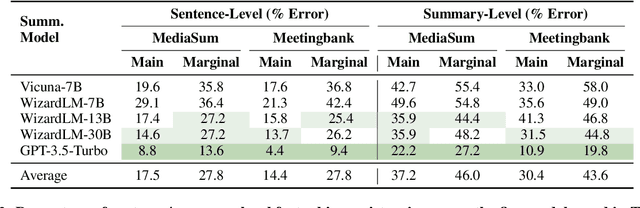

Single document news summarization has seen substantial progress on faithfulness in recent years, driven by research on the evaluation of factual consistency, or hallucinations. We ask whether these advances carry over to other text summarization domains. We propose a new evaluation benchmark on topic-focused dialogue summarization, generated by LLMs of varying sizes. We provide binary sentence-level human annotations of the factual consistency of these summaries along with detailed explanations of factually inconsistent sentences. Our analysis shows that existing LLMs hallucinate significant amounts of factual errors in the dialogue domain, regardless of the model's size. On the other hand, when LLMs, including GPT-4, serve as binary factual evaluators, they perform poorly and can be outperformed by prevailing state-of-the-art specialized factuality evaluation metrics. Finally, we conducted an analysis of hallucination types with a curated error taxonomy. We find that there are diverse errors and error distributions in model-generated summaries and that non-LLM based metrics can capture all error types better than LLM-based evaluators.