 Add to Chrome
 Add to Firefox
 Add to Edge
RAVEN: Frozen Random Graph Reservoirs with Physics-Informed Interaction Fingerprints for Protein-Ligand Binding Affinity Prediction
Aug 10, 2026
Quantitative estimation of protein-ligand binding affinity from three-dimensional complex structures is a fundamental task in structure-based computational chemistry and molecular modeling. Reliable prediction remains challenging because available structure-affinity data are limited, experimentally heterogeneous, conformation-dependent, and sensitive to dataset partitioning. RAVEN (Randomized Atomistic Views with Ensemble Neural Reservoirs) utilizes a multihead reservoir of independently initialized and fully frozen atomistic graph encoders to generate diverse structural projections without end-to-end optimization of the graph representation. These projections are integrated with a deterministic physicochemical interaction fingerprint and processed by heterogeneous supervised readers, including neural and tree-based regressors, whose outputs are combined through validation-based nonnegative fusion. The random reservoir expands structural feature coverage across independent encoder realizations, whereas the explicit physicochemical descriptors and heterogeneous readers contribute complementary information and distinct inductive biases. Evaluation on a similarity-isolated PDBbind 2020R1 split reconstructed using GEMS similarity resources, together with the protected CASF-2016 subset, demonstrated strong predictive performance. The results indicate that frozen multi-view graph representations, explicit physicochemical statistics, and heterogeneous model fusion provide a robust and flexible framework for protein-ligand binding-affinity prediction.

Constrained Multi-shape Evolution for Overlapping Cytoplasm Segmentation
Apr 15, 2020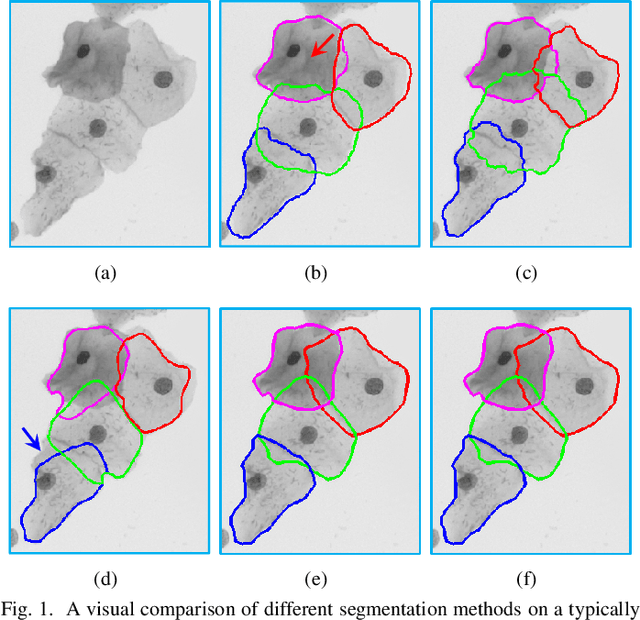
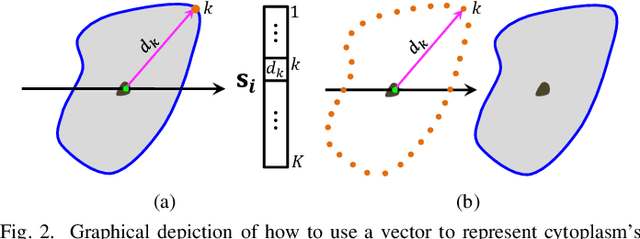
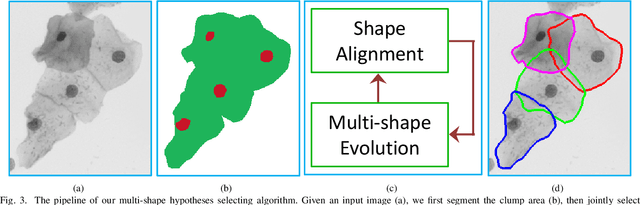
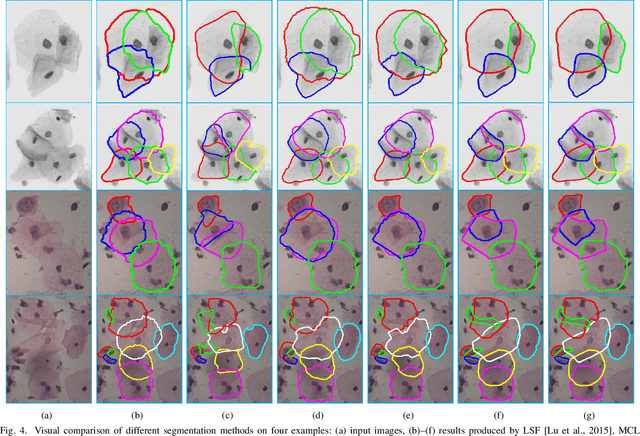
Segmenting overlapping cytoplasm of cells in cervical smear images is a clinically essential task, for quantitatively measuring cell-level features in order to diagnose cervical cancer. This task, however, remains rather challenging, mainly due to the deficiency of intensity (or color) information in the overlapping region. Although shape prior-based models that compensate intensity deficiency by introducing prior shape information (shape priors) about cytoplasm are firmly established, they often yield visually implausible results, mainly because they model shape priors only by limited shape hypotheses about cytoplasm, exploit cytoplasm-level shape priors alone, and impose no shape constraint on the resulting shape of the cytoplasm. In this paper, we present a novel and effective shape prior-based approach, called constrained multi-shape evolution, that segments all overlapping cytoplasms in the clump simultaneously by jointly evolving each cytoplasm's shape guided by the modeled shape priors. We model local shape priors (cytoplasm--level) by an infinitely large shape hypothesis set which contains all possible shapes of the cytoplasm. In the shape evolution, we compensate intensity deficiency for the segmentation by introducing not only the modeled local shape priors but also global shape priors (clump--level) modeled by considering mutual shape constraints of cytoplasms in the clump. We also constrain the resulting shape in each evolution to be in the built shape hypothesis set, for further reducing implausible segmentation results. We evaluated the proposed method in two typical cervical smear datasets, and the extensive experimental results show that the proposed method is effective to segment overlapping cytoplasm, consistently outperforming the state-of-the-art methods.
CNN in CT Image Segmentation: Beyound Loss Function for Expoliting Ground Truth Images
Apr 08, 2020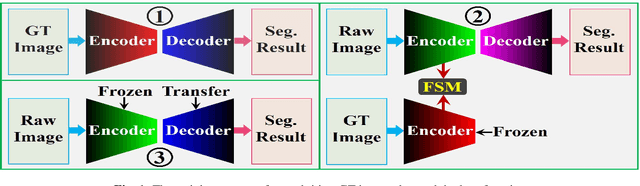
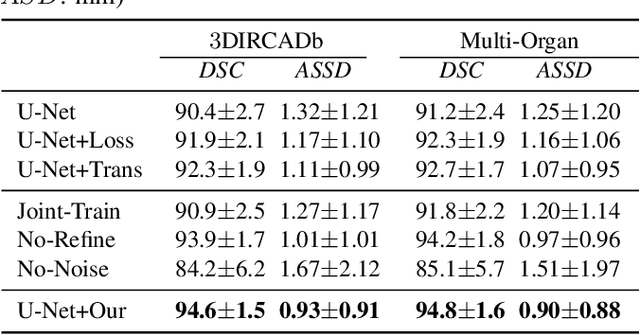
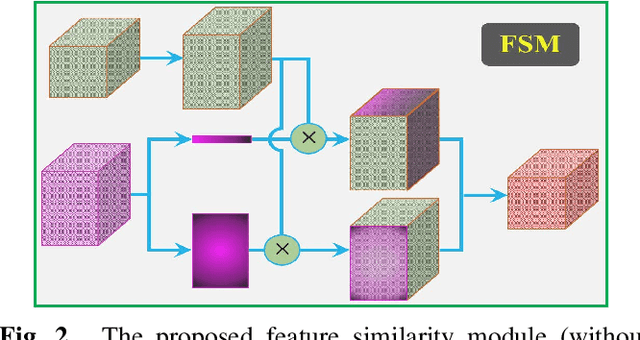
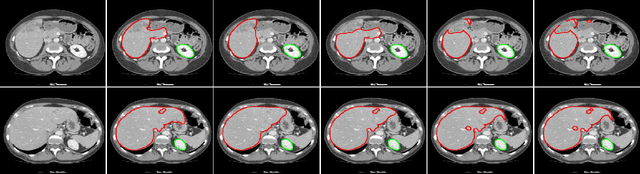
Exploiting more information from ground truth (GT) images now is a new research direction for further improving CNN's performance in CT image segmentation. Previous methods focus on devising the loss function for fulfilling such a purpose. However, it is rather difficult to devise a general and optimization-friendly loss function. We here present a novel and practical method that exploits GT images beyond the loss function. Our insight is that feature maps of two CNNs trained respectively on GT and CT images should be similar on some metric space, because they both are used to describe the same objects for the same purpose. We hence exploit GT images by enforcing such two CNNs' feature maps to be consistent. We assess the proposed method on two data sets, and compare its performance to several competitive methods. Extensive experimental results show that the proposed method is effective, outperforming all the compared methods.