 Add to Chrome
 Add to Firefox
 Add to Edge
DualEval: Joint Model-Item Calibration for Unified LLM Evaluation
Jun 24, 2026
Current LLM evaluation relies on two complementary but often disconnected signals: static benchmarks with objective correctness labels and arena-style preference data that better reflect open-ended user interactions. We introduce DualEval, a latent model-item calibration framework that represents models and evaluation items in a shared space, jointly estimating model ability together with item difficulty and sharpness. We apply DualEval across four domains: coding, math, miscellaneous domain-knowledge tasks, and generic everyday user queries. Our evaluation uses 18 frontier LLMs, static benchmark labels, and reward-model scores validated against held-out human preferences for open-ended model responses. Empirically, our framework produces reliable and balanced model rankings, and its learned item-level profiles support downstream applications such as benchmark compression for sample-efficient evaluation and anomaly detection for contamination or outlier analysis. Overall, DualEval unifies static and arena-style evaluation through joint model-item calibration, producing model rankings and item-level diagnostics that support more sample-efficient, interpretable, and auditable evaluation pipelines.

Origami-based Zygote structure enables pluripotent shape-transforming deployable structure
Aug 08, 2022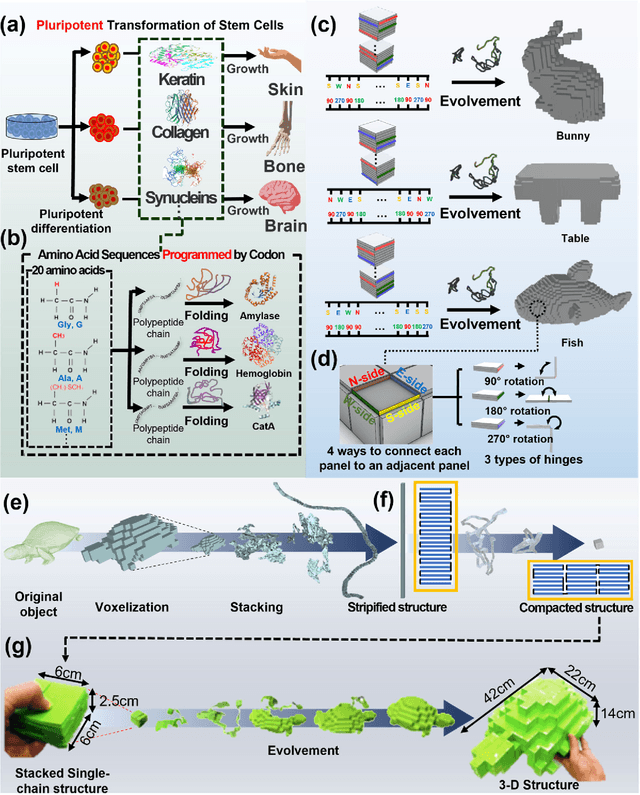
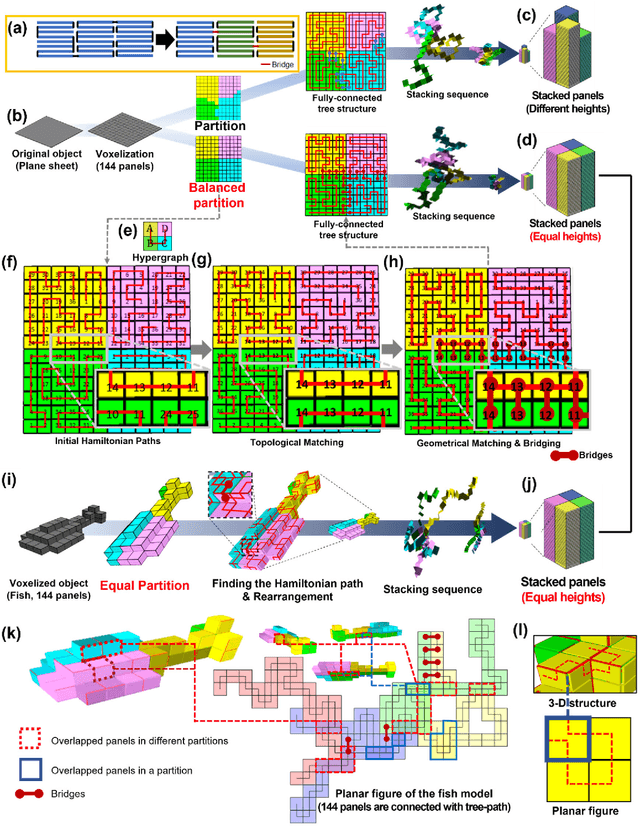
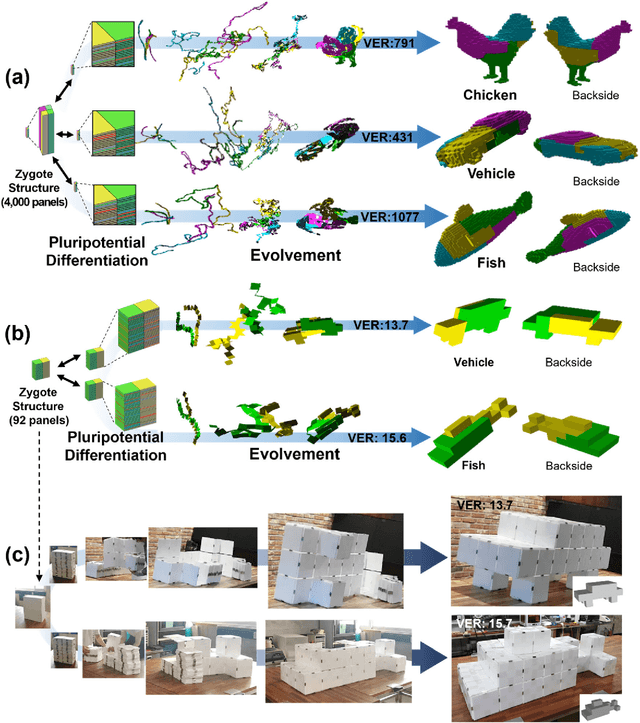
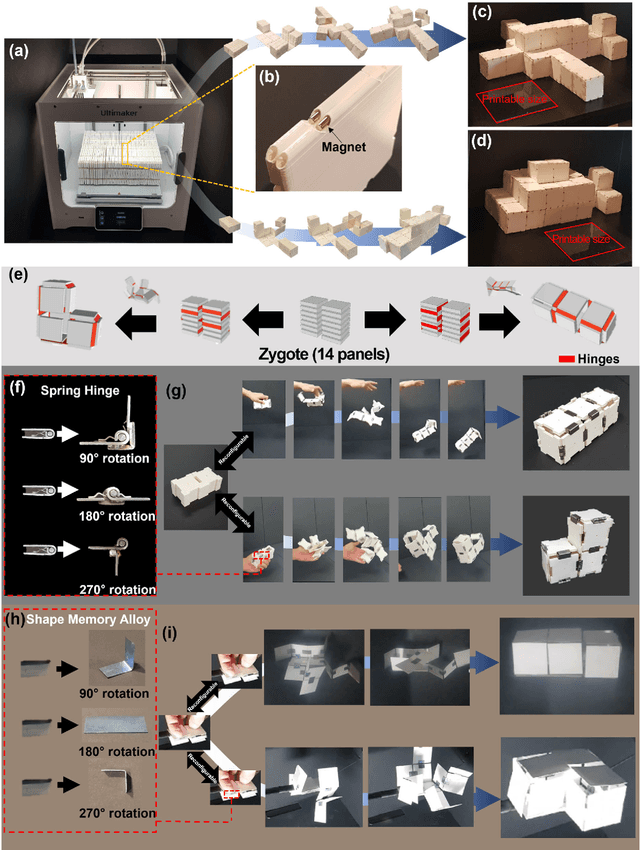
We propose an algorithmic framework of a pluripotent structure evolving from a simple compact structure into diverse complex 3-D structures for designing the shape transformable, reconfigurable, and deployable structures and robots. Our algorithmic approach suggests a way of transforming a compact structure consisting of uniform building blocks into a large, desired 3-D shape. Analogous to the pluripotent stem cells that can grow into a preprogrammed shape according to coded information, which we call DNA, compactly stacked panels named the zygote structure can evolve into arbitrary 3-D structures by programming their connection path. Our stacking algorithm obtains this coded sequence by inversely stacking the voxelized surface of the desired structure into a tree. Applying the connection path obtained by the stacking algorithm, the compactly stacked panels named the zygote structure can be deployed into diverse large 3-D structures. We conceptually demonstrated our pluripotent evolving structure by energy releasing commercial spring hinges and thermally actuated shape memory alloy (SMA) hinges, respectively. We also show that the proposed concept enables the fabrication of large structures in a significantly smaller workspace.