 Add to Chrome
 Add to Firefox
 Add to Edge
Are Text-to-Image Models Inductivist Turkeys? A Counterfactual Benchmark for Causal Reasoning
Jun 24, 2026
Text-to-image (T2I) generation models have achieved remarkable progress in producing visually realistic images from natural language prompts. Yet it remains unclear whether their success reflects genuine causal understanding or sophisticated pattern matching over visual-textual correlations. Inspired by Russell's inductivist turkey, we introduce Counterfactual-World (CF-World), a counterfactual benchmark designed to investigate whether text-to-image models can generate images under rules that systematically contradict real-world priors. CF-World organizes each scenario into three progressive levels: factual generation under ordinary world knowledge, explicit counterfactual generation with direct visual instructions, and implicit counterfactual generation requiring causal deduction from altered rules. We evaluate both open-source and closed-source T2I models using a Vision Language Model (VLM)-based evaluator (CF-Eval). Furthermore, we introduce two metrics: Prior Resistance Rate (PRR), which measures a models' ability to overcome entrenched real-world priors, and Reasoning Retention Rate (RRR), which assesses whether models can maintain reasoning-dependent counterfactual generation without explicit visual cues. Experiments show that all models exhibit sharp degradation from factual to counterfactual settings. Further analyses suggest that these failures arise because current T2I models encode world knowledge and visual appearances as tightly coupled patterns. Consequently, their heavy reliance on frequent visual co-occurrences within the training data forces them to default to familiar commonsense priors when tasked with rendering counterfactual worlds.

The Influence of Data Pre-processing and Post-processing on Long Document Summarization
Dec 03, 2021

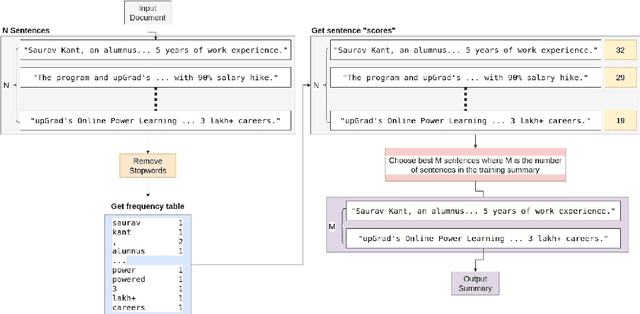
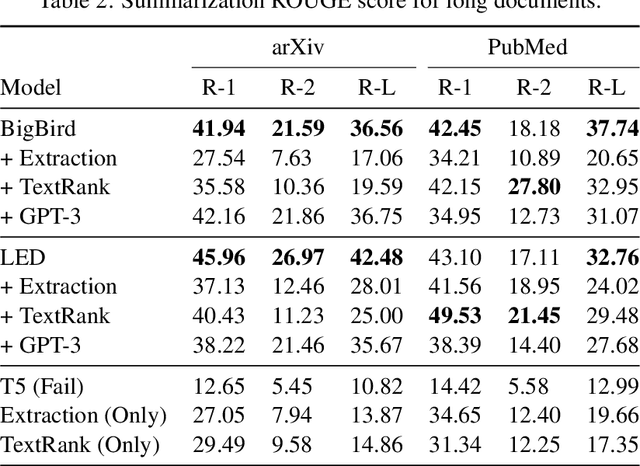
Long document summarization is an important and hard task in the field of natural language processing. A good performance of the long document summarization reveals the model has a decent understanding of the human language. Currently, most researches focus on how to modify the attention mechanism of the transformer to achieve a higher ROUGE score. The study of data pre-processing and post-processing are relatively few. In this paper, we use two pre-processing methods and a post-processing method and analyze the effect of these methods on various long document summarization models.