 Add to Chrome
 Add to Firefox
 Add to Edge
Enhancing Noise Resilience in Face Clustering via Sparse Differential Transformer
Dec 27, 2025
The method used to measure relationships between face embeddings plays a crucial role in determining the performance of face clustering. Existing methods employ the Jaccard similarity coefficient instead of the cosine distance to enhance the measurement accuracy. However, these methods introduce too many irrelevant nodes, producing Jaccard coefficients with limited discriminative power and adversely affecting clustering performance. To address this issue, we propose a prediction-driven Top-K Jaccard similarity coefficient that enhances the purity of neighboring nodes, thereby improving the reliability of similarity measurements. Nevertheless, accurately predicting the optimal number of neighbors (Top-K) remains challenging, leading to suboptimal clustering results. To overcome this limitation, we develop a Transformer-based prediction model that examines the relationships between the central node and its neighboring nodes near the Top-K to further enhance the reliability of similarity estimation. However, vanilla Transformer, when applied to predict relationships between nodes, often introduces noise due to their overemphasis on irrelevant feature relationships. To address these challenges, we propose a Sparse Differential Transformer (SDT), instead of the vanilla Transformer, to eliminate noise and enhance the model's anti-noise capabilities. Extensive experiments on multiple datasets, such as MS-Celeb-1M, demonstrate that our approach achieves state-of-the-art (SOTA) performance, outperforming existing methods and providing a more robust solution for face clustering.

From Cradle to Cane: A Two-Pass Framework for High-Fidelity Lifespan Face Aging
Jun 26, 2025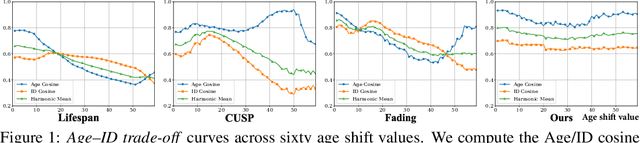
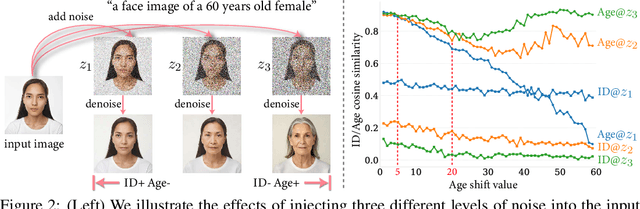
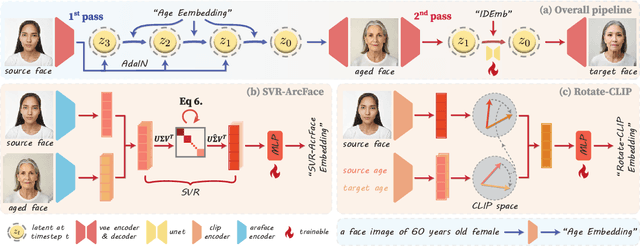
Face aging has become a crucial task in computer vision, with applications ranging from entertainment to healthcare. However, existing methods struggle with achieving a realistic and seamless transformation across the entire lifespan, especially when handling large age gaps or extreme head poses. The core challenge lies in balancing age accuracy and identity preservation--what we refer to as the Age-ID trade-off. Most prior methods either prioritize age transformation at the expense of identity consistency or vice versa. In this work, we address this issue by proposing a two-pass face aging framework, named Cradle2Cane, based on few-step text-to-image (T2I) diffusion models. The first pass focuses on solving age accuracy by introducing an adaptive noise injection (AdaNI) mechanism. This mechanism is guided by including prompt descriptions of age and gender for the given person as the textual condition. Also, by adjusting the noise level, we can control the strength of aging while allowing more flexibility in transforming the face. However, identity preservation is weakly ensured here to facilitate stronger age transformations. In the second pass, we enhance identity preservation while maintaining age-specific features by conditioning the model on two identity-aware embeddings (IDEmb): SVR-ArcFace and Rotate-CLIP. This pass allows for denoising the transformed image from the first pass, ensuring stronger identity preservation without compromising the aging accuracy. Both passes are jointly trained in an end-to-end way. Extensive experiments on the CelebA-HQ test dataset, evaluated through Face++ and Qwen-VL protocols, show that our Cradle2Cane outperforms existing face aging methods in age accuracy and identity consistency.