 Add to Chrome
 Add to Firefox
 Add to Edge
RecRM-Bench: Benchmarking Multidimensional Reward Modeling for Agentic Recommender Systems
May 12, 2026
The integration of Large Language Model (LLM) agents is transforming recommender systems from simple query-item matching towards deeply personalized and interactive recommendations. Reinforcement Learning (RL) provides an essential framework for the optimization of these agents in recommendation tasks. However, current methodologies remain limited by a reliance on single dimensional outcome-based rewards that focus exclusively on final user interactions, overlooking critical intermediate capabilities, such as instruction following and complex intent understanding. Despite the necessity for designing multi-dimensional reward, the field lacks a standardized benchmark to facilitate this development. To bridge this gap, we introduce RecRM-Bench, the largest and most comprehensive benchmark to date for agentic recommender systems. It comprises over 1 million structured entries across four core evaluation dimensions: instruction following, factual consistency, query-item relevance, and fine-grained user behavior prediction. By supporting comprehensive assessment from syntactic compliance to complex intent grounding and preference modeling, RecRM-Bench provides a foundational dataset for training sophisticated reward models. Furthermore, we propose a systematic framework for the construction of multi-dimensional reward models and the integration of a hybrid reward function, establishing a robust foundation for developing reliable and highly capable agentic recommender systems. The complete RecRM-Bench dataset is publicly available at https://huggingface.co/datasets/wwzeng/RecRM-Bench.

Generative AI for Film Creation: A Survey of Recent Advances
Apr 11, 2025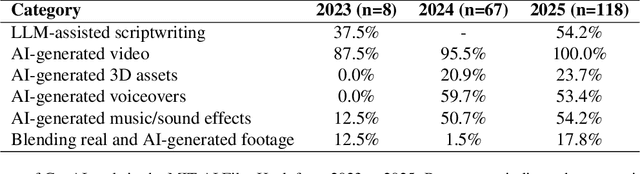

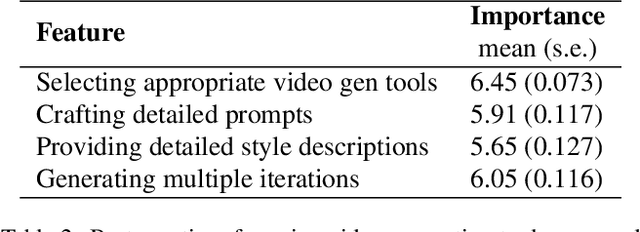
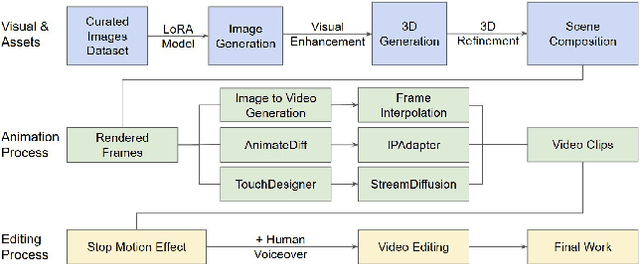
Generative AI (GenAI) is transforming filmmaking, equipping artists with tools like text-to-image and image-to-video diffusion, neural radiance fields, avatar generation, and 3D synthesis. This paper examines the adoption of these technologies in filmmaking, analyzing workflows from recent AI-driven films to understand how GenAI contributes to character creation, aesthetic styling, and narration. We explore key strategies for maintaining character consistency, achieving stylistic coherence, and ensuring motion continuity. Additionally, we highlight emerging trends such as the growing use of 3D generation and the integration of real footage with AI-generated elements. Beyond technical advancements, we examine how GenAI is enabling new artistic expressions, from generating hard-to-shoot footage to dreamlike diffusion-based morphing effects, abstract visuals, and unworldly objects. We also gather artists' feedback on challenges and desired improvements, including consistency, controllability, fine-grained editing, and motion refinement. Our study provides insights into the evolving intersection of AI and filmmaking, offering a roadmap for researchers and artists navigating this rapidly expanding field.