 Add to Chrome
 Add to Firefox
 Add to Edge
MosaicIMU: Composing Carrier Experts for Generalizable Neural Inertial Odometry
Jun 08, 2026
Robust inertial odometry is essential for various carriers when external sensing is unreliable. Learning-based methods reduce integration drift by capturing local motion priors, but these methods often remain tied to a particular carrier, limiting generalization across heterogeneous platforms. We present MosaicIMU, a carrier-conditioned Mixture-of-Experts (MoE) pretraining-and-adaptation framework for generalizable neural inertial odometry. MosaicIMU uses a prototype-based router to compose carrier-specific expert features, decodes local velocity and uncertainty constraints, and integrates them with a history-aware EKF. For unseen domain adaptation, it freezes the pretrained base model and learns a new lightweight expert residual branch. For edge-deployment, it further reuses the router to select informative online samples for efficient incremental updates. Experiments show that MosaicIMU consistently outperforms learning-based baselines, reducing average ATE and RTE-10s by 40% and 34%, respectively. These results highlight that MosaicIMU provides a scalable pretraining-to-deployment paradigm for generalizable and adaptive neural inertial odometry.

Closed-Form Pose Estimation of Endoluminal Medical Devices via Gradiometer-Based Electromagnetic Localization System
Jun 01, 2026Embedded magnetic tracking holds highly attractive prospects for remote navigation of endoluminal medical devices. However, existing six-degree-of-freedom pose recovery approaches often require pre-calibrated workspace field maps or iterative nonlinear optimization. This letter presents a Gradiometer-Based Electromagnetic Localization System (GELS), a closed-form tracking framework that uses a compact magnetometer array as an embedded quasi-gradiometer to estimate local magnetic fields and gradient tensors. These quantities are mapped by the Euler homogeneous relation to displacements between source and array, from which multi-source Procrustes registration recovers the array orientation and position using at least three non-collinear sources. The algorithm requires known source positions and array geometry, but no pre-calibrated workspace field maps, initial pose guesses, or calibrated excitation-source moments. The recovered pose also enables a proof-of-concept sub-level dipole localization task by serving as a mobile magnetic reference frame. Benchtop experiments across sensor-array configurations and excitation modes demonstrate sequence-averaged position errors of \SI{10.80}{\milli\meter}--\SI{15.57}{\milli\meter}, a fastest update rate of \SI{14.49}{\hertz}, and a median solver runtime of \SI{172.00}{\micro\second}. A perturbation-based error propagation analysis further identifies inter-sensor inconsistency and dipole-model mismatch as the dominant accuracy limits, thereby informing future sensor array and magnetic source design for further reducing pose-estimation error.
RecRM-Bench: Benchmarking Multidimensional Reward Modeling for Agentic Recommender Systems
May 12, 2026The integration of Large Language Model (LLM) agents is transforming recommender systems from simple query-item matching towards deeply personalized and interactive recommendations. Reinforcement Learning (RL) provides an essential framework for the optimization of these agents in recommendation tasks. However, current methodologies remain limited by a reliance on single dimensional outcome-based rewards that focus exclusively on final user interactions, overlooking critical intermediate capabilities, such as instruction following and complex intent understanding. Despite the necessity for designing multi-dimensional reward, the field lacks a standardized benchmark to facilitate this development. To bridge this gap, we introduce RecRM-Bench, the largest and most comprehensive benchmark to date for agentic recommender systems. It comprises over 1 million structured entries across four core evaluation dimensions: instruction following, factual consistency, query-item relevance, and fine-grained user behavior prediction. By supporting comprehensive assessment from syntactic compliance to complex intent grounding and preference modeling, RecRM-Bench provides a foundational dataset for training sophisticated reward models. Furthermore, we propose a systematic framework for the construction of multi-dimensional reward models and the integration of a hybrid reward function, establishing a robust foundation for developing reliable and highly capable agentic recommender systems. The complete RecRM-Bench dataset is publicly available at https://huggingface.co/datasets/wwzeng/RecRM-Bench.
Towards Lifelong Aerial Autonomy: Geometric Memory Management for Continual Visual Place Recognition in Dynamic Environments
Apr 10, 2026Robust geo-localization in changing environmental conditions is critical for long-term aerial autonomy. While visual place recognition (VPR) models perform well when airborne views match the training domain, adapting them to shifting distributions during sequential missions triggers catastrophic forgetting. Existing continual learning (CL) methods often fail here because geographic features exhibit severe intra-class variations. In this work, we formulate aerial VPR as a mission-based domain-incremental learning (DIL) problem and propose a novel heterogeneous memory framework. To respect strict onboard storage constraints, our "Learn-and-Dispose" pipeline decouples geographic knowledge into static satellite anchors (preserving global geometric priors) and a dynamic experience replay buffer (retaining domain-specific features). We introduce a spatially-constrained allocation strategy that optimizes buffer selection based on sample difficulty or feature space diversity. To facilitate systematic assessment, we provide three evaluation criteria and a comprehensive benchmark derived from 21 diverse mission sequences. Extensive experiments demonstrate that our architecture significantly boosts spatial generalization; our diversity-driven buffer selection outperforms the random baseline by 7.8% in knowledge retention. Unlike class-mean preservation methods that fail in unstructured environments, maximizing structural diversity achieves a superior plasticity-stability balance and ensures order-agnostic robustness across randomized sequences. These results prove that maintaining structural feature coverage is more critical than sample difficulty for resolving catastrophic forgetting in lifelong aerial autonomy.
DRIVE-Nav: Directional Reasoning, Inspection, and Verification for Efficient Open-Vocabulary Navigation
Mar 30, 2026Open-Vocabulary Object Navigation (OVON) requires an embodied agent to locate a language-specified target in unknown environments. Existing zero-shot methods often reason over dense frontier points under incomplete observations, causing unstable route selection, repeated revisits, and unnecessary action overhead. We present DRIVE-Nav, a structured framework that organizes exploration around persistent directions rather than raw frontiers. By inspecting encountered directions more completely and restricting subsequent decisions to still-relevant directions within a forward 240 degree view range, DRIVE-Nav reduces redundant revisits and improves path efficiency. The framework extracts and tracks directional candidates from weighted Fast Marching Method (FMM) paths, maintains representative views for semantic inspection, and combines vision-language-guided prompt enrichment with cross-frame verification to improve grounding reliability. Experiments on HM3D-OVON, HM3Dv2, and MP3D demonstrate strong overall performance and consistent efficiency gains. On HM3D-OVON, DRIVE-Nav achieves 50.2% SR and 32.6% SPL, improving the previous best method by 1.9% SR and 5.6% SPL. It also delivers the best SPL on HM3Dv2 and MP3D and transfers to a physical humanoid robot. Real-world deployment also demonstrates its effectiveness. Project page: https://coolmaoguo.github.io/drive-nav-page/
Topology-Inspired Morphological Descriptor for Soft Continuum Robots
Aug 01, 2025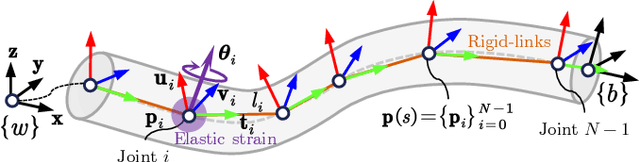
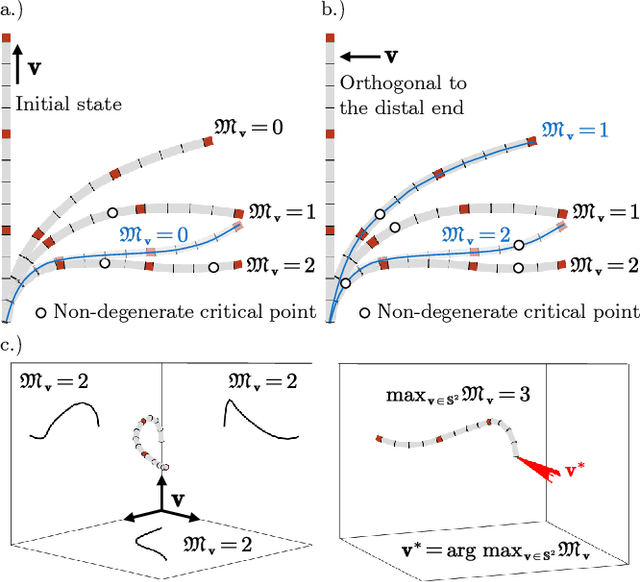
This paper presents a topology-inspired morphological descriptor for soft continuum robots by combining a pseudo-rigid-body (PRB) model with Morse theory to achieve a quantitative characterization of robot morphologies. By counting critical points of directional projections, the proposed descriptor enables a discrete representation of multimodal configurations and facilitates morphological classification. Furthermore, we apply the descriptor to morphology control by formulating the target configuration as an optimization problem to compute actuation parameters that generate equilibrium shapes with desired topological features. The proposed framework provides a unified methodology for quantitative morphology description, classification, and control of soft continuum robots, with the potential to enhance their precision and adaptability in medical applications such as minimally invasive surgery and endovascular interventions.
Closed-Loop Magnetic Control of Medical Soft Continuum Robots for Deflection
Aug 06, 2024Magnetic soft continuum robots (MSCRs) have emerged as powerful devices in endovascular interventions owing to their hyperelastic fibre matrix and enhanced magnetic manipulability. Effective closed-loop control of tethered magnetic devices contributes to the achievement of autonomous vascular robotic surgery. In this article, we employ a magnetic actuation system equipped with a single rotatable permanent magnet to achieve closed-loop deflection control of the MSCR. To this end, we establish a differential kinematic model of MSCRs exposed to non-uniform magnetic fields. The relationship between the existence and uniqueness of Jacobian and the geometric position between robots is deduced. The accurate control direction induced by Jacobian is demonstrated to be crucial in simulations. Then, the corresponding quasi-static control (QSC) framework integrates a linear extended state observer to estimate model uncertainties. Finally, the effectiveness of the proposed QSC framework is validated through comparative trajectory tracking experiments with the PD controller under external disturbances. The proposed control framework effectively prevents the actuator from reaching the joint limit and achieves fast and low error-tracking performance without overshooting.