 Add to Chrome
 Add to Firefox
 Add to Edge
MASQuant: Modality-Aware Smoothing Quantization for Multimodal Large Language Models
Mar 05, 2026
Post-training quantization (PTQ) with computational invariance for Large Language Models~(LLMs) have demonstrated remarkable advances, however, their application to Multimodal Large Language Models~(MLLMs) presents substantial challenges. In this paper, we analyze SmoothQuant as a case study and identify two critical issues: Smoothing Misalignment and Cross-Modal Computational Invariance. To address these issues, we propose Modality-Aware Smoothing Quantization (MASQuant), a novel framework that introduces (1) Modality-Aware Smoothing (MAS), which learns separate, modality-specific smoothing factors to prevent Smoothing Misalignment, and (2) Cross-Modal Compensation (CMC), which addresses Cross-modal Computational Invariance by using SVD whitening to transform multi-modal activation differences into low-rank forms, enabling unified quantization across modalities. MASQuant demonstrates stable quantization performance across both dual-modal and tri-modal MLLMs. Experimental results show that MASQuant is competitive among the state-of-the-art PTQ algorithms. Source code: https://github.com/alibaba/EfficientAI.

La RoSA: Enhancing LLM Efficiency via Layerwise Rotated Sparse Activation
Jul 02, 2025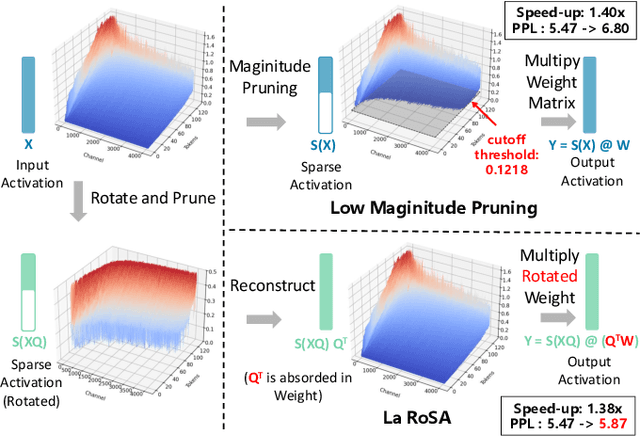
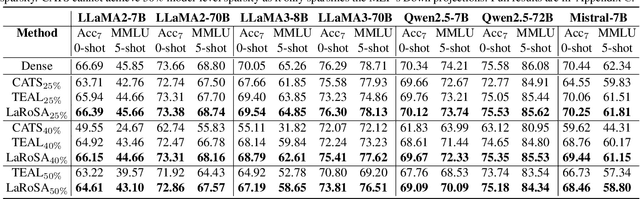
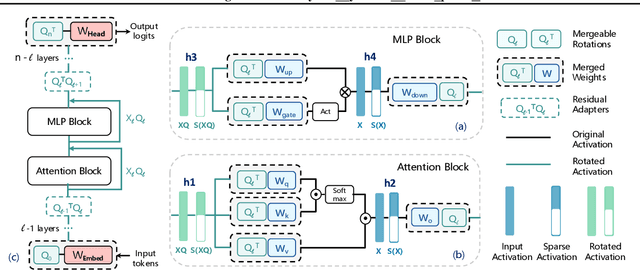
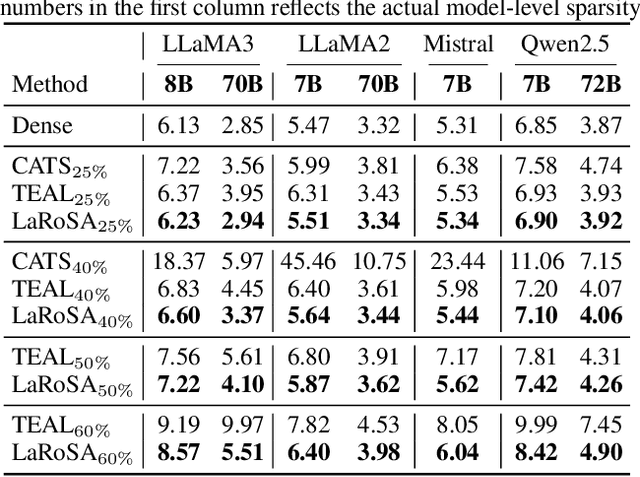
Activation sparsity can reduce the computational overhead and memory transfers during the forward pass of Large Language Model (LLM) inference. Existing methods face limitations, either demanding time-consuming recovery training that hinders real-world adoption, or relying on empirical magnitude-based pruning, which causes fluctuating sparsity and unstable inference speed-up. This paper introduces LaRoSA (Layerwise Rotated Sparse Activation), a novel method for activation sparsification designed to improve LLM efficiency without requiring additional training or magnitude-based pruning. We leverage layerwise orthogonal rotations to transform input activations into rotated forms that are more suitable for sparsification. By employing a Top-K selection approach within the rotated activations, we achieve consistent model-level sparsity and reliable wall-clock time speed-up. LaRoSA is effective across various sizes and types of LLMs, demonstrating minimal performance degradation and robust inference acceleration. Specifically, for LLaMA2-7B at 40% sparsity, LaRoSA achieves a mere 0.17 perplexity gap with a consistent 1.30x wall-clock time speed-up, and reduces the accuracy gap in zero-shot tasks compared to the dense model to just 0.54%, while surpassing TEAL by 1.77% and CATS by 17.14%.