 Add to Chrome
 Add to Firefox
 Add to Edge
Towards Event-Aware Forecasting in DeFi: Insights from On-chain Automated Market Maker Protocols
Apr 22, 2026
Automated Market Makers (AMMs), as a core infrastructure of decentralized finance (DeFi), uniquely drive on-chain asset pricing through a deterministic reserve ratio mechanism. Unlike traditional markets, AMM price dynamics is triggered largely by on-chain events (e.g., swap) that change the reserve ratio, rather than by continuous responses to off-chain information. This makes event-level analysis crucial for understanding price formation mechanisms in AMMs. However, existing research generally neglects the micro-structural dynamics at the AMMs level, lacking both a comprehensive dataset covering multiple protocols with fine-grained event classification and an effective framework for event-aware modeling. To fill this gap, we construct a dataset containing 8.9 million on-chain event records from four representative AMMs protocols: Pendle, Uniswap v3, Aave and Morpho, with precise annotations of transaction type and block height timestamps. Furthermore, we propose an Uncertainty Weighted Mean Squared Error (UWM) loss function, which incorporates the block interval regression term into the traditional Time-Point Process (TPP) objective function by weighting the uncertainty with homoscedasticity. Extensive experiments on eight advanced TPP architectures demonstrate that this loss function reduces the time prediction error by an average of 56.41\% while maintaining the accuracy of event type prediction, establishing a robust benchmark for event-aware prediction in the AMMs ecosystem. This work provides the necessary data foundation and methodological framework for modeling the discreteness and event-driven characteristics of on-chain price discovery. All datasets and source code are publicly available. https://github.com/yosen-king/Deep-AMM-Events

Team AcieLee: Technical Report for EPIC-SOUNDS Audio-Based Interaction Recognition Challenge 2023
Jun 15, 2023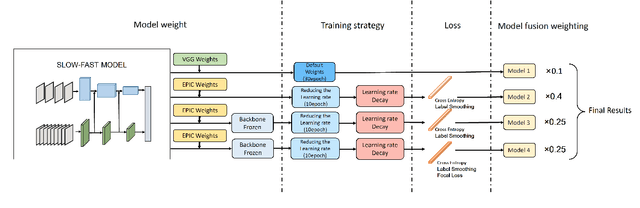


In this report, we describe the technical details of our submission to the EPIC-SOUNDS Audio-Based Interaction Recognition Challenge 2023, by Team "AcieLee" (username: Yuqi\_Li). The task is to classify the audio caused by interactions between objects, or from events of the camera wearer. We conducted exhaustive experiments and found learning rate step decay, backbone frozen, label smoothing and focal loss contribute most to the performance improvement. After training, we combined multiple models from different stages and integrated them into a single model by assigning fusion weights. This proposed method allowed us to achieve 3rd place in the CVPR 2023 workshop of EPIC-SOUNDS Audio-Based Interaction Recognition Challenge.